





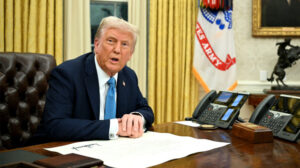
The White House officially announced late on Saturday the imposition of tariffs on products from Canada, Mexico, and China, a move expected to have significant repercussions for the U.S. economy.
The additional tariffs on Canadian and Mexican products will be 25%, although for energy imports from Canada, they will be set at 10%. Tariffs on Chinese goods will also be 10%, as previously stated by President Trump.
The justification for this decision stems from Trump’s concerns that:
- Canada has not addressed the trafficking of fentanyl,
- Mexico is not cooperating on illegal immigration, and
- China has failed to resolve the trade deficit.
According to the White House, Mexican cartels are “the leading traffickers of fentanyl, methamphetamine, and other drugs worldwide. These cartels have collaborated with the Mexican government, jeopardizing both U.S. national security and public health.”
The additional tariffs on Canada will remain “until Canada cooperates with the U.S. in combating drug traffickers and ensuring border security,” the White House claims, adding that last year, authorities seized enough fentanyl to potentially kill 9.8 million Americans.
?President Donald Trump is taking decisive action to protect Americans from the fentanyl crisis. Fentanyl is the leading cause of death for Americans ages 18 to 45.
— The White House (@WhiteHouse) February 1, 2025
Today’s tariff announcement is necessary to hold China, Mexico, and Canada accountable for their promises to halt… pic.twitter.com/qY9X2wx9CT
Three Countries Represent Nearly 40% of U.S. Imports
Last year, Canada, Mexico, and China accounted for $1.3 trillion in U.S. imports, representing nearly 40% of total U.S. imports. At the same time, these nations are also top buyers of American agricultural products.
The move sets the stage for a potential trade war in North America, notes Politico, which—according to economists—could harm economic growth across the continent and fuel inflation.
Moreover, it has not even been a week since the “tariff war” with Colombia, which demonstrated that for Trump, both the threat and enforcement of tariffs are tools he is willing to use to pressure other countries into compliance.
Trump also continues to hold over the U.S. market the threat of a blanket 10% or 20% tariff on all imports, possibly even higher for strategically important materials, such as semiconductors, pharmaceuticals, oil, and natural gas.
Canada’s Response
Upon being notified today that the U.S. will impose 25% tariffs starting Tuesday, Canada is preparing retaliatory measures, aiming to impose tariffs on U.S. products in an effort to turn American public opinion against Trump’s trade policies.
This strategy is forcing Canada to reassess its economic dependence on the U.S., according to Bloomberg.
Natural Resources Minister Jonathan Wilkinson stated that Canada’s response will target American products sold in high volumes within the country, particularly those with available Canadian alternatives.
“We will identify which products we can tax without harming Canadian consumers, while simultaneously applying pressure on U.S. exports,” Wilkinson said in an interview.
Ottawa’s strategy is designed to inflict political costs on the U.S., pressuring American lawmakers and, ultimately, Trump himself, as the tariffs will impact specific industries in the U.S..
Former Canadian Finance Minister and prime ministerial candidate Chrystia Freeland proposed a highly targeted tariff: a 100% tax on Tesla electric vehicles, directly hitting Elon Musk, one of Trump’s strongest allies.
How Mexico Will Respond
Throughout the past week, Mexican President Claudia Sheinbaum expressed optimism that the Trump administration would not impose tariffs, according to BBC. However, even if tariffs were enacted, she claimed her government had a “Plan A, a Plan B, and a Plan C” to counteract the effects.
Mexico is the U.S.’s largest trading partner, having recently overtaken China in that role.
Now, Mexican businesses and citizens are waiting for President Sheinbaum to reveal her strategy. Most expect that she will implement retaliatory tariffs on U.S. products, as she has repeatedly stated Mexico would be forced to do.
Additionally, Sheinbaum argues that Mexico is already doing its part to combat drug trafficking, stating that the U.S. needs to take action on the issue within its own borders.
Ask me anything
Explore related questions




