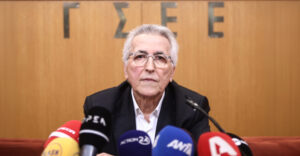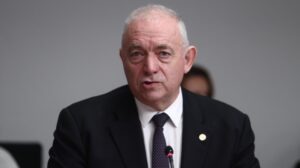
Euthymis Lekkas, speaking from Heraklion, made it clear that there is no connection between the seismic upheavals and any volcanic events, clarifying that these are completely independent processes, neakriti.gr.
Approximately fourteen days after the intense seismic outbreak, it appears that we are entering a phase of recession of seismic excitation, according to the analysis made from Heraklion, during an official visit, by the Professor of Natural Disasters of the National and Kapodistrian University of Athens and head of the Organization for Earthquake Planning and Protection, Efthimios Lekkas.
As indicated by the assessments and guidelines provided by the Seismic Risk Assessment and Volcanic Monitoring Committees, the data indicate that seismic mobility is likely to continue for the coming weeks with weak tremors, with magnitude expected to be around 5 Richter.
Over twelve days, 17,000 tremors of up to 5.3 magnitude have been recorded, which the professor described as an extremely rare phenomenon at an international level. However, he made it clear that there is no connection between the seismic upheavals and any volcanic events, explaining that these are completely independent processes.
Lekkas stressed that no damage has occurred to the public infrastructure of Santorini. The only structures that may present an increased risk are some buildings in the Caldera area, which may not meet the necessary seismic criteria.
No threat to Crete
As neakriti.gr reports, regarding Crete, the professor stressed that the island is not at risk from the current seismic sequence, while he ruled out the possibility of a strong volcanic eruption, stating with absolute certainty that there is no such cause for concern. At the same time, he urged the public to trust the official announcements of the specialized bodies and stressed that the decisions of the competent Committees are taken with full unanimity.
The presence of Efthymios Lekkas in Crete is linked to the conduct of the civil protection exercise “Minos”, which took place in April 2024. The scientific bodies, in cooperation with the Region of Crete and the local authorities, are now planning a set of actions aimed at upgrading education in natural disaster response and climate change impact mitigation.
The plans include educating a large proportion of residents, starting with students in schools, continuing with public service personnel, and ending with the general population, the OASP president pointed out.
Ask me anything
Explore related questions