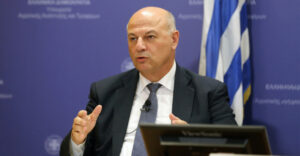


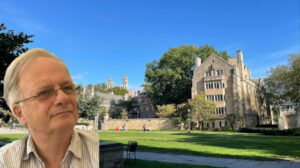
A change of course and a shift from low-productivity tourism to innovation and technology is recommended for the Greek economy by Costas Megir, Professor at the Douglas A. Warner III Chair of Economics at Yale University and member of the Committee that drafted the Pissarides Report.
In the interview he gave to euronews on the occasion of his participation in the 10th Delphi Economic Forum, K. Megir emphasizes the need to upgrade the education system, explains why tourism burdens other productive sectors and admits that few of the reforms recommended by the Pissarides Report have been implemented.
The US-EU trade war is constantly escalating. How far can it go and how will Greece be affected?
“The influence on Greece is indirect, because we do not have enough exports – and perhaps this is one of our problems. We will definitely be affected, there is a broader geopolitical issue here, which will affect Greece. International relations are entering a very, very volatile phase and this cannot but have an impact on the EU and on investors’ willingness to invest anywhere.”
International funds seem to be abandoning the American market and heading towards the European one. Could Greece claim a piece of the pie, in the stock market and in the real economy?
“Greece has a lot of opportunities, if it decides to make radical reforms, which we have been talking about for 20 years. Greece could become an investment paradise. It is very well located in the Mediterranean, it has generally friendly relations with its neighbors, it has human resources, whether in Greece or abroad.
But we need to create a truly free business environment where it will be easy to invest, operate a company and take risks. This unfortunately presupposes a lot, such as reform of the labor and judicial systems.”
You were a member of the Committee that drafted the famous Pissarides Report. How many of the proposals you submitted have been implemented?
“In general, my impression is that very little has been implemented and some have even gone in the opposite direction. For example, the educational system in Greece essentially leaves children uneducated. The reality is that the level of Greek schools and universities is low and has fallen compared to the past.
The Diamantopoulos law, which was an excellent law, was repealed by the Left itself and New Democracy did nothing to revive it. This is a huge problem.
I have a vision where Greece becomes a technological hub. But for this to happen, it must be fed by graduates who have a very high level and immediately find work, as is done in Israel.
There is an impression that in Greece the human resources are well educated. Do you have a different picture?
“There is a section that is well educated, a small elite, but in general, if you look at the PISA results – which is an international assessment system for students aged 14-15 – we will see that they have huge shortcomings. So we have a dichotomy, with some who for various reasons have a better education, a small elite who acquire the skills they need. But that is not enough. You need a much more massive quality to significantly develop a sector.
And of course one of the things that is missing in Greece is a good system of providing loans and capital financing to businesses. One of the things I would look at would be the financing. There is no stable funding for research and also for start-ups.”
Does your proposal to develop Greece into a technological hub come alongside the point that there should not be so much dependence on tourism?
“Yes, of course. Greece is a wonderful country. Of course, the way we manage tourism, it will cease to be a wonderful country. Tourism needs an organization, a plan, some limitation, some quality. When the parameters of development are not clear and constantly changing, tourism will remain simple and of mediocre quality.
But the most basic thing is that we are essentially subsidizing tourism. First of all, we allow the NSRF to go to various tourist units, hotels, etc.
The second is that tourism depends to a very large extent on informal work. Essentially, it has access to very cheap labor, to which other sectors do not have access, because they are more formal sectors and therefore work openly.
This creates a distortion of the economy. It makes it very easy to operate in the tourism sector and makes it more difficult to operate elsewhere.
What does this mean? It means that we are essentially pushing a very large percentage of young Greeks to become waiters or receptionists in hotels, to work part of the year, while all this workforce, which also has ambitions, should be channeled into more productive work.
I want to note that tourism – and not only in Greece – is the sector with the lowest productivity. This is true throughout Europe. The income generated per employee is the lowest than in almost any other activity.”
If the Greek authorities were to ask you to prioritize one or two corrective actions that can be taken immediately to help the Greek economy respond to today’s challenges, what would you propose?
“We need to work with the business community and see what exactly is causing obstacles to business activity. I can list various ideas, but the important thing is to work with the key players to change the framework in which companies operate.
And at the same time, of course, I would look at the basic infrastructure of Greece, the education system. Because we will not move forward if we do not increase productivity and to increase productivity in the long term we need innovation and well-educated young people.”
Konstantinos Megir will attend the city of Delphi in April, as part of the 10th Delphi Economic Forum to be held from 9 to 12 April 2025. The Forum celebrates 10 years of presence this year and is an important reference point for public debate and the exchange of ideas, contributing to the formation of policies and strategies at the national and international level.
Ask me anything
Explore related questions