





May 18, 1965, marks a turning point in post-war Greece. Exactly 60 years ago, the ASPIDA affair was revealed to the public – a case that remains one of the most disputed episodes of modern Greek history, with interpretations varying depending on political perspective.

King Constantine and Georgios Papandreou. The rupture between the palace and the government proved disastrous.
History has since promoted a prevailing interpretation, branding the affair as an absolute falsehood — a political and military plot against Georgios Papandreou’s government, though the matter has never been definitively resolved. A counterargument exists, citing a genuine scandal involving a group of military officers, allegedly operating illegally with the political backing of Andreas Papandreou and other prominent Centre Union figures, aiming to control the armed forces. Some even suggested a more extreme but unproven theory — that they were preparing a coup, much like the one later executed by IDEA.
Nonetheless, there is consensus that the exposure of the ASPIDA affair served as the spark that ignited a series of events which, within two years, culminated in the April 21, 1967 coup and the seven-year dictatorship. The truth is far more complex than sweeping statements suggest. It is equally true that parts of the affair still leave historical questions unanswered — foremost among them, the very identity of ASPIDA and a host of accompanying questions: Was it an organization of junior officers with democratic ideals aiming to protect themselves from the machinations of their IDEA-aligned colleagues, or were their ambitions deeper?

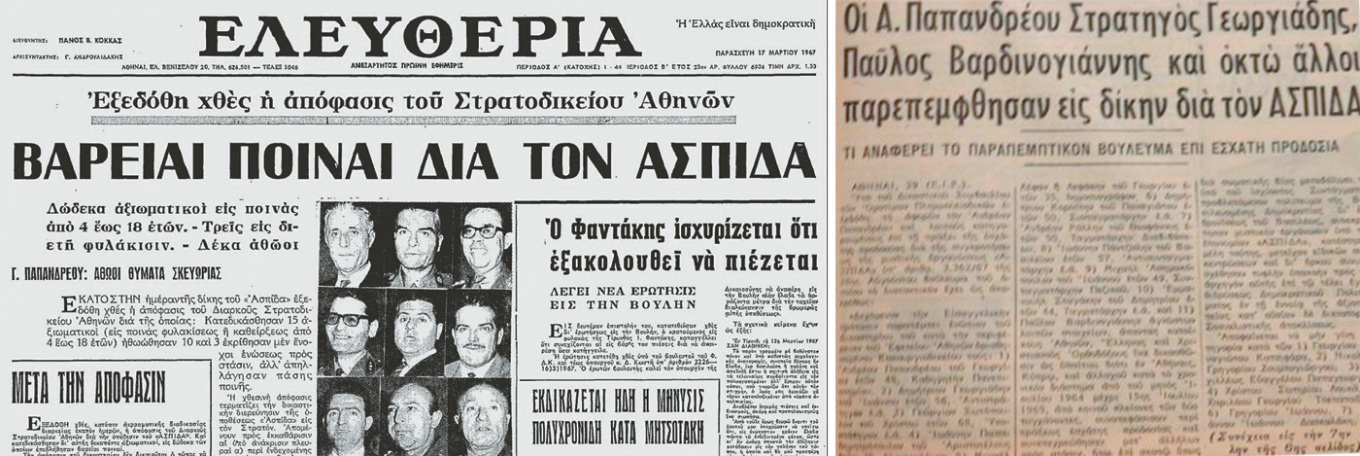
Then-captain Aris Bouloukos at the ASPIDA trial
What was the real relationship between Andreas Papandreou and ASPIDA? Was he the political leader of the organization? What did Prime Minister Georgios Papandreou know about it? What were the actual connections between the accused officers who were tried and convicted as members? Was the indictment strong across the board, or were some persecuted for their political beliefs? How much did this serve as a pretext for the Palace to justify the July 1965 schism with Georgios Papandreou, and later as a stepping stone for the April coup plotters? And what role did King Constantine play?
The “Beneficiaries”
In hindsight, two groups benefited most from the ASPIDA affair: First, the clique of rogue military officers led by Georgios Papadopoulos, who managed to neutralize ASPIDA. Future junta figures played key roles as prosecution witnesses, such as EAT-ESA torturer Theodoros Theofilogiannakos and Nicos Sampson, the puppet president of Cyprus installed by the coup plotters on July 15, 1974, in place of Archbishop Makarios.
The other major beneficiary was Andreas Papandreou. The intense personal attacks and legal persecution against him catapulted his popularity, shaping the image of a leader who forced the Palace and its mechanisms into unconstitutional tactics to counter him. Many of the military defendants and defense lawyers later joined PASOK as key figures and MPs, some even becoming top ministers in his governments: Menios Koutsogiorgas and Evangelos Giannopoulos were among the defense lawyers; Aris Bouloukos, Dimitrios Chondrokoukis, Panagiotis Papageorgopoulos, and Theofanis Tombras were among the officers.
The definitive losers — fatally so — were democracy and political normalcy.
Additionally, May 18 is linked to the tragic fate of one of the trial’s key figures, lawyer Nikiforos Mandilaras, who distinguished himself as a defense attorney. In a chilling calendar coincidence, on May 18, 1967, Mandilaras was found dead on a beach in Rhodes under murky circumstances, with overwhelming signs pointing to murder.
The ASPIDA bombshell exploded two weeks after Andreas Papandreou returned to his father’s government as Minister to the Presidency. The country was enduring a prolonged period of extreme political polarization, triggered by the 1961 elections that launched Georgios Papandreou’s “Relentless Struggle,” the assassination of Grigoris Lambrakis, the exit of Constantine Karamanlis from politics and his relocation to Paris, and the sweeping Centre Union victory in the February 1964 elections.
On May 18, 1965, the ultraright-wing Larissa-based newspaper Imerisios Kirix reported the existence of a secret left-leaning organization within the Army. It was called ASPIDA — an acronym for “Officers Save the Fatherland, Ideals, Democracy, Meritocracy.” According to the article, its goal was to expel the King and establish a leftist dictatorship with Andreas Papandreou as political leader.
The opposition press launched fierce attacks on the government. The Ministry of National Defense appointed Military Justice Lieutenant General Ioannis Simos to begin an investigation. The next day, 13 MPs from the right-wing ERE party submitted a parliamentary question on the matter, triggering a political earthquake.
Opposition newspapers harshly criticized Andreas Papandreou for “trying to set up a political shop within the Army.” The government insisted it was a frame-up designed both to discredit the Centre Union and to conceal the activities of the far-right paramilitary IDEA (Sacred Bond of Greek Officers), which was later proven to include many April coup plotters.
Ask me anything
Explore related questions




