





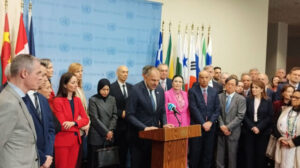
A joint statement by Greece and following concerted diplomatic efforts, a joint statement by 80 UN member states on the protection of civilians in armed conflict has been achieved.
The statement was made by Foreign Minister George Gerapetritis before the start of a meeting of the Security Council, which Greece chairs this month.
“Today, we come with a clear message: The protection of civilians is not optional. It is a legal obligation under international humanitarian law and a moral imperative that we cannot ignore,” the Foreign Minister stressed.
In closing the intervention, he noted: “Let us reiterate our collective responsibility to protect the most vulnerable, to uphold international law, to prioritize the security, dignity and rights of civilians, and to ensure that their faces and voices – often unseen and silenced behind the statistics – remain at the heart of our actions.”
The Minister’s intervention:
“I have the honour to deliver this statement on behalf of 80 Delegations committed to upholding international humanitarian law and protecting civilians in armed conflict.
This year, civilians in armed conflict continue to live under unimaginable conditions of constant danger, insecurity, and suffering. The United Nations has recorded at least 36,000 civilian deaths in 14 armed conflicts in 2024. The use of explosive weapons in populated areas caused tens of thousands of casualties in many conflicts, while landmines and remnants of war continued to endanger civilians.
According to the Office for the Coordination of Humanitarian Affairs (OCHA), Gaza is facing the “worst humanitarian crisis” since the start of hostilities since the 7 October 2023 attacks, with civilians suffering from hunger and at critical risk of starvation, according to IPC, and hundreds of humanitarian aid workers killed since the conflict began. In Sudan, civilians are bearing the brunt of the violence, with millions internally displaced and over half of the population facing high levels of acute food insecurity. Civilians also suffer extensive suffering in the Democratic Republic of Congo, Mali, Mozambique, Myanmar, Nigeria, Nigeria, Somalia, South Sudan, Syria, Ukraine and elsewhere.
This cannot continue. Today, we come with a clear message: Protecting civilians is not optional. It is a legal obligation under international humanitarian law and a moral imperative that we cannot ignore.
In view of the worsening armed conflict and the disregard for civilian life in many areas, we call on all warring parties to respect international humanitarian law in all circumstances, and on all Member States to use their influence to ensure that it is respected by all parties. This is the minimum – it is not an expectation, but a commitment – it is a legal obligation.
Civilians, women and men, children, the elderly, and the disabled, all are suffering. Health workers, farmers, and teachers are killed, injured, and forced to flee. Civilians are too often targeted or simply abandoned as collateral damage of the war. Their protection should not be a secondary issue – it must be at the heart of all military planning and political decisions. We reiterate our call on belligerent parties to protect civilians and civilian infrastructure, including those necessary for civilian survival, and to treat all persons within their jurisdiction with humanity.
We commend the vital role of humanitarian actors and condemn all acts of violence and threats against them. Last year was the year with the most recorded deaths for humanitarian workers, with more than 360 humanitarian workers killed in 20 countries. This must stop. We reaffirm our determination to take action and use diplomatic means to guarantee the safety and security of humanitarian personnel and to allow them to carry out their activities and carry out their mandate in accordance with humanitarian principles.
We call on parties involved in conflict to allow and facilitate, as required by international humanitarian law, safe, rapid, and unimpeded humanitarian access to all civilians in need. The instrumentalization of aid for political, military, or strategic security objectives is unacceptable.
We recognize the important work of journalists, media professionals, and their partners and call on the parties involved to respect their professional independence and rights. At a time when misinformation and misreporting have been facilitated and widely disseminated, often fuelling conflict, independent media and on-the-ground reporting are of particular importance.
We affirm that accountability for those who commit violations is essential. Alleged violations of international humanitarian law and alleged violations and abuses of human rights in armed conflict must be systematically addressed through credible investigation,s and perpetrators must be held accountable. Impunity cannot be the norm. Impunity is not just a failure of justice – it is a license to repeat.
With “Protection of Civilians Week” underway and today’s open debate putting the spotlight back where it belongs – on civilians in conflict zones – we stress that protection is not just about responding to crises – it is also about preventing them. We need a more comprehensive approach to fully protect civilians.
Let us reiterate our collective responsibility to protect the most vulnerable, uphold international law, prioritise the safety, dignity, and rights of civilians, and ensure that their faces and voices – often unseen and silenced behind the statistics – remain at the heart of our actions.
Let us recommit ourselves not just with words, but with concrete steps – towards protection, towards accountability, and, ultimately, towards peace.
Thank you.”
Ask me anything
Explore related questions




