






An unexpected escalation has emerged just as Greek Foreign Minister Giorgos Gerapetritis is preparing to visit both Tripoli and Benghazi in early July. Libya’s interim government issued a sudden statement accusing Greece of violating its sovereign rights by designating two offshore exploration blocks south of Crete.
Libya’s Foreign Ministry Reaction
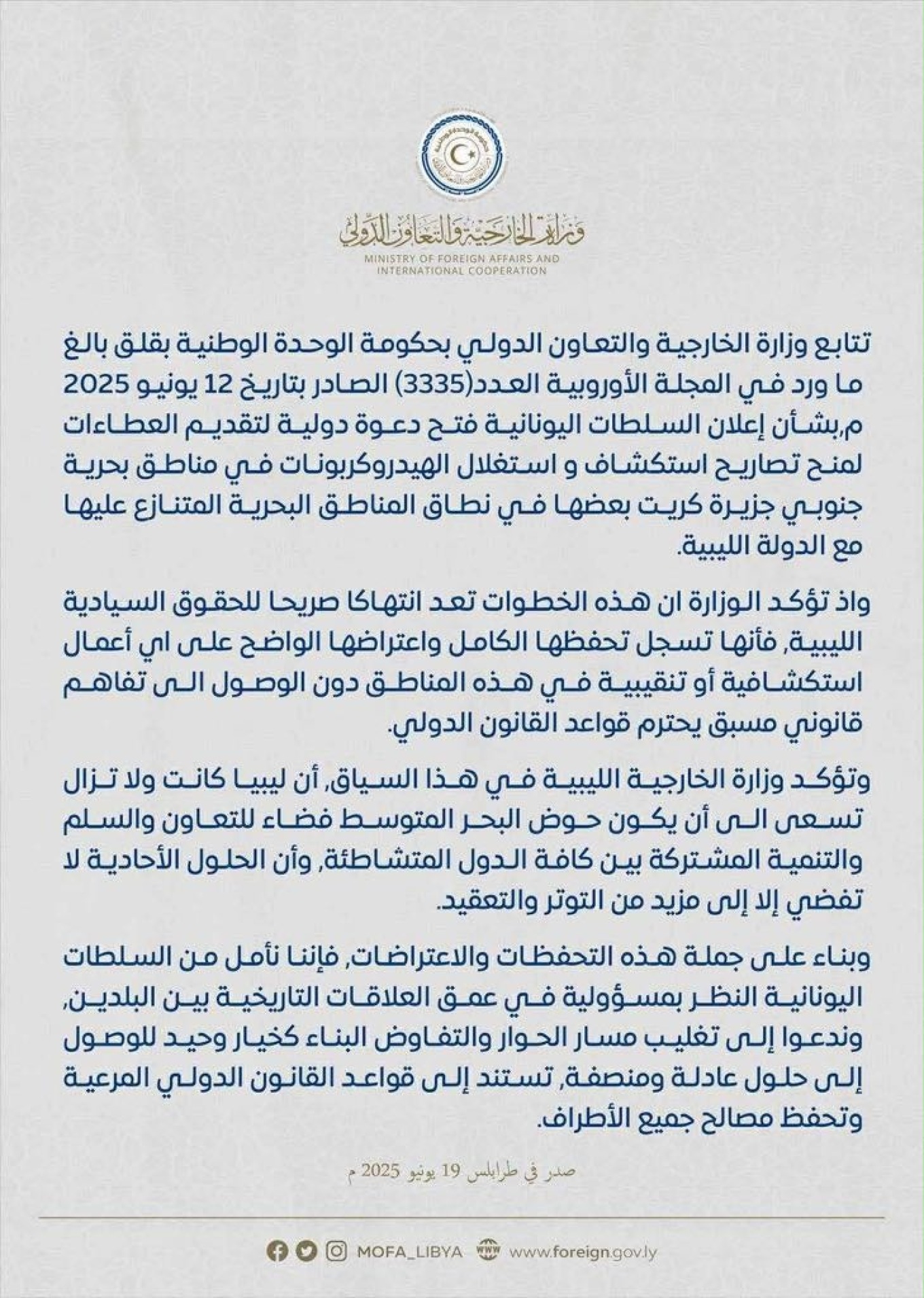
The Libyan Ministry of Foreign Affairs expressed concern over Greece’s June 12, 2025 announcement in the EU regarding an international tender for hydrocarbon exploration and exploitation licenses in maritime zones south of Crete. Libya claims that parts of these areas fall within disputed maritime zones and therefore constitute a violation of its sovereign rights.
The Libyan ministry asserts that such unilateral actions are unacceptable without prior legal agreement that respects international law. It reiterated Libya’s commitment to turning the Mediterranean basin into a space for cooperation and warned that unilateral moves lead only to more tension. It called on Greece to respect the deep historical ties between the two nations and pursue constructive dialogue as the only path to fair solutions.
Athens Reacts Swiftly
Greek government and Energy Ministry sources responded immediately. “Greece is exercising its sovereign rights in accordance with international law and the Law of the Sea,” they said, emphasizing that Athens remains open to dialogue, always within the framework of legality.
Government officials added: “We are not afraid to assert our sovereign rights. The Foreign Minister’s visit to Libya will proceed as planned.”
Context and Tensions with the Turkey-Libya Pact
The Greek government had expressed satisfaction that there had been no reaction until now regarding the licensing of the two blocks, which were defined using the median line principle. These blocks partially overlap with the maritime areas claimed by Libya under the Turkey-Libya Memorandum.
Chevron has reportedly shown interest in these blocks. Tripoli’s reaction is seen as a move to counter Greece’s renewed diplomatic outreach to Eastern Libya and to reintroduce the Turkey-Libya agreement into play.
This diplomatic friction complicates Gerapetritis’ planned trip, but it may also present an opportunity for a well-prepared proposal to both Libyan sides, suggesting dialogue on maritime boundaries. If no agreement is reached, the matter could be referred to the International Court in The Hague — a path Libya has taken before with Malta and Tunisia.
Broader Geopolitical Dynamics
Greek Ambassador to Tripoli Nikos Garilidis and Consul General Mr. Kalognomis recently met with House of Representatives Speaker Aguila Saleh in Tobruk. The Greek delegation received assurances that Eastern Libya’s opposition to the Turkey-Libya deal remains unchanged.
Coinciding with these developments, Libya’s Minister of Energy met with the Turkish ambassador in Tripoli. Discussions included strengthening strategic cooperation in oil and gas and possible collaboration between Libya’s National Oil Corporation and Turkey’s TPAO, aiming to boost investments and technical partnerships. This follows the Libyan minister’s request for Turkish oil companies to return, made during a summit in Istanbul last month.
In Summary:
The Libyan government’s protest, aligning with Turkey’s stance, introduces new diplomatic hurdles for Greece’s energy plans south of Crete. While Athens firmly defends its actions as lawful, the incident reopens broader regional disputes and highlights the complex triangle of Greece–Libya–Turkey in the Eastern Mediterranean.
Ask me anything
Explore related questions




