To address the practical and chronic needs of people with disabilities “for a Greece with all for all”, the Minister of State Akis Skertos, as head of the Coordinating Mechanism for the Rights of Persons with Disabilities, and the Deputy Prime Minister Kostis Hatzidakis, have jointly recommended the inclusion of three major actions amounting to 232.4 million euros. The European Commission and the European Parliament jointly agreed to include in the budget of the new European Funds, the Social Climate Fund and the Modernisation Fund.
These actions, according to an announcement, were prioritized based on the key criterion to serve the everyday needs of persons with disabilities following a systematic dialogue with the disability community and in the context of the vertical inventory of needs by type of disability that is now being followed. All are fully aligned with the objectives of the National Strategy for the Rights of Persons with Disabilities 2024-2030.
Specifically, as stated in the announcement, the actions concern:
1. Supply of 210 electric buses to transport students with disabilities and installation of charging infrastructure in special schools.
The action provides a solution to the chronic discontinuity and unreliability of the existing transport systems using hired buses through competitive tendering. Unsuccessful tenders often leave students with disabilities without transportation for long periods, depriving children of the opportunity to learn and socialize, and creating serious obstacles to the daily lives of their working parents. The present action concerns the supply of electric buses for special schools, with the simultaneous creation of charging infrastructure, offering a holistic and sustainable solution for the stable and dignified transport of more than 12,000 students with disabilities. At the same time, it is in line with national and European policies on climate neutrality, accessibility and social inclusion.
Beneficiaries: more than 12,000 pupils with disabilities
Budget: €106,800,000
Funding body: Social Climate Fund
Timeline: Q1 2026 – Q4 2028.
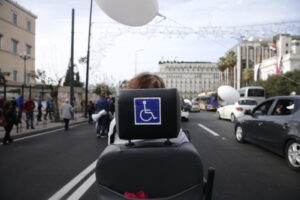
2. Subsidy for electric wheelchairs and equipment to convert manual wheelchairs to electric wheelchairs for persons with quadriplegia, paraplegia, or hemiplegia.
The lack of independent means of transport is a key factor in social exclusion for people with paraplegia, quadriplegia, or hemiplegia. Due to insufficient accessibility to the physical environment, the electric wheelchair is often the only solution for daily autonomy without dependence on third parties. However, the cost of suitable wheelchairs or conversion systems significantly exceeds the reimbursement of the NHS, with the result that many people are unable to obtain them. This action ensures zero burden for beneficiaries, fully covering the cost difference.
In this way, their access to clean, accessible, and sustainable transport is enhanced, reducing their dependence on energy-intensive private transport services.
Beneficiaries: 15,000 people with paraplegia, quadriplegia, or hemiplegia
Budget: €52.5 million
Funding body: Social Climate Fund
Funding source: Social Fund of the European Climate Change Fund.
Timeline: Q1 2026 – Q4 2030.
3. Energy upgrade of 478 special schools
To date, special schools have been using oil heating, which is costly and difficult to control. This disproportionately affects the most vulnerable, such as children with disabilities, causing inequalities. Interventions include but are not limited to the installation of heat pumps, small photovoltaic panels, thermal insulation, and upgrading of the building envelope. The aim is to save energy, reduce operating costs, improve thermal comfort, and ensure the safety of students and staff. In addition, the action contributes to reducing the environmental footprint of schools, promoting their sustainable operation and social equity.
Beneficiary structures: 478 special schools (special primary schools, special secondary schools, special high schools, ENEGYL, EEEEK)
Budget: €73,134,000
Funding body: Modernisation Fund
Timeframe: Q1 2026 – Q4 2032
All three actions reflect the real needs of the disability community and the government’s commitment to a more sustainable and environmentally friendly future, with respect for equality and accessibility.
In addition to the actions proposed by the Coordination Mechanism, there were also recommendations from the ministries to include in the Social Climate Fund actions that implement the National Strategy for the Rights of Persons with Disabilities, such as “Upgrading the taxi fleet to serve persons with disabilities” by replacing conventional vehicles with 6 to 9-seat vans equipped with certified wheelchair ramps and special wheelchair positioning places), the “implementation of an integrated electronic system for mapping and guiding disabled persons at public transport stations” in conjunction with the ongoing “Strengthening of accessible and environmentally friendly buses”, the “improvement of accessibility at railway stations” and the “upgrading of existing metro services”, with an emphasis on improving accessibility for persons with reduced mobility and persons with disabilities and the “leasing of electric vehicles by vulnerable households”.
Ask me anything
Explore related questions