Developments in Turkey’s defence industry have been repeated, as this is one of the most dynamic sectors of the neighbouring country’s economy, which is becoming a battering ram at a time of rapid upgrading of European defence.
Specifically, through a series of successive bilateral agreements, Ankara is attempting to bring EU member states closer and closer to the market for Turkish weapons systems, at a time when the neighboring country is investing billions of dollars annually in the procurement, research and development of defense applications, significantly excelling in defense innovation in the region.
Starting on the Mediterranean coast, Turkey has so far managed to strike a deal with Spain to supply Madrid with Turkish Hurjet training aircraft, while the acquisition of Italian company Piaggio, through Leonardo, has provided Ankara with a strong manufacturing base within the EU and a stone’s throw from Greece.
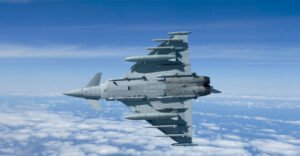
However, if until now Turkey’s zone of defensive influence reached through its Bayraktar drones deployed from Ukraine to the Balkans and the Arabian Gulf countries, yesterday’s development “changed the track” for the neighbouring country. This is because Germany approved yesterday the delivery of 40 Eurofighter Typhoon aircraft to Turkey, at a time when a bilateral agreement between the UK and Turkey allows the latter to make use of these aircraft. Thus, Turkey is formally developing bilateral frameworks of agreement with countries of the European north, at a time when both Germany and Britain are investing in a trilateral defense scheme, which includes France.
According to Reuters, Great Britain signed a preliminary agreement allowing Ankara to handle Eurofighter aircraft, while Germany approved the delivery of 40 of them to Turkey, which has relied on both foreign purchases and its own defense projects, including indigenous aircraft, to bolster deterrence.
Notably, discussions on the purchase of 40 Eurofighter Typhoon had begun as early as 2023, and the aircraft will be built by a consortium of Germany, Britain, Italy and Spain, represented by Airbus, BAE and Leonardo. Speaking at a signing ceremony with British Defense Minister John Healey in Istanbul, the neighbor’s Defense Minister Jasar Guler said the deal brought Turkey “one step closer to a fully integrated agreement,” adding that the above development would also strengthen NATO and Turkey’s air capabilities. At the same time, the Turkish defense minister stressed that the composition of the planned procurement is for 40 aircraft, but at the same time different options are being considered. Earlier, Spiegel magazine reported that the German government’s Federal Security Council, which decides on arms export licenses, has taken a positive decision on the order of 40 aircraft.
For its part, Britain said negotiations with Turkey on a final sale would continue in the coming weeks, and the deal would be the first export order Britain has secured for Eurofighters since 2017, reconfiguring the final assembly line, in the north of England. Welcoming the deal, British Prime Minister Kir Starmer described how the multi-billion dollar deal with Turkey would “retain and protect 20,000 jobs in the UK for years to come”, while a BAE Systems official explained last week that the company was confident of winning new orders from countries including Turkey.
“Headache” for Israel
At the same time, Ankara is not backing down from talks with the US over the supply of F-16 fighter jets, with its attempt to boost its air power alarming Israel. According to the Jerusalem Post, Turkey’s acquisition of the Eurofighters “does not pose a direct or immediate threat to Israel’s air superiority, but it is a ‘headache,'” an Israeli official explained to the paper, given that the deal marks an important step in Ankara’s ongoing efforts to modernize its military.
As noted, “the aircraft, jointly developed by the UK, Germany, Italy, Germany and Spain, are considered among the most advanced fourth-generation and above fighter aircraft in the world” and “their inclusion in the Turkish Air Force fleet would significantly enhance the country’s air capabilities.” With this in mind, there is strong movement by members of the US Congress, of Greek and Armenian origin, to ensure that Turkey does not return to the F-35 acquisition program, as these fighter jets are the only ones that can currently upset the balance of power in the Aegean due to their nature as a strategic weapon.
Thorns in the armament
Even if Athens has enough and upgraded fighter aircraft, the question for the coming period is the armament of the Eurofighters, i.e. whether it will include Meteor missiles or long-range weapons such as the Taurus, comparable to the Greek SCALP EG, giving new capabilities to the Turkish air force.
Ask me anything
Explore related questions