





Key points:
A powerful 8.8-magnitude earthquake struck off the coast of Russia’s Kamchatka Peninsula in the early hours of the morning, marking the strongest seismic event in the region in nearly 73 years. The undersea quake set off a series of tsunami warnings and waves across the Pacific.
Initially, Hawaii was placed under the highest level of tsunami alert, but officials have since downgraded the warning as conditions stabilized. The largest wave recorded in the state reached 1.74 meters (approximately 5.7 feet) on the southern coast of Maui.
Tsunami alerts have now been lifted in several regions, including Japan, Sakhalin Island, and Russia’s own Kamchatka Peninsula.
Adding to the region’s seismic unrest, the Klyuchevskoy volcano—also located on the Kamchatka Peninsula—began erupting shortly after the earthquake, though it remains unclear whether the two events are directly related.
Tsunami waves have been confirmed as far as Alaska, Hawaii, California, Oregon, and Washington. The tremor also prompted warnings in other countries across the Pacific Rim, including Chile, Costa Rica, French Polynesia, and China.
Authorities across affected regions continue to monitor the situation closely, urging coastal residents to remain vigilant despite the lifting of some warnings.
Japan downgrades tsunami warnings for much of the country
The Japan Meteorological Agency has downgraded the tsunami warnings that had been issued for a large part of the archipelago, while maintaining strict warnings in effect for the northern regions of the country, according to AFP.
Specifically, the warnings covering the eastern Ibaraki region through to the southern Wakayama prefecture have now been downgraded to “advisories,” as stated on the agency’s official website.
Woman killed in Japan while trying to evacuate coastal area due to tsunami
In Japan, tsunami alerts sounded early today in towns along the country’s Pacific coast, and evacuation orders were issued for tens of thousands of people.
The Asahi TV network reported that a 58-year-old woman lost her life when her car plunged off a cliff in the central Mie prefecture while she was evacuating the area. According to officials, three tsunami waves were recorded in Japan, the largest reaching a height of 1.3 meters.
The Tsunami Has Reached the Coast of California
The National Weather Service (NWS) of Los Angeles announced that the tsunami has reached the coast of California. Authorities are urging people near the shore to move away from beaches, piers, and harbors and head toward higher ground.
The first tsunami waves reached Crescent City, in the northern part of the state near the Oregon border. According to data from the U.S. National Oceanic and Atmospheric Administration (NOAA), the area recorded a wave approximately 30 centimeters high, with more waves expected soon.
The city lies along a 160-kilometer stretch of Northern California’s coastline that is currently under a tsunami warning — the highest alert level. This area is considered at increased risk due to its unique underwater geomorphology, which, according to the NWS, has the ability to “channel the energy of the waves.”
Lekkas on the Earthquake in Russia: “It is Among the 10 Largest Ever Recorded Worldwide”
Speaking to ERT, the president of the Earthquake Planning and Protection Organization (OASP), Efthymios Lekkas, commented on the 8.8-magnitude earthquake that struck in the early hours of Wednesday off the coast of Russia’s Kamchatka Peninsula, causing tsunamis in Russia, Japan, and Hawaii.
“It was a major earthquake. It is among the ten largest earthquakes ever recorded during the period of instrumental seismology worldwide. An earthquake that, because it occurred in the underwater area east of the Kamchatka Peninsula, can cause a tsunami,” Mr. Lekkas stated.
He further explained that it is impossible to predict the exact height of the tsunami waves that may hit the coasts of the countries under warning.
“The height, of course, depends on the coastal area, that is, on the configuration of the seabed and the orientation of each specific region,” Mr. Lekkas noted.
1.3m Tsunami Recorded in Japan
A tsunami with a height of 1.30 meters struck a port in the Miyagi Prefecture, northern Japan, at 13:52 local time (07:52 Greek time), the Japan Meteorological Agency (JMA) announced.
The JMA has maintained the tsunami warning level, cautioning of possible waves up to 3 meters along Japan’s Pacific coast following the 8.8-magnitude earthquake that occurred off the coast of Kamchatka.
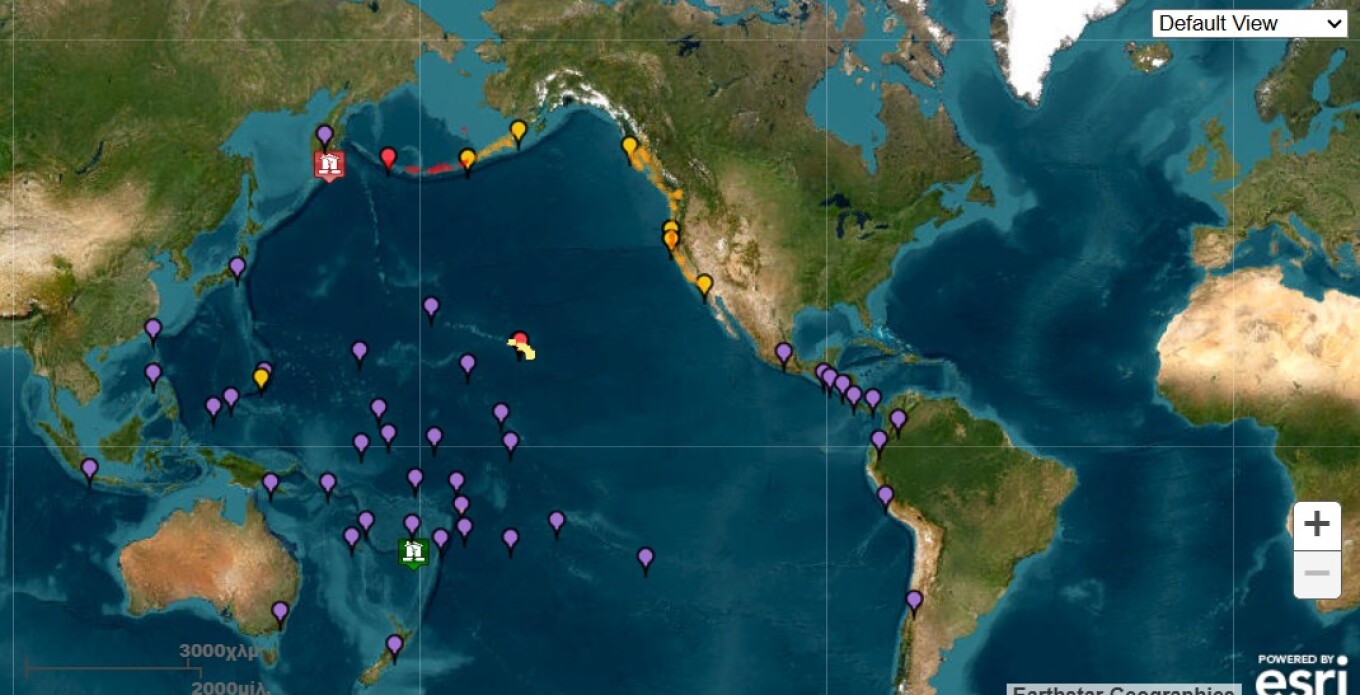
See below a map from NOAA (U.S. National Oceanic and Atmospheric Administration) showing the affected areas – red indicates a warning, purple indicates a threat, and yellow indicates an advisory:
Emergency Shelters Opened in Hawaii
According to U.S. media, the first tsunami waves have already reached Alaska and Hawaii. In Hawaii, which had the highest level of warning, the tallest wave recorded so far is on the south coast of Maui at 1.5 meters.
🚨#BREAKING: Watch as footage taken from Hilo, Hawaii shows seawater flooding into local streets causing possible damage as tsunami waves strike the area. Officials continue to urge residents to avoid the coastline and remain on higher ground until the threat has fully passed pic.twitter.com/BTJxAg11Ha
— R A W S A L E R T S (@rawsalerts) July 30, 2025
Emergency shelters had been opened earlier in the Hawaiian archipelago to accommodate residents who were instructed to evacuate coastal areas. The state’s governor warned that, although the first waves were not alarming, it would take 1–2 hours for them to reach the Big Island and for a clearer picture of the phenomenon’s development to emerge.
According to a list published by local network KGMB/KHNL (affiliated with CNN), residents have been informed about multiple shelters across the islands of Oahu, Kauai, Maui, and Hawaii County.
Hawaiian authorities had earlier urged the public to move to higher ground, emphasizing that preventive measures were being taken ahead of the arrival of the waves.
30/07/2025 – 10:15
Japanese Media Urge Residents of Coastal Areas to Evacuate Immediately
Japanese public broadcaster NHK interrupted its regular programming and began live coverage of developments, with its anchor pleading with residents of coastal areas:
“Evacuate immediately to save your lives.”
Workers at the damaged Fukushima nuclear power plant (eastern Japan) — the site of one of the two most serious nuclear disasters in modern history in 2011 — were also evacuated urgently, announced plant operator TEPCO.
30/07/2025 – 10:13
The Most Powerful Earthquake Since 1952
According to scientists from the Geophysical Service of the Russian Academy of Sciences, this was the most powerful earthquake recorded in the area since 1952.
Watch video from the town of Severo-Kurilsk in the northern Kuril Islands, which was flooded by rushing waters – Warnings issued in Japan, people evacuating coastal areas – Possible waves 1–3 meters high on the coasts of Chile, Costa Rica, French Polynesia, China, and other countries.
A magnitude 8.8 earthquake, the strongest in the area in almost 73 years, struck in the early hours offshore of Russia’s Kamchatka Peninsula, triggering tsunamis in Russia and Japan and prompting emergency warnings to citizens in nearly all countries bordering the Pacific Ocean.
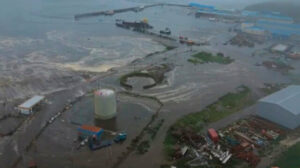
The tsunami already flooded the town of Severo-Kurilsk, in the northern part of the Russian Kuril Islands, according to the Russian Federation’s Ministry of Emergency Situations.
Eyewitness footage shows tsunami waves crashing onto the coastal town of Severo-Kurilsk in Russia's Sakhalin region following an earthquake in Kamchatka.
— WION (@WIONews) July 30, 2025
.
.
.
.
.
.
.#WIONUncut #Russia #Tsunami #TsunamiWARNING pic.twitter.com/eAglrfBlJB
Videos uploaded to social media show rushing waters invading properties in the town of about 2,000 residents, whose population was hastily evacuated.
Meanwhile, live footage on Japanese television showed people leaving by car or on foot to higher ground, especially on the northern island of Hokkaido, where an initial tsunami about 30 centimeters high was observed.
🚨 BREAKING: CATASTROPHIC tsunami damage seen in the village of Severo-Kurilsk, Russia
— Nick Sortor (@nicksortor) July 30, 2025
This originated from the same earthquake sending tsunami waves to Hawaii
GET TO HIGHER GROUND, HAWAII! THIS COULD BE YOU! pic.twitter.com/njK8vhAsMS
The US Geological Survey (USGS) initially reported the quake as magnitude 8.0, later upgrading it to 8.7, and finally to 8.8. The tremor struck at 02:35 (Greek time), at a depth of 20.7 km, about 126 km from the capital of the Kamchatka region in Russia’s Far East.
According to scientists at the Russian Academy of Sciences’ geophysical service, this is the strongest earthquake recorded in the region since 1952.
Whoahhhhh! Videos showing the shaking from the M8.7 earthquake that hit off the coast of Kamchatka, Russia 😱👀😱 pic.twitter.com/Q5dYAstWil
— Volcaholic 🌋 (@volcaholic1) July 30, 2025
Japan Issues Urgent Evacuation Calls
Japanese public broadcaster NHK interrupted regular programming for live coverage, with its anchor urging coastal residents:
“Evacuate immediately to save your lives.”
Workers present at the damaged Fukushima nuclear power plant in eastern Japan—site of one of the world’s worst nuclear accidents in 2011—were evacuated, according to plant operator TEPCO.
The Japan Meteorological Agency (JMA) warned citizens not to go to sea and “not to approach the coast until the alert is lifted.” Initially forecasting 1-meter waves, it later revised its estimate to as high as 3 meters. Several rail services were suspended.
Three whales have washed ashore in Tateyama City, Chiba Prefecture, Japan. It is unclear whether this is related to the seismic activity.https://t.co/XquHfbn64Q
— Volcaholic 🌋 (@volcaholic1) July 30, 2025
Government spokesperson Yoshimasa Hayashi also urged residents in the warning zones to head to safe locations or sturdy buildings. Alerts covered all northern and eastern coasts, extending as far south as Osaka, and remote islands. Tokyo and Osaka were forecast to receive waves up to 1 meter.
A tsunami warning of up to 3 meters has been issued along Japan's Pacific coast
— NHK WORLD News (@NHKWORLD_News) July 30, 2025
Visit our website: https://t.co/c5rNNHGHlF pic.twitter.com/sKSX8Pb8Ox
Pacific-Wide Tsunami Threat
The Pacific Tsunami Warning Center (PTWC) estimated that “dangerous” tsunami waves could strike the coasts of California, Oregon, Washington, Hawaii, Guam, and elsewhere, as well as Ecuador’s coast.
It also warned of possible 1–3 meter waves on the shores of Chile, Costa Rica, French Polynesia, China, and others.
The Mexican government ordered its civil protection agency to evacuate coastal populations. The Navy warned of “very strong currents at harbor entrances” from Baja California (northwest) to Chiapas (south).
Warnings for 1-meter waves were also issued from Australia to Colombia, the Philippines to New Zealand, and from the Tonga Islands to Taiwan and Indonesia. China’s Ministry of Natural Resources tsunami prevention center warned that the tsunami “could cause damage in some coastal areas of China.”
The Philippines in particular called on coastal residents to move inland to higher ground, expecting waves up to 1 meter between 08:20 and 09:40 (Greek time). Fishermen at sea were instructed to remain in deep waters.
Aftershocks and Historical Context
At least six strong aftershocks were recorded after the main quake, including two very strong ones measuring 6.9 and 6.3, according to USGS. Russian seismologists in Kamchatka warned that aftershocks up to 7.5 magnitude could occur within the next month.
On July 20, a 7.4-magnitude quake followed by many aftershocks also struck off Kamchatka but caused no serious damage or casualties.
Today’s quake caused only minor injuries in Russia, according to local authorities.
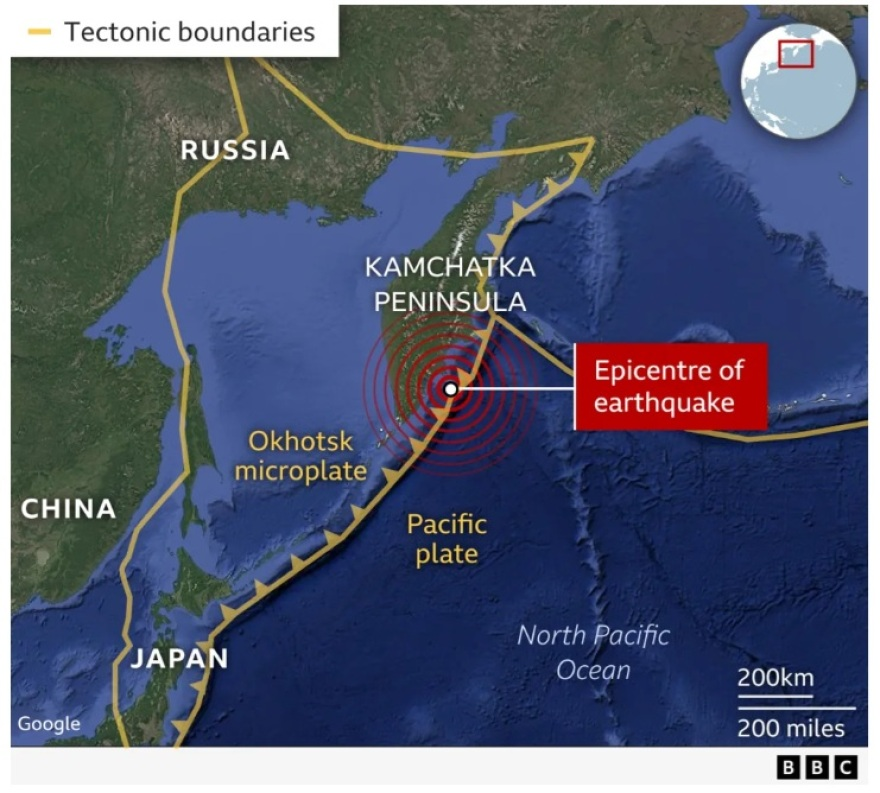
The epicenter is very close to that of a devastating magnitude 9 earthquake in November 1952, which triggered a catastrophic tsunami that hit the entire Pacific, USGS noted.
Beneath Kamchatka, the Pacific and North American tectonic plates meet, making the region one of the most seismically active on the planet. The Russian peninsula, which separates the Sea of Okhotsk from the Pacific Ocean, is among the world’s most earthquake-prone areas, according to USGS.
Since 1900, seven very strong earthquakes—magnitude 8.3 or higher—have struck along this peninsula.
Ask me anything
Explore related questions




