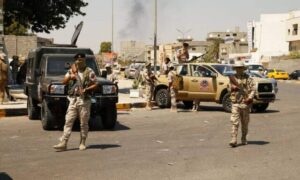
Libya is going through a defining period, as the UN has presented the Security Council with a detailed roadmap for elections and for unifying the country’s fragmented institutions. This discussion comes shortly after the recent municipal elections, in which citizen participation proved to be expressively high, despite serious obstacles and interference.
Political developments within the country also intersect with geopolitical balances in the region. At the same time, a Bloomberg report said that Marshal Haftar appears ready to give Ankara permission for exploration in the Eastern Mediterranean based on the Turkey-Libya memorandum, a development that causes concern in Athens as it is directly linked to Greek interests.
The Special Envoy of the Secretary General and head of the UN Support Mission in Libya (UNSMIL), Hana Tete, welcomed the holding of the elections, stating that “26 Libyan municipal authorities went to the polls on 16 August despite significant challenges” and noted that the turnout, which reached 71%, was “a clear signal that the Libyan people want to elect their representatives”. He said that in many areas it was the first election process held since 2014.
Interventions and cancellations
Tete stressed that the environment was not seamless. The government appointed by the Eastern Libyan Parliament suspended the electoral process in 16 municipalities on polling day, and had already banned elections in 11 others in July, including Benghazi, Sirte, Tobruk and Sabha. “This situation clearly demonstrates the challenge of divided institutions,” he said, calling on the de facto authorities in the East “to allow the resumption of elections as soon as possible.”
In the West, the situation was also tense, as on the eve of the elections, unknown persons set fire to the offices of the Supreme National Electoral Commission in Zawiya, destroying election materials. Attacks also occurred in Zliten and Sahel al-Garbi. Despite this, the process was completed, exemplified by the Commission officials in Shahel al-Garbi who “set up the polling stations outside their burnt offices to ensure the citizens’ vote.”
International consultations
The head of UNSMIL presented the results from the nationwide consultations organised following the May Advisory Committee report. As she said, “We participated in cities, municipalities, organized open meetings with broad representation. Those attending clearly expressed their democratic aspirations, but also their frustration with the political developments of recent years.”
Through an online consultation, over 22,500 responses were collected. Of these, 42% prefer simultaneous presidential and parliamentary elections, 24% support a new assembly to replace the existing institutions, 19% believe a permanent constitution is necessary and 12% call for parliamentary elections only. The participation of women and young people was also significant, who, as Tete stressed, “reaffirmed their desire to participate meaningfully in shaping Libya’s political future, calling for guaranteed representation and institutional safeguards.”
Three-pillar roadmap
Tete presented a roadmap based on three pillars: (1) a technically credible and politically feasible electoral framework for holding presidential and parliamentary elections; (2) institutional consolidation through a new unified government; and (3) structured dialogue involving a broad spectrum of society to address the root causes of the conflict and create a shared vision.
He noted that the process would be gradual, with an overall horizon of 12-18 months, and would include steps such as: reconstitution of the Electoral Commission, amendments to the legal and constitutional framework, formation of a new government, and security and economic management measures. “If there are obstacles or delaying tactics, UNSMIL will seek the support of the Council to move the process forward,” he said.
Challenges: Security and Human Rights
On security, Tete referred to a “fragile ceasefire” in Tripoli after the May clashes, with violations that have not escalated. She called on the Government of National Unity and the Directorate for Combating Organized Crime to resolve differences “through dialogue, not provocation.”
He expressed grave concern about 20 deaths in custody since 2024, including activist Abdel Munim al-Maremi, who died in Tripoli in July.
“These cases are part of an ongoing pattern of serious violations with impunity,” he said, and referred to the dramatic conditions of refugees, especially Sudanese in Kufra.
Appeal to the Security Council
Concluding, Tete stressed that “the Libyan people look to this Council for help to achieve a solution and a political process leading to elections and unified institutions.”
He called for unity on the part of the Council, noting that its message should “resonate throughout Libya in favor of stability, unity and the democratic will of the people.”
Greece: Ready to work with Libya for a more stable and prosperous future for both countries
Greece’s Deputy Permanent Representative Ioannis Stamatekos expressed full support for the efforts of UNSG Special Representative Hannah Tete and the UN Mission in the country UNSMIL to advance the political process and formulate a political roadmap leading to presidential and parliamentary elections as soon as possible.
He welcomed the efforts of the Presidential Council to maintain the ceasefire in Tripoli and called for the withdrawal of all foreign forces, foreign fighters and mercenaries from the country.
Stamatekos called for effective implementation of the sanctions regime and stressed the importance of the EU’s Operation Peace.
He reaffirmed Greece’s readiness to work with Libya for a more stable and prosperous future for both countries, following the constructive visit of Greek Foreign Minister G. Gerapetritis to Libya last month.
Ask me anything
Explore related questions