

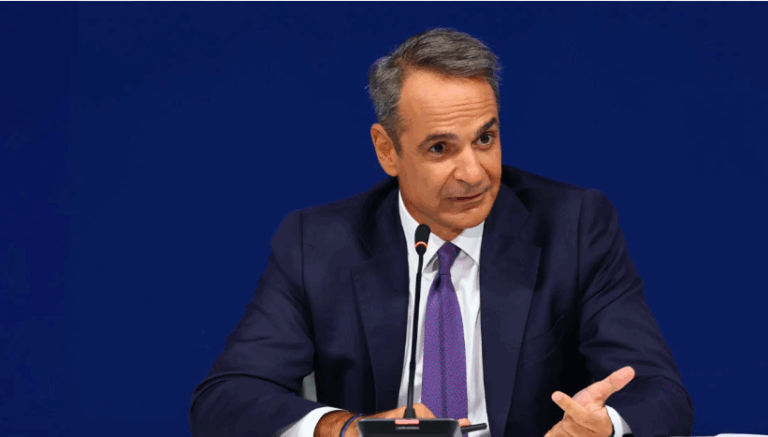
End of the Press Conference
After 44 questions, the Prime Minister’s press conference concluded, lasting 2.5 hours. At the end, the newspaper Rizospastis protested, noting that, for the third consecutive year, it had not been called on to ask a question.
Key Points from the Prime Minister’s Statements
- He has no intention of changing the electoral law, emphasizing his belief in single-party governments.
- Questions about a mid-term leadership change are “not serious,” especially as New Democracy leads by 10 points. There is no thought of stepping down; those who cultivate such narratives will be left disappointed.
- New Democracy remains the dominant political force; the government will take stock in 2027. Elections will take place in 2027. Reforms will continue.
- As long as the casus belli exists, Turkey will not participate in the SAFE program.
- The abolition of nationwide exams is not under discussion; the dialogue on a national high school diploma will begin next month.
- There are interests acting as “golden sponsors” of Alexis Tsipras.
- The government has chosen to put more money into households’ pockets; the effects of tax relief will be visible from January 1.
- On Antonis Samaras’ remarks about party matters, he expressed hope that reason prevails, adding: “Right now, I only see a father who lost his child.”
- Pledged recovery of embezzled funds from OPEKEPE, with initial recoveries already made.
- Greece has not yet fully transitioned from a clientelistic state to a citizen-oriented state; learning from past mistakes is key, and this is being applied at OPEKEPE and across all clientelistic structures.
- Serious governance requires a strategic, “mission-driven” state apparatus.
- The “alliance of bullying” that exploited the pain of relatives in the Tempi tragedy was condemned as reprehensible.
- Relations with the United States remain excellent; the only solution to the Palestinian issue is a two-state solution.
- Criticism regarding evacuations during wildfires is “nonsense.”
- Constitutional revision requires consensus; he has chosen to lower the tone in public political debate.
The press conference concluded nearly three hours after it began, with 44 questions answered. Some media outlets, notably Rizospastis, protested that they were not given the opportunity to ask questions.
Question from Athens Voice on Libya
Prime Minister Mitsotakis described the Turkey-Libya memorandum as unfounded. He emphasized that Greece maintains communication with both sides in Libya and expressed confidence that a resolution can be achieved, similar to the successful agreement reached with Egypt.
Question from ALPHA 989 on small and medium-sized enterprises
Prime Minister Mitsotakis emphasized that through the Development Bank the government has significantly expanded access to bank financing. He underlined, however, that capital must also reach smaller businesses, noting that the government is actively seeking solutions to ensure broader and fairer credit availability across the SME sector.
Question from AMNA (Athens–Macedonian News Agency) on Greek holidays
Prime Minister Mitsotakis contested the accuracy of Eurostat’s index regarding Greeks’ ability to afford vacations, noting that it does not reflect the real picture. He pointed to government initiatives such as Social Tourism programs, the extension of the tourism season, and measures to keep ferry ticket prices under control, underscoring that these policies collectively expand access to holidays for Greek citizens.
Question from Ellada24 on milestones leading up to 2027
Prime Minister Mitsotakis underlined that the government’s performance will be measured against the commitments undertaken in 2023. He reiterated that a central priority was — and remains — the strengthening of disposable income for households, stressing that this will be the key benchmark for evaluation. “That is the standard by which we will ultimately be judged,” he affirmed.
Question from Naftemporiki on government mistakes
Prime Minister Mitsotakis stated that any errors should ultimately be judged by the citizens themselves. He emphasized that he does not underestimate public discontent but made clear that he is not a magician who can solve every problem overnight. He stressed that his government will not “blow up the bank” or jeopardize fiscal stability for short-term gains, underscoring that responsible governance requires discipline. “We are doing the best possible under the circumstances,” he noted, adding that the final judgment will be rendered by society at the ballot box in 2027.
Question from Star Central Greece on farmers
Prime Minister Mitsotakis underlined that Greece today maintains a trade surplus in agricultural exports, stressing that the sector’s future lies in technological innovation. He noted that progress has already been achieved in securing more affordable electricity for producers, though he acknowledged that irrigation remains a critical structural challenge that the government must address.
Question from the newspaper Thessaloniki on funding allocated to the city
Prime Minister Mitsotakis acknowledged that Western Thessaloniki has long felt neglected, noting that major projects are now being delivered under his government: the Metro has been completed, the new hospital is being staffed, the FlyOver project is advancing, and the Thessaloniki International Fair grounds are undergoing transformation.
He emphasized that targeted interventions are underway in Western Thessaloniki, highlighting the forthcoming expansion of the suburban railway toward the west within the next 18 months — an interim but fast-track solution. At the same time, he pointed to investments in education infrastructure, with interventions already carried out in 430 schools.
Question from protagon.gr regarding political consensus
Prime Minister Mitsotakis stressed that he has made a conscious effort to lower the tone of public political debate, warning that excessive polarization only drives citizens toward abstention. He underlined that during the upcoming constitutional revision, consensus will be essential, since 180 votes are required by the Constitution itself.
He noted that he accepted PASOK leader Nikos Androulakis’s proposal for an open call in Parliament regarding candidates for the three key independent authorities. “I am making gestures of goodwill,” Mitsotakis said, “but goodwill must be mutual. PASOK remains the main party with which genuine agreements are possible, but I do not yet see a similar willingness on their part.”
Question from zarpanews.gr regarding farmers
Prime Minister Mitsotakis pledged that the government will do everything possible to ensure timely payments without delays. He underscored that efforts are underway to restructure and clean up OPEKEPE, while also acknowledging ongoing challenges with the land registry system (ATAK).
Question from EfSyn regarding VAT
Prime Minister Mitsotakis stated that he was not aware of any referral to the European Court of Justice on the matter.
Question from Gnomi Patron regarding the wildfires
The Prime Minister criticized the mayor of Patras, arguing that he behaves as though he can wage his own “guerrilla war,” risking tragedies like that of Mati. He firmly defended the success of the 112 emergency alert system, stressing that criticism often comes “from the safety of the couch.” He emphasized the importance of individual responsibility, asking what happens, for instance, if a neighbor fails to clear their own land.
Mitsotakis also highlighted the broader European context: this year, 8 million acres have burned across Europe compared to a 20-year average of 2 million. In Greece, 474,000 acres were lost to wildfires, closely in line with the long-term average of 476,000. “Under these climate conditions, can this truly be called a bad fire season?” he asked.
Question from news247 regarding the labor bill and the 13-hour workday
Prime Minister Mitsotakis underlined that the government’s central aim is to raise wages across the country, pointing to the forthcoming increase in the minimum wage and the steady decline in unemployment. He explained that many young people already choose to work two jobs, and the provision for a 13-hour day allows them to do so with the same employer, earning more income with greater security. “Why should that be considered anti-labor?” he asked.
He also noted that the introduction of the digital work card has led to a surge in declared overtime hours, though some complaints were voiced by small and medium-sized enterprises. He stressed that the government supports businesses, but above all stands with workers: “Whenever employees are blackmailed, we will crack down on the employer.”
Question from the newspaper To Manifesto regarding the political situation in France
Prime Minister Mitsotakis expressed concern about developments in France, noting that the country is trapped in a state of governmental instability. He highlighted that France currently borrows at higher rates than Greece, a fact he said speaks for itself, and expressed hope that a stable government will emerge. He added that, fortunately, Greece is not facing a similar situation.
Question from newsbreak regarding the Greek government’s alignment with Israel
The Prime Minister emphasized that Greece maintains a strategic alliance with Israel, but this has not prevented the government from issuing strong criticism of Israel’s operations in Gaza. He reiterated that Greece supports a two-state solution and stated that recognition of a Palestinian state remains a question of timing and method.
Question from voria.gr regarding the Tempi tragedy
Prime Minister Mitsotakis stressed that the government is committed to ensuring that such a tragedy never happens again. He emphasized that the investigations have revealed the misconduct of those who tried to exploit the tragedy at the expense of the victims’ families, describing their actions as deplorable. The findings of the official reports have made this clear.
Question from newsbeat regarding relations with the Trump administration
Prime Minister Mitsotakis highlighted that Greece has historically maintained strong relations with both Democratic and Republican administrations. He noted that the collaboration during Trump’s first term was excellent. While expressing concern that the new ambassador has not yet arrived, he stressed that this does not pose a problem. He added, with a touch of humor, that his relationship is not quite as close as that of former Defense Minister Panos Kammenos…
Question from “Pontiki” and pontiki.gr regarding the European Public Prosecutor’s investigation into recycling plants
Prime Minister Mitsotakis stressed that it is entirely normal and appropriate for the European Public Prosecutor to investigate multiple cases. He emphasized that the government has nothing to fear from any scrutiny and welcomes such oversight. “We cannot allow every audit to be politicized; this happens only in Greece,” he remarked. He also highlighted the government’s determined fight against criminal networks, citing examples from football, and insisted that those involved will face imprisonment.
Question from Apogevmatini on the National Health System (ESY)
Prime Minister Mitsotakis emphasized that significant improvements have already been achieved. He highlighted the largest ongoing building renovation program and noted that Greece is on track to set a record in surgeries. While acknowledging challenges in the primary training of internists and anesthesiologists, he stressed that salaries have been significantly increased. “This is not a Ministry of Sickness, but a Ministry of Health,” he remarked, pointing to substantial progress in preventive care. He also made clear that he will not allow a faction of unionists to present a distorted picture, noting that dialogue is impossible as they reject even basic principles.
Question from Eleftheros Typos on pay raises for uniformed personnel
Prime Minister Mitsotakis noted that the first salary increases had already been implemented in July. He added that next year, there would be capacity for substantial social support, emphasizing that the best is yet to come and asking for patience until the Thessaloniki International Fair of 2026. He stressed that the measures announced are permanent, recalling that a decade ago, the public had barely realized the implications of the third Memorandum at a similar time.
Question from flash.gr on internal political speculation within New Democracy
Prime Minister Mitsotakis dismissed such suggestions as unfounded, emphasizing that he has not encountered any credible scenarios of leadership change within the party. He reaffirmed his position as an elected Prime Minister with strong popular legitimacy, even acknowledging the natural political wear over time.
Question from liberal.gr on Greece’s stance in the Ukraine conflict
Regarding Ukraine, the Prime Minister stressed that it is inconceivable for Greece to compromise its national defense or fail to support the defenseless against the aggressor. He highlighted the enduring national trauma from Cyprus, asserting that Greece will not become a geopolitical scapegoat, especially given the country’s strengthened defense capabilities.
Question from mononews on scandals and corruption
Prime Minister Mitsotakis stressed that the government will complete its full four-year term, highlighting a stable parliamentary majority and a clear mandate from the citizens. He dismissed political gossip, noting that such intrigue concerns only the regulars of Kolonaki Square, and reiterated that he is not fixated on a potential third term. Should it arise, he added, it will be addressed appropriately.
Question from newsit.gr on pensions
Prime Minister Mitsotakis noted that the phased reduction and eventual elimination of the “personal difference” over two years fulfills a long-standing demand of 670,000 pensioners, which the government is now in a position to address. He acknowledged that inflation remains the greatest challenge, recognizing the difficulties pensioners face.
Mitsotakis emphasized that the government is not only focusing on income support but also on reducing expenses. He highlighted that 200,000 pensioners currently earn supplementary income through legal employment.
Question from TV100 Thessaloniki on OPEKEPE
Prime Minister Mitsotakis stated that the governing majority did not see sufficient grounds to establish a Preliminary Investigative Committee regarding OPEKEPE. He emphasized that postal votes are widely used and questioned whether abolishing them would be realistic.
Highlighting the role of the “executive state,” he described it as a mechanism of accountability and oversight, stressing that he personally assumed responsibility for OPEKEPE, acknowledging that the burden rests on all of them, and on him first. Mitsotakis underscored that there is no alternative form of governance beyond the executive state, adding that allowing each minister to operate independently is not a viable way to govern a country.
Question from OPEN on the OPEKEPE case
Prime Minister Mitsotakis acknowledged that the longstanding issues surrounding OPEKEPE cannot be attributed to a single government, yet emphasized that it falls upon the current administration to resolve them. He took full responsibility for the fact that, over the past six years, the agency’s reform and cleanup had not reached the desired level.
Highlighting decisive action, he explained that when the situation reached a critical point, the government opted for the agency’s dissolution. Measures are already underway to recover misappropriated funds, with €20 million reclaimed so far, starting with major offenders and extending controls to an additional 5,000 taxpayer IDs.
Mitsotakis concluded by stressing the broader societal goal: transforming Greece from a “client society” into a “citizen society.”
Question from To Vima on Samaras and Karamanlis
Prime Minister Mitsotakis refrained from offering a political assessment regarding former Prime Minister Antonis Samaras, citing the recent personal loss he has suffered. He emphasized the sensitivity of the situation, noting that it remains very recent.
On the broader political landscape, Mitsotakis reaffirmed that New Democracy remains the sole pillar of political stability in Greece, expressing confidence that this principle will continue to guide the country’s governance.
Question from Action24 on Rural Development
Prime Minister Mitsotakis outlined the government’s ongoing efforts to strengthen Greece’s regional and local infrastructure, emphasizing the prioritization of key projects. He cited the Patras-Pyrgos highway and the forthcoming E65 corridor to Thessaloniki as examples of initiatives aimed at improving connectivity and fostering economic growth across the countryside.
Highlighting inefficiencies in public administration, Mitsotakis criticized the highly fragmented water management system, which currently involves over 600 separate authorities, and signaled the need for comprehensive reform.
Tourism was described as a significant engine for development, generating new opportunities for local economies.
On fiscal measures, the Prime Minister expressed his aspiration to expand VAT reductions to additional islands, building on the initial implementation in the Eastern Aegean. He also highlighted a €10,000 subsidy program designed to encourage families to settle in Northern Evros, while noting that Southern Evros is experiencing rapid growth.
These initiatives reflect a broader strategy to promote regional cohesion, support local communities, and create sustainable economic opportunities across Greece’s rural areas.
Key Takeaways from Prime Minister Mitsotakis’ Press Conference
- The Prime Minister reaffirmed that there is no intention to amend the electoral law, emphasizing his commitment to single-party governments as a cornerstone of political stability.
- He stressed that New Democracy remains the preeminent political force in the country, with the government focused on completing its full four-year term and continuing its reform agenda, with national elections scheduled for 2027.
- On foreign policy, Mitsotakis underscored that as long as the casus belli persists, Turkey will be excluded from participation in the SAFE program, signaling a firm stance on national sovereignty and regional security.
- Regarding education, he clarified that the abolition of nationwide exams is not under consideration. However, a structured dialogue on the implementation of a national high school diploma is set to commence next month, reflecting the government’s commitment to measured and evidence-based educational reforms.
- The Prime Minister highlighted the influence of external interests, which he described as acting as significant “sponsors” of opposition leader Alexis Tsipras, framing the political landscape in terms of transparency and accountability.
- On economic policy, Mitsotakis reaffirmed the government’s priority to enhance household income through targeted tax relief measures, set to take effect from January 1st, underscoring a strategy aimed at supporting citizens amid rising cost-of-living pressures.
Question from newsbomb.gr on elections
“Under no circumstances will there be early elections. We will complete the full four-year term. I want to win the next elections. In 2023, I made certain commitments to the citizens, and I am focused on fulfilling that agenda. The people will decide in 2027 whether they want a single-party government or coalition governments.”
Question from “Parapolitika” on foreign universities and the national diploma
“Against the alarmist claims of the opposition, we have proven that very strict standards have been set for foreign universities. That’s why only four were licensed in the first round. Both Harvard and Yale have come to Greece in collaboration with public universities. This is something that needs to be highlighted.”
Question from capital.gr on demographics
“This is a huge, long-term problem affecting the entire Western world. It’s not just an economic issue, but a social one. In South Korea, the average birth rate is below one child per woman. We established a birth allowance as an initial form of support and increased vouchers for kindergartens and nurseries.
Our tax reform sends a message to families. We are listening and we know the cost of living has risen. Demographics also involve the senior population: more than 200,000 retirees have chosen to continue working today because we didn’t cut their pensions. No country has found a magic solution to solve the demographic challenge.”
ERT question on housing
“What poses a challenge for tenants often benefits property owners. Housing is a concern in a rapidly evolving economy. We have taken measures with programs like “My Home 1” and “My Home 2,” which have enabled 30,000 citizens to own a home. Many properties remain unused. I am open to extending restrictions on short-term rentals.”
Ta Nea question on the polls
“It’s natural for a government in its seventh year to experience some wear. Still, we remain the dominant force, with a lead of over 10 points above the second party. The social alliances we seek are consistent with those pursued in 2019 and 2023. With two years until the next elections, I’m not preoccupied with 2027; otherwise, I would be slowing down reforms. I won’t set them aside to push populist measures. I have complete confidence in the Justice system to handle all scandals.”
ALPHA question on eliminating “unfair” taxes such as ENFIA or fuel taxes
“The government has already reduced ENFIA by 30%, so abolition is not on the table and would, in a sense, be unfair. Measures have been taken to support rural Greece, making life in villages more manageable. VAT has been lowered on a range of goods and services. Any further reduction would mostly benefit businesses rather than citizens, and cutting VAT on fuel would carry a very high fiscal cost.”
Real News question on Greek-Turkish relations
“I aim for calm waters, but from a position of strength and confidence, without compromising the country’s sovereignty. Our Marine Parks are an exercise of national sovereignty. Turkey must revoke its casus belli; as long as it exists, we will block Turkey’s entry into the SAFE program.”
During a question from iefimerida about developments in the Left and Alexis Tsipras, the Prime Minister stated that any potential comeback of Mr. Tsipras primarily concerns the center-left. He criticized Tsipras for asking citizens to conduct self-reflection instead of doing so himself, emphasizing that he failed both as Prime Minister and as leader of the opposition. The Prime Minister noted that his success in elections was not about defeating Tsipras personally, but about earning the trust of the people. He also highlighted the influence of certain media outlets and business interests that act as major supporters of Tsipras.
During a question from STAR regarding migration and asylum requests, the Prime Minister reiterated the need for a strict yet fair policy centered on protecting Greece’s borders, referencing the Evros crisis as a turning point. He pledged to take every possible measure to curb illegal migration, noting that steps to limit arrivals from Libya have been effective. Emphasizing national control, he stated that Greece should decide who enters the country, not traffickers. He also announced plans for legislation on legal migration, including visas for students, technology professionals, and the agricultural sector, while noting that a decision on extending measures for asylum applications has not yet been made.
Addressing a question from ANT1 regarding crime and organized criminal networks, the Prime Minister emphasized that Greece is making daily progress in the fight against lawlessness. He highlighted the uncovering of multiple organized crime rings by the Greek FBI, improvements in professional football clubs, the exposure of corruption in public services, and the absence of active university occupations. He also noted the stricter traffic regulations and new technology systems, acknowledging that while every battle may not be won, the government will persist in its efforts.
Addressing a question from Kathimerini about the Greece-Cyprus electricity interconnection, the Prime Minister noted that Cyprus stands to benefit from the project. He added that for it to move forward, Cyprus must show concrete commitment and highlighted technical matters, including pending payments from Cyprus.
In response to a question from SKAI regarding political stability and the electoral law, Prime Minister Kyriakos Mitsotakis stated that he has no plans to change the law. He reaffirmed his support for single-party governments, highlighting that while many doubted a majority was possible in 2023, his party succeeded. He also noted that the 2027 elections are not the government’s immediate priority.
When addressed the question by Proto Thema about tax relief and rising retail prices, Prime Minister Kyriakos Mitsotakis stressed the government’s focus on supporting families with children. He highlighted the bold move to eliminate income tax for a 22-year-old entering the workforce with an income under €20,000, describing it as a significant step to increase household income. Mitsotakis added that the fight against high prices involves interventions in food, energy, and fuel costs, aiming to put more money directly into households’ pockets to help them cope with accumulated inflation.
Asked by Makedonia about the 13th salary for public sector employees, Prime Minister Kyriakos Mitsotakis emphasized that his government has introduced the boldest tax reform since the Metapolitefsi. While most European countries are implementing austerity measures, Greece is taking the opposite approach. With available fiscal reserves, the government is distributing a €1.6 billion “dividend” to citizens. Mitsotakis clarified, however, that offering both the 13th salary and the announced tax cuts would violate fiscal rules, making it impossible to provide both simultaneously.
The Prime Minister’s press conference will mark the conclusion of his three-day visit to Thessaloniki for the 89th International Fair.
The press conference is scheduled for 12:00 at the “Ioannis Vellidis” Conference Center.
Yesterday, from the podium of the 89th Thessaloniki International Fair, Kyriakos Mitsotakis announced what he described as “the boldest reform in income taxation in the history of the post-dictatorship era,” amounting to €1.6 billion.
This sweeping package of tax reforms affects approximately 4 million taxpayers and includes, in brief: a general reduction of two percentage points in all tax rates except the entry-level rate, with increased tax credits based on the number of children; a zero tax rate for new employees starting in 2027; reductions in ENFIA property taxes in villages; a 30% VAT cut for remote islands; and the gradual elimination of the personal difference for around half a million pensioners.
Ask me anything
Explore related questions