





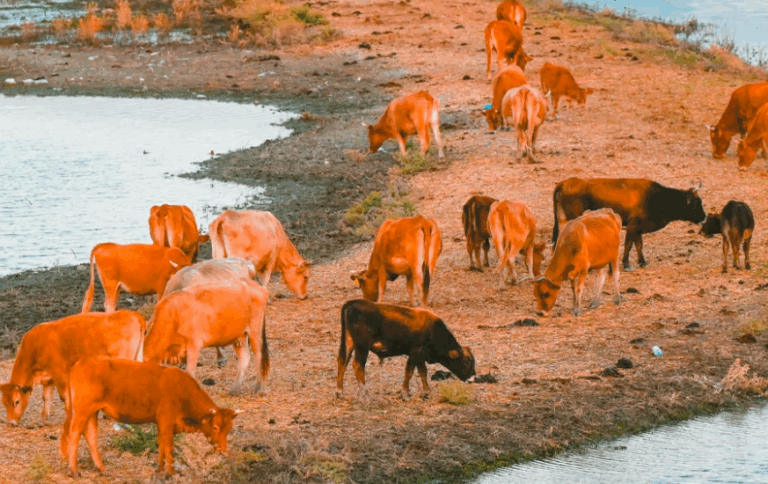
Market and Livestock Crisis
The situation in the meat market and livestock farming seems hopeless: while beef and goat/sheep meat prices have skyrocketed, putting the “housewife’s basket” on fire, many farmers struggle to survive. The mandates of the so-called EU Green Deal directly reduce beef production. Plagues and, subsequently, foot-and-mouth disease, which devastate entire herds of sheep and goats from Evros and Thessaly to the Peloponnese, are removing local lamb and goat meat from the market, increasing prices and pushing farmers to abandon livestock farming.
Feta cheese is also affected, as discussions about vaccinating animals arise. Vaccination is rejected by large markets, which refuse products from vaccinated animals.
Only 12% Greek
Recently, beef prices have continuously risen as supply decreases but demand remains constant. Greece has very low self-sufficiency in beef.
As Giorgos Kefalas, Deputy Regional Governor for Agricultural Economy in Central Macedonia and a livestock farmer, tells THEMA:
“Nine out of ten steaks we consume come from other EU countries,” including the Netherlands, Germany, and primarily France, which has dominated the Greek market since the mid-1980s.
At that time, policies made imported meat artificially cheaper, subsidizing imports via the “green parity of the drachma.” Choosing the cheaper option had the unintended consequence of shrinking Greek cattle farming. Today, domestic production, including calves born locally or imported but fattened in Greece, accounts for only 12% of market needs.
The EU Green Deal Effect
The Green Deal aims to reduce methane emissions, largely blaming cattle. Human-caused methane emissions in the EU are 54% from livestock, with a goal of reducing total emissions by 19% by 2030.
To achieve this, production decreases while demand stays the same or grows. Supply drops → prices rise. According to the August agricultural price bulletin from Piraeus Bank, beef prices are at historic highs in wholesale and retail. The trend is expected to continue short-term.
For example, INRA estimates France will drop from 6.5 million cattle today to 5.5 million by 2027. Combined with the aging European farming population and fewer young farmers, the reduction in livestock is reinforced.
“After the pandemic, the situation worsened,” says Kefalas. “Slaughterhouses lost workers, reducing supply while demand remained, pushing prices up. Production costs also rose.”
Imports and Global Factors
While the EU sets strict rules for domestic farming, there’s no real control over imports from third countries. Agricultural products rarely show origin labeling, so consumers often choose cheaper meat over higher-cost, environmentally friendly, low-pesticide alternatives.
The Mercosur agreement, signed recently, increases beef imports from South America. Transport alone raises the environmental footprint, and hormones, growth factors, and even child labor may be involved.
Sheep and Goat Meat Shortages
Livestock diseases have killed tens of thousands of sheep and goats – over 220,000 animals, about 5% of the total livestock. This has increased frozen meat imports from New Zealand. Summer tourism further increased demand, driving prices higher.
“I only have dogs left,” says Anastasios Angelis, a farmer in Marmarini, Larissa.
“In July, all 590 of my animals were culled. Compensation barely buys half as many animals. Imported young animals from France are expensive. Each animal costs 10–12 euros/month for feed before they produce milk. I may not recover income for a year.”
Many farmers in the wider Larissa area are effectively unemployed, struggling to rebuild herds, and younger farmers are considering leaving the profession.
Foot-and-Mouth Disease
Foot-and-mouth disease, a zoonotic disease not transmitted to humans, has surged again this year. Initially in Thrace, it spread to Thessaly and the Peloponnese. Professor Giorgos Arsenos of Thessaloniki University explains that the spread is largely due to farmers failing to follow biosecurity measures. Disinfection facilities were not installed by regional authorities. Proper measures would include:
- Changing clothes when entering/exiting barns
- Recording everyone entering
- Wearing protective shoe covers
- Disinfecting trucks
Only Thrace has started such facilities. Lost livestock could be replaced within five years, but farmers need training to modernize facilities and improve production.
Vaccines and Feta Cheese
Mass culling and loss of income sparked discussion about vaccination. Professor Arsenos strongly opposes it: no DIVA vaccines exist that can distinguish vaccinated from naturally infected animals. Without DIVA vaccines, infected herds must be culled.
The greatest risk is losing export markets for feta and other Greek cheeses if vaccinated animals enter production – a potentially catastrophic outcome.
Kefalas adds that there is no real strategy for livestock. Accurate animal census and tagging with electronic GPS-enabled boluses are basic steps needed, alongside farmer education and genetic improvement of herds.
“Livestock can generate income if modern methods are used,” he concludes.
Ask me anything
Explore related questions




