





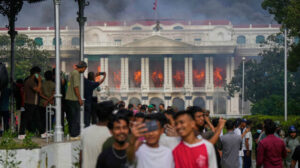
Protesters set fires at government buildings, police stations and politicians’ homes in the capital of Nepal, Kathmandu, as unrest continued for a second day, even after Prime Minister KP Sharma Oli resigned and social media restrictions were lifted.
Oli’s resignation without a replacement essentially left the country “headless”. Several other high-ranking officials also resigned, according to the New York Times. Recall that on Monday, authorities opened fire on a crowd of young protesters, killing at least 19 people in one of the most widespread instances of social unrest in the South Asian country in recent years.
Protesters set fire to K.P. Sharma Oli’s house and threw furniture to fuel the flames and smashed windows with stones and bricks. At noon, K.P. Sharma Oli announced his resignation “so that steps can be taken for a political solution,” he said in a letter to Nepal’s President Ramchandra Pundel. An adviser to Puntel told Reuters that the resignation was accepted and that the president has begun “the process and discussions for a new leader.”
“The government has fallen, the young people have won and taken control of the country,” said one protester, Sundan Gurung, “the future belongs to us.”
According to Reuters, young people entered the parliament complex on hearing the news of the prime minister’s resignation, raising their hands in the air and chanting slogans as smoke billowed from parts of the building. “We won,” one protester wrote in huge orange letters on a wall of the parliament building, while another nearby made a victory sign with his fingers.
Although protesters remain on the city’s streets, there were no clashes or violence as security forces did not intervene or try to use force, eyewitnesses told Reuters. Despite the curfew that went into effect this morning, groups of young protesters took to the streets of Kathmandu and attacked public buildings and the homes of political leaders.
Nepal’s president called for national unity. “I call on everyone, including the protesters, to work together for a peaceful resolution of the difficult situation in the country,” President Ramchandra Pundel said in a statement after protesters set fire to the parliament building as well as his office. “I call on all sides to show restraint, not to cause further damage to the country and to start negotiations,” he said.
Dead in Kathmandu
On Monday, police opened fire on thousands of protesters demonstrating on the streets of Kathmandu, demanding an end to a social media blockade ordered four days earlier and denouncing corruption among the country’s elites. At least 19 people were killed, including 17 in the capital, and hundreds more were injured, according to an official account.
In the evening, the head of government ordered the restoration of social media and the opening of an “independent” investigation into the circumstances under which the police intervention took place.
.
The blocking of social media
The government had announced on Thursday the blocking of social media, implementing a Supreme Court ruling in 2023 that required a local representative and content regulator to be named.
Among the platforms banned were Facebook, X, YouTube and LinkedIn to the regret of millions of users.
“The government did not want to block the use of social media,” the prime minister initially said today. “It just wants to protect the context of their use,” he insisted, “it wasn’t worth protesting about it.”
Initially prompted by this blockade, yesterday’s protests then turned more broadly to denouncing the corruption of the authorities in a country with an idling economy and high unemployment.
The end of Ollie
As head of Nepal’s Communist Party, Olli ends a 60-year political career, marked largely by the long civil war that bloodied Nepal until the monarchy was abolished in 2008.
Olli was first elected prime minister in 2015, re-elected in 2018, briefly reappointed as head of government in 2021 and then again in 2024, leading a parliamentary coalition that included mostly the centre-right. His resignation follows that of three other ministers, including the interior minister.
Ask me anything
Explore related questions




