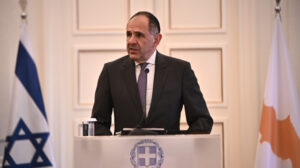
“We will very soon have the start of the technical committee discussions on the delimitation of the sea zones with Libya”, Greek Foreign Minister Giorgos Gerapetritis said in an interview on Sunday on Sky radio.
He will have a meeting today, Monday, with the foreign minister of Libya‘s Government of National Unity, and has already held similar discussions with eastern Libya.
“Greece is the only European country which is discussing at the highest level with the leaderships of the two sides,” he noted, adding: “It is an important visit, which we will have next week. It is an expressed will of the government in western Libya to start these discussions, so it is a valid assumption that you are making.”
Furthermore, he said that migration flows from Libya have been minimized. “There has been no progress in terms of the ratification of the Turkish-Libyan memorandum, although there is the anticipated pressure and we are constantly developing our relations with both sides,” he noted.
The foreign minister said that we have many open challenges ahead of us, as beyond the usual foreign policy and diplomacy, the international arena is now completely unpredictable.
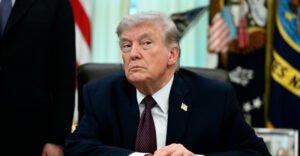
Gerapetritis referred to the regular UN General Assembly in September, which this year is expected with particular interest, as it will be the first attendance of the second term of US President Donald Trump. It will also be in the shadow of two very large wars still raging in Ukraine and the Middle East.
“International organizations, unfortunately, have not been seen to be able to provide the good services needed and we often see them being substituted by the big countries that are mediating so that we can have a calmer situation,” he stressed.
Asked about the Palestinian issue, he said the criticism of the government is “unfair”. “Greece is pre-eminently a pioneer in terms of the humanitarian dimension in Palestine. We have taken major initiatives, we are in full coordination with the Palestinian Authority. We are the ones who, among the Europeans, have the greatest support for the Palestinian Authority,” he added.
He noted that Greece believes that there should be a state of Palestine, “but this must emerge through a political process. It has been proven that unilateral recognitions have not contributed at all to the political process.”
Regarding the expected meeting between Greek Prime Minister Kyriakos Mitsotakis and Turkish President Recep Tayyip Erdogan, he said that over the past two years, meetings between the two have taken the form of a greater regularity.
“There is an intention by both of them to have a meeting. We are trying to find a suitable time, because scheduling is not easy, the speeches of the two in the General Assembly do not coincide. But I am hopeful that there will be the right timing to have the meeting,” he stated.
“With Turkey there is a very specific framework for dialogue. This framework is the structured dialogue that is taking place on the political, on the economic Positive Agenda and on the Confidence Building Measures. We continue to maintain a very basic stance which is that, recognizing our underlying differences, we can nevertheless discuss, so that no crises are produced,”
the Foreign Minister underlined.
He also said that “our position in the seas has been significantly upgraded and this is something irrefutable. Turkey is reacting and it is reasonable to react. It has its own perception of its claims in the Eastern Mediterranean. We will stick to something we have said from the beginning. Greece will never discuss sovereignty issues and will not make any concessions.”
“We are upgrading our position. We are not going to be deterred by the fact that others are making claims. The same is true of the claims we may have from Libya. We believe that through dialogue viable solutions can be found. We do not feel that a crisis will be created by them, and there is always a way, which is provided for by international law, which is international jurisdiction. If Turkey considers that in the part of the delimitation of the maritime zones, the EEZ and the continental shelf, there is a dispute between the two countries, there is always the way of the International Court of Justice,” he said.
Finally, when asked about the criticism he receives from former Prime Minister Anthony Samaras, he noted that he has great respect for his contribution to the country and his career in New Democracy.
“He has a different approach when it comes to national issues. I am convinced that if we sit down and discuss these issues – where we were two years ago with Turkey and where we are today – I think we will conclude objectively and impartially that not only have there been no concessions, but on the contrary, the international footprint of the country today is stronger than ever,” he noted.
“In this very recent and fresh development, with the expressed interest of Chevron, it also attests to the fact that we have an excellent relationship, despite rumours to the contrary, with the United States,” he added.
“Because foreign policy is a matter of facts and not of assumptions and speculation, I have a feeling that there could be a discussion with Samaras as well, which would be productive. Foreign policy, national issues, do not lend themselves to a digestible approach or criticism. It should always be done on the basis of arguments. And arguments that refer to the field and not to theory,” concluded Mr. Gerapetritis.
Ask me anything
Explore related questions