





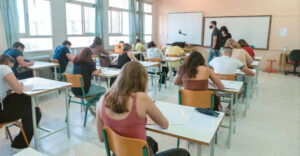
Significant improvements in education are highlighted in a new report by OECD (“Education at a Glance 2025” – September 2025), such as reducing school dropout, increasing postgraduate qualifications, enhancing digital access with new technologies, and infrastructure improvements.
However, Greece continues to lag behind the OECD average on critical indicators: expenditure per pupil, teacher salaries, and international student mobility. In addition, chronic challenges remain, such as the need to better link education to the labour market and support lifelong learning. Particularly prominent are also social inequalities in schools
The challenge for the next decade is twofold: to strengthen quality and funding for education on the one hand, and to address the demographic crisis that threatens to further shrink the student population on the other. Without targeted policies and investment, the risk is that the gap with the rest of the OECD will widen.
In more detail, the figures in the OECD’s annual report:
– Reduction in the number of young people without a high school diploma
Greece follows the positive trend recorded in the OECD with a decrease in the number of young people aged 25-34 years old who have not completed secondary education. The rate fell from 13% in 2019 to just 7% in 2024, a significant progress that brings the country closer to the OECD average.
– Completing secondary education reduces the risk of unemployment
Across OECD countries, 12.9% of young people without a school leaving certificate are unemployed, compared to 6.9% of those with a school leaving certificate. In Greece, the rates remain higher: 24.2% for those without a school leaving certificate, 16.2% for those who have one and 12.3% for those with a higher education degree.
– Postgraduate Studies – Up but down compared to OECD
13% of 25-34 year olds in Greece have a postgraduate degree, lower than the OECD average (16%) but up from 9% in 2019. This rise shows the dynamic demand for specialisation, but also the need for more academic and career development opportunities.
On average, individuals with a master’s degree or equivalent have significantly higher employment rates and earnings than those with a bachelor’s degree or equivalent. However, the proportion of young adults (25-34 years old) obtaining a postgraduate degree varies widely across OECD countries, ranging from 1% to 39% in 2024.
– Demographic Challenge – Fewer children in schools
The severe demographic shrinkage that Greece is facing is now clearly reflected in the student population. The number of 0-4 year olds fell by 25% between 2013 and 2023 and a further 11% drop is expected by 2033. This affects the need for adaptation in the design of school infrastructure and resource allocation.
– Higher Education in the spotlight
All young people entering higher education in Greece are enrolled in Bachelor’s level programmes – 100%, compared to an OECD average of 78%. Women make up 55% of new entrants, slightly higher than the OECD average (54%).
In terms of subjects, Greece shows a high orientation towards science and technology (30% of Bachelor graduates), while social sciences and humanities account for 24%.
However, international student mobility remains low. The share of international students decreased from 3.4% in 2018 to 3% in 2023, while the OECD recorded an increase from 6% to 7.4%.
– Funding – below OECD average, Greece
Public spending on education in Greece remains low. The country spends US$6,420 per pupil on primary and secondary education, well below countries that reach or exceed US$27,000. In higher education, spending falls even lower, to US$4,497 per student, when the OECD average is US$15,102.
As a percentage of GDP, total investment in education is 3.9%, compared to 4.7% in the OECD. 78.3% of funding comes from the state, lower than the average of 90.1%. At the same time, spending on education has decreased as a share of the public budget from 6.2% in 2015 to 5.9% in 2022.
There was a significant increase in pre-school education: +16.6% in spending, due also to an 11.7% increase in the number of children enrolled. However, per capita expenditure increased by only 4.4%, well below the OECD average (24%).
– Stability with low salaries for teachers
Greece has low teacher mobility: 2.6% retire and just 0.1% resign annually. This reduces the pressure for new recruitment but limits renewal in the sector.
The number of teachers in the sector is only 2%.
Teachers’ salaries remain low: primary school teachers are paid 31% less than other workers with a higher education degree, when the OECD average is -17%. Wage growth over the period 2015-2024 was just 1.4%, compared to 14.6% in the OECD.
– Timetable, lessons, and classes
Pupils in Greece have 718 hours of compulsory education per year in primary school and 791 in secondary school, less than the OECD average (804 and 909 hours, respectively). Holidays amount to 16.8 weeks per year, one of the longest in the OECD.
41% of time in primary school is devoted to language and mathematics, while in secondary school it drops to 37%, above the OECD average (27%). The average number of pupils per class is 16.9, among the lowest in the OECD.
– The ratio of students to teachers in universities
In higher education, the ratio of students to academic staff is high, especially in institutions with a strong research orientation: 40 students per staff member compared to 36 in institutions with fewer PhD graduates.
Ask me anything
Explore related questions




