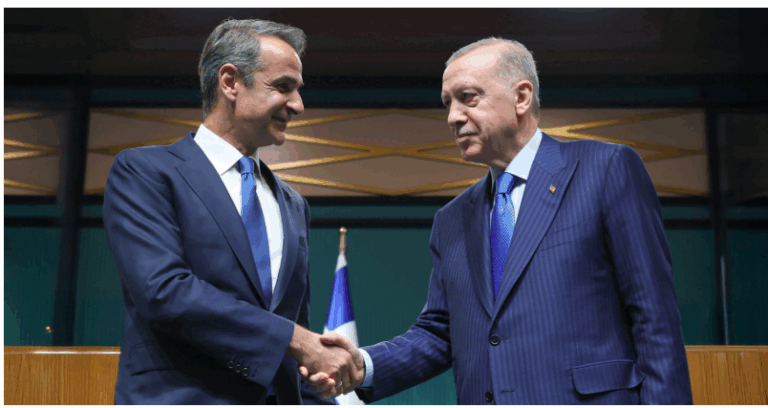
The difficult balance of maintaining issues in the Aegean, despite the ever-rising tension in Greek-Turkish relations with the “unfurling” of all Turkish claims in the field and Athens’ reaction to this policy, is being sought by Athens from the difficult meeting of Kyriakos Mitsotakis with Turkish President Tayyip Erdogan on the sidelines of the UN General Assembly in New York.
The climate has been significantly aggravated in recent months, both by provocative moves and challenges to Greek sovereign rights and by the fact that Ankara often seems to react spasmodically to moves by Athens to defend its sovereign rights and strengthen the country’s defense.
This climate is exacerbated by the international environment due to the crisis in Gaza, where Turkey is raising the banner of the anti-Israel front, even accusing any countries that still maintain relations with Israel of being “complicit in the commission of genocide.”
The meeting was up in the air until the last minute, mainly due to the tight UNGA schedule and the fact that the two leaders’ presence in New York coincided only over the weekend of September 23-24, when there were already a plethora of General Assembly commitments.
Continual postponements
As it has been a long time since there has been a summit (apart from the brief talks they had in June in The Hague in the NATO framework) and the famous High Cooperation Council has been constantly postponed since January, it was felt by both sides that a signal should be given that the process remains alive.
However, no one hides the concern that this meeting may bring out with greater intensity the problems, old and new, that have arisen since December 2023, when Messrs Mitsotakis and Erdogan signed the Athens Declaration with the expectation that it would lead to a change of course in Greek-Turkish relations.
Almost two years later, not only has there been no progress in the Gerapetritis-Fidan talks and the Political Dialogue for the start of substantive discussions on the delimitation of the EEZ/shelf, but all of Turkey’s differences and claims have moved from the level of rhetoric to the field.
Many of the tensions that are being caused are based on Turkey’s attempt to react to Greece’s moves to exercise its sovereign rights and thus break the perception that it wants to impose that the Athens Declaration also means self-limitation in the exercise of sovereign rights.
The Marine Spatial Planning (MSP) was a first test, as it captured the maximum of Greek claims to maritime zones, provoking an immediate reaction from Turkey, both with its own MSP and with statements and announcements that document the whole web of its disputes. The core of these positions is that the median line is calculated on the basis of the mainland coastline, completely ignoring that islands do not automatically produce maritime zones beyond 6 nautical miles, and of course, the “grey zone” theory and casus belli is also reintroduced.
The Greek IHL, of course, remains at the level of announcements and has not been submitted to the Commission. But its implementation on the ground will be tested by Turkey’s reaction.
However, the three issues that constitute a test of strength for Greek-Turkish relations at this stage are: Greece’s attitude towards Ankara in the SAFE programme, the electrical interconnection between Cyprus and Crete and the competition in the Libyan field.
The Greek Prime Minister has repeatedly stated that Turkey’s participation in the 150 billion euro SAFE programme for the rearmament of Europe will not be given the green light as long as Turkey continues to threaten a member state with war. Despite the “windows” that are open for Turkish companies to participate in the program, the clear position of Athens and Nicosia to veto such a project is causing anger in Turkey.
Erdogan himself considers his country’s defense industry, which is now an important tool for increasing and expanding Ankara’s political and diplomatic influence, to be the “pride” of his nearly 25-year tenure as Turkey’s leader. For Greece and Cyprus to put obstacles in the way of such a project is not tolerated by the Turkish leadership.
Mitsotakis has stated that he will raise the issue of the casus belli with the Turkish leader, and this discussion will be of particular interest, as Turkey considers this position a non-negotiable issue and a pillar of the “Blue Homeland”. After all these years, the only thing it has been discussing during the exploratory talks was the limited extension of Greek territorial waters and, at any rate, not in the maritime area of the East Aegean islands and the Dodecanese.
The issue of electrical interconnection is a critical issue, which, of course, will not be discussed in its technical dimension. But here too, Turkey has shown its determination, stating that no project in the region will take place without its approval. For Greece, it is a major issue because it is essentially the first move to exercise sovereign rights in the EEZ declared by the Greek-Egyptian Agreement and, at the same time, the first attempt to challenge the Turkish-Cypriot Memorandum. The longer the project is delayed, the greater the risk of consolidating the image that the Turkish-Colombian Memorandum is “stronger” than the Greek-Egyptian delimitation.
On this issue, however, the meeting that Prime Minister Kyriakos Mitsotakis will have on Tuesday in New York with Cypriot President Nicos Christodoulides is of particular importance, in an attempt to dispel the clouds that have been created on the occasion of the electrical interconnection and to find a way to overcome the obstacles that have arisen through the responsibility of the Cypriot side.
Athens would at least expect the Turkish side to understand that the issue of the interconnections does not only concern Greece but also Turkey itself, and thus, a workable way should be found so that the research and laying of cables can be carried out without raising issues of sovereignty and sovereign rights, as these works are free in international waters.
Various ideas have been on the table, including notifying all coastal countries in the region of the survey work by the survey vessel. However, the question will remain as to which country will exercise jurisdiction and issue the NAVTEX to conduct the work.
It is also a matter to be explored that the Egyptians have started to promote the idea of a regional conference to carry out the interconnectivity work and, at a later stage, the delimitation.
In addition to the other problems that arise, this formula runs up against Turkey’s demand that the pseudo-state participate on an equal footing.
Libya, especially the western side, has in recent years been a privileged field for the exercise of Turkish influence, which led to the Turkish-Libyan Memorandum. Athens, with great delay, has made an opening to both sides of Libya, attempting to reverse the existing climate, restore channels, and exploit the diplomatic leverage offered by both its membership of the EU and its presence as a non-permanent member of the UN Security Council.
This mobility has irritated Ankara, which retains strong interests in the country and exerts influence on both sides, having now re-established relations with General Haftar. Ankara is offering Eastern Libya economic and trade relations and balance with Tripoli by asking Haftar to ratify the Turkish-Libyan Memorandum. On the other hand, Tripoli responds to this “disloyalty” of Ankara by agreeing with Athens to start a dialogue on the delimitation of the EEZ/shelf.
Of course, the process that George Gerapetritis and his counterpart from the Tripoli government agreed to initiate last Wednesday is extremely difficult and unlikely to come to a conclusion. This is not only because there are “heavy weights” on the table, as the Greek side is demanding that the Turkish-Libyan Memorandum be ignored, while the Libyan side is demanding the acceptance of the map submitted to the UN and the abolition of the median line based on which Greece also drew the land south of Crete heading for Chevron.
The Tripoli government is transitional, and it is doubtful that any subsequent unified government will consider itself bound by what has been discussed or agreed in this dialogue process. The Gaza issue is another issue of friction, as for Erdogan, a statement that there must be a ceasefire and the humanitarian crisis must be addressed is no longer enough for him to label a country “complicit in Israel’s genocide”. The Turkish president has even said that he will be in New York as “the voice of Palestine,” and there can be no understanding with Athens in this discussion. But it is interesting if the Turkish side raises the issue that has dominated the Turkish media in recent days, and even the Turkish MoD on Thursday indirectly issued threats, with the inclusion in the Cyprus National Guard of the Israeli BARAK MX anti-aircraft system, which significantly strengthens the defense of the Republic of Cyprus. Turkish media are already developing conspiracy theories about Israel’s attempt, through Cyprus and Greece, to surround Turkey, recalling the scenarios of 1998, when, under threat of force, Cyprus withdrew its S-300s.
Joint exercises
In the context of the rivalries in the Eastern Mediterranean, Turkey’s noted rapprochement with Egypt should not be downplayed. The joint exercises announced for the coming period, the first of this kind in 13 years, as well as the intended cooperation in the defense industry, are worrying signs. As does the dual visit of MIT commander Ibrahim Kalin to both General Haftar and his Egyptian counterpart, with the aim of Ankara-Cairo coordination on Libya. Now, the game of regional balances and rivalries is being turned upside down, catalyzed by developments in Gaza and Israel’s growing isolation from its Arab neighbors. And this backdrop now directly affects Greek-Turkish relations, posing new challenges for Athens.
Erdogan at the White House with F-16 and F-35 on the agenda
Friday night’s announcement by President Trump that he will receive Erdogan at the White House on September 25 certainly changes the landscape, as this is a major development that will further strengthen Ankara’s arrogance. President Trump said in his post that he looks forward to welcoming Erdogan, “with whom we have always had good relations,” on September 25, and that ahead of the meeting they are working on several trade and military deals, including a large-scale purchase of Boeing aircraft, a major F-16 deal and the continuation of F-35 talks, which are expected to conclude positively. Donald Trump confirmed reports over the past two days that his son’s visit to Turkey and his secret meeting with Erdogan, where he was offered a generous proposal to buy 300 Boeing aircraft for Turkish Airlines, and the promotion of major energy deals, were what opened the White House door to the Turkish president.
Of course, a crucial point will be how the Turkish leader will position himself at the UN General Assembly on the Gaza war, as he has also turned against the US for its support of Israel.
However, it is significant for the Turkish leader that after six years, he has secured an invitation to visit the White House.
Ask me anything
Explore related questions