





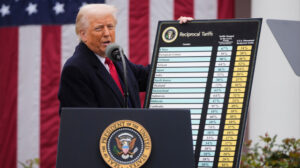
The legality of many of the tariffs imposed by Donald Trump is being considered today by the U.S. Supreme Court, with the ultimate stakes being the extent of the U.S. president’s powers.
The executive branch is pushing the nine justices – six conservatives and three progressives – to keep tariffs on imported goods, because they bring in billions of dollars in revenue and have allowed the US to extract from its partners promises of investment and more favorable conditions for US exports.
The Court’s verdict is expected to be announced many months from today, although there is a possibility that it could be made public very quickly.
The government is putting all its weight behind the trial, where Treasury Secretary Scott Bessend and White House trade spokesman Jamison Greer are expected to attend today.
Donald Trump argued on Tuesday, in a post on the Truth Social platform, that keeping the tariffs in place is “a matter of life or death for our country” because otherwise “we will find ourselves essentially without a defense against the other countries that have benefited from us for years.”
Since his return to the White House in January, the Republican president has made tariffs a key driver of his economic and diplomatic policy. He boasts that in doing so, he will not only re-industrialize the country and reduce the chronic trade deficit but also, by imposing tariffs on Mexico, Canada and China, he will address the crisis of fentanyl, the powerful opioid whose overdoses kill tens of thousands of Americans every year.
The president invoked a 1977 law, IEEPA (the International Emergency Economic Powers Act), to impose tariffs on the grounds that the US trade deficit, though chronic for decades, constituted an “emergency”. It thus claims to have the power to increase or decrease tariffs at will.
Companies affected by the tariffs, as well as some states (most controlled by Democrats), have appealed to the courts, holding that the president cannot bypass Congress to impose tariffs that affect businesses and the lives of American consumers. Several federal courts have ruled these tariffs illegal, which are a separate piece from those imposed on specific sectors such as auto or steel.
The tariffs, however, remain in place until the Supreme Court rules.
“With the tariffs, we are a rich country; without the tariffs, we are poor,” argued the government’s legal adviser, John Sauer, in his speech.
“The administration argues that the president can impose tariffs on Americans whenever he wants, at the rate he wants, on whatever country and products he wants, and for as long as he wants, simply by stating that chronic trade deficits constitute an emergency,” lawyers for one of the affected companies responded. “The president can still change his mind tomorrow and change it again the day after,” they stressed, referring to Trump’s repeated reversals on his tariff policy.
“It is up to Congress, not the president, to decide whether and how much to tax Americans who import products,” the twelve states that appealed to the Supreme Court argued, urging it not to allow the president “to usurp that power.”
“Tariffs on tomatoes do not solve the fentanyl crisis,” they added.
The Court is also expected to rule on other issues related to the scope of presidential powers, such as the firing of officials of independent agencies, particularly the Federal Reserve.
Ask me anything
Explore related questions




