





On March 28, 1985, Christos Sartzetakis was elected President of the Republic. At the same time, however, his election marked the end of the feud that closed the last vendetta in Crete.
Pentaris, a Member of Parliament from Chania, who had even mourned his own brother as a victim in the cycle of bloodshed, voted for a Sartzetakis. The “dishonor” of a woman, after all, is said to have been the cause of the conflict between Pentaris and Sartzetakis families, and during the 70 or more years that the feud lasted, more than 120 people from the two families lost their lives…
According to those who know well the rules of revenge for injustice, none of the cycles of violence that started and unfolded after this feud meet the characteristics of a vendetta, which is based on retaliation for an offense against honor.

What happened, though, in Vorizia, a village that has mourned deaths due to revenge in the past, and notably over a “trivial cause”?
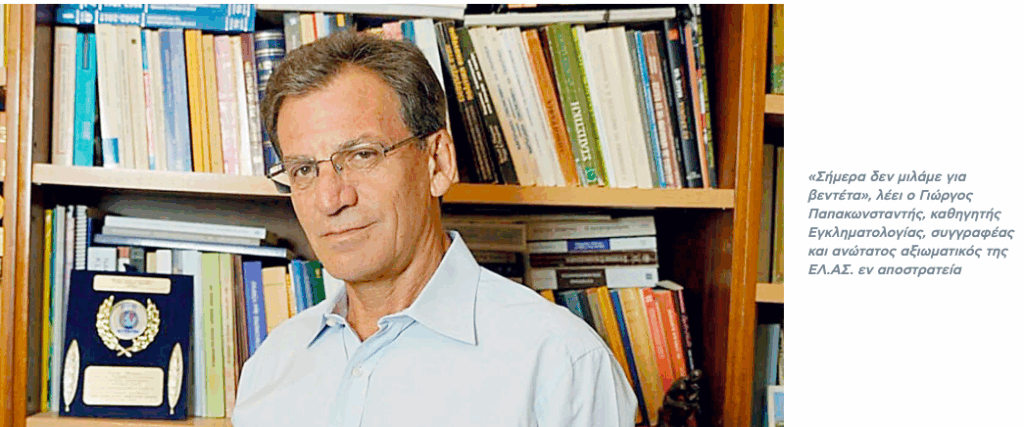
“We are not talking about a vendetta,” says Giorgos Papakonstantis, professor of Criminology, author, and retired senior officer of the Hellenic Police. He adds that the term that best describes the recent events, which resulted in two deaths, one from each family, is “conflict violence.”
It is clear from testimonies and descriptions that the Kargakis and Fragkiadakis families have had bad relations for years — something that can happen between families anywhere, not exclusively in Crete. The tension between the families escalated over the sale of a house, ultimately resulting in crime.
Anywhere else, we would speak of settling scores; however, as Mr. Papakonstantis points out, two particularities stand out in this case: these are not groups of opposing individuals but family members, something common in Crete, and simultaneously, there is possession and use of firearms, also common on the island. “There is no active vendetta. The last was between the Sartzetakis and the Pentaris families; the rest belong to myths surrounding tradition, which have now reached the point of illegality.”
According to vendetta rules, the killer knows at that very moment that they will be the next victim. It is characteristic that during vendettas, not only the victim’s mother would mourn but also the murderer’s mother, knowing her child would be next. The target was the “flower” of each family.
“Today we are not talking about vendettas,” says Giorgos Papakonstantis.
“Unsubmissive”
In the mountainous villages of Crete, where even faded customs and traditions remain, there is a lingering atmosphere that men must display toughness and stubbornness: to be “captains,” something rooted in the island’s history of resisting successive invaders and conquerors. However, this show of toughness nowadays takes the form of drinking alcohol and owning expensive and fast cars, even if these are only used to drive to the nearest town for shopping, not for travel or pleasure, but for show.
At the same time, gun possession, which completes the image, is considered “men’s business.” “In reality, we are not talking about all of Crete but specific mountainous villages with a population not exceeding 15,000–20,000 out of the island’s total 620,000,” Mr. Papakonstantis emphasizes.
Mountain villages like Vorizia, Zoniana, and those of Mylopotamos are closed communities with large families, usually having many children. Despite the acknowledgment that Crete is essentially a matriarchal society, women remain limited. The heavy Cretan accent of women from the Kargakis and Fragkiadakis families, who spoke publicly in recent days, shows they have little contact with society outside their villages.
“The question is how much influence women or mothers can have on the men or sons in these villages,” Mr. Papakonstantis says, emphasizing that “in the dark side of Crete,” women can hardly even go to the cafés unaccompanied. In the micro-societies of mountainous, often very isolated villages, the concept of sogi (kinship), the family, is the foundation, and its reinforcement in any way is a priority: godparents and in-law relations form networks of influence, but the question is how these are used. The family may simply strengthen socially or increase its economic power, but it can — and this has been found in many cases — function as a criminal network. Kinship ties build trust, an important factor for those acting outside the law.
Zoniana, 2007
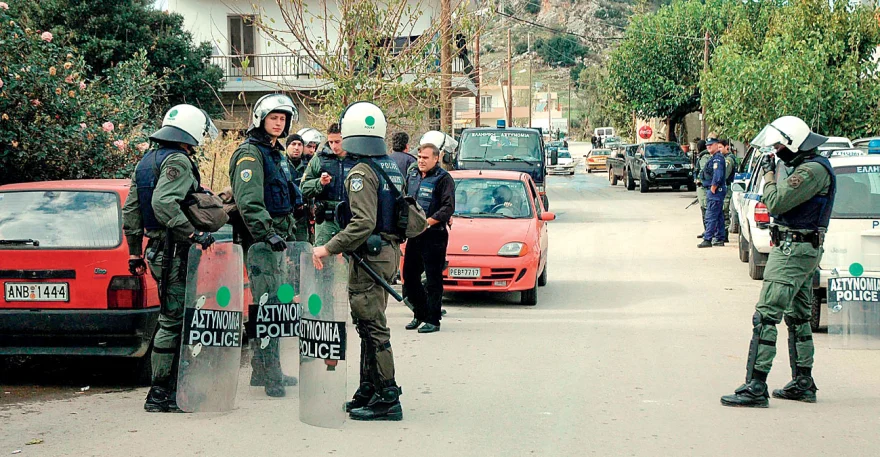
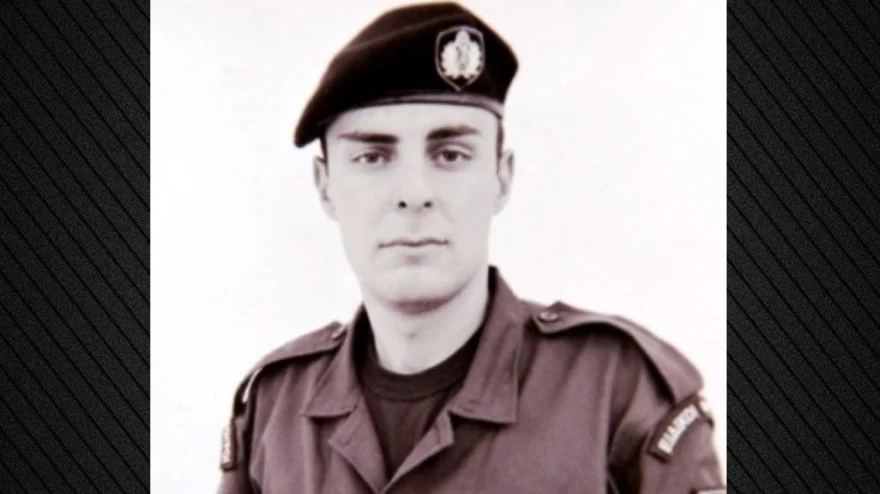
In the violent police intervention in Zoniana in 2007, when officer Stathis Lazaridis was killed, the families acted as criminal networks to block the police entry, later to remove weapons, and “clean” the village of incriminating evidence before a new, reinforced police operation. The village awaited the police operation, since two cousins had been arrested for drugs, and the families welcomed the police convoy of 14 jeeps with Kalashnikovs.

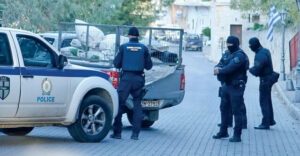
Similarly, last week in Vorizia, families rushed to hide the weapons used in the deadly clash: the police searched with metal detectors even in cemeteries. According to Mr. Papakonstantis, who had left the police years ago but had organized and participated in operations in Crete’s mountain villages, “things are better now than 20–30 years ago.” Then, most children dropped out of school almost immediately after elementary school, something no longer recorded.
The Toughness
Among factors enhancing criminal behavior, he includes the fact that closed societies retain pre-modern elements. He also notes that secured income, either from subsidies or illegal activities (like cannabis cultivation, now significantly reduced), has created entire generations of idlers, especially in areas where most families are large. “With a distorted mindset, prestige within the family and community comes from toughness. They even take pride in having been to prison, while rivalries between families escalate.”
The criminologist stresses that even in villages showing family-type criminality, such behaviors do not concern the entire population. However, he admits it is very hard for law-abiding citizens to react even when they suffer consequences of increased crime, both from lawbreakers and the law itself…
“Even the police unintentionally push citizens’ feelings toward the offenders,” he says, explaining: “For example, police operations usually involve general roadblocks, and everyone is treated the same. Imagine a law-abiding citizen being checked by armed police as a high-risk suspect, even in front of their child. Such behavior causes friction with the police. Yet, Crete is the most heavily policed region in all of Greece. What is missing is information, not roadblocks or general operations. An information network leading to targeted action can bring results.”
The Term by Vasilis Skoulas
Mr. Papakonstantis does not overlook the role of some social groups in shaping and often reinforcing behaviors leading to crime. For example, some artists, like Vasilis Skoulas, require that no weapons be used and refuse to perform at festivals where they are present. Skoulas was shot by gunfire years ago while performing.
“However, there are others whose behavior contributes to the problem, encouraging gunfire and basing their musical success on songs about guns and misguided notions of manliness.” Another example is the Church’s stance on essentially forced baptisms: “Baptizing a child to follow the parent’s funeral is based on a 19th-century, outdated belief. What is the Church’s role when it accepts such forced rites?” he wonders.
Can stricter penalties solve the problem? For Mr. Papakonstantis, who has faced the issue both as a criminologist and as an active law enforcement officer, the immediate need is modernization and flexibility in legislation: “Making gun ownership stricter and more demanding with many documents is ineffective and deterrent — guns will remain illegal. Also, not all guns can be treated the same: a Kalashnikov is different from a World War I or II military gun that is a family heirloom. Importantly, the police must enhance information flow and use modern tools to map who is doing what, to avoid acting indiscriminately.”
Ask me anything
Explore related questions




