Those who managed to benefit from cheap, duty-free shopping packages from China, Turkey, or other countries are about to lose that privilege. Starting in early 2026, the customs-exemption regime for small parcels comes to an end. Along with it, the “era of miracles” in Europe — ultra-cheap purchases from online platforms like Temu and Shein — also seems to be ending. Beginning next year, comprehensive customs checks will start, and all orders that previously passed through “duty-free” will now be subject to tariffs.
This change is expected to increase the final cost for Greek consumers by 15% to over 50%, overturning the landscape for online purchases from non-EU countries and creating a fairer competitive environment for European businesses.
The milestone agreement was announced at the Ecofin Council on November 13 and accelerates the abolition of the 150-euro minimum threshold for imposing tariffs on small parcels from non-EU countries. It closes the loophole for cheap online purchases that have flooded Greece and Europe. The longstanding regime is being abolished with the aim of transparency, consumer protection, and fairer competition for the market and businesses.
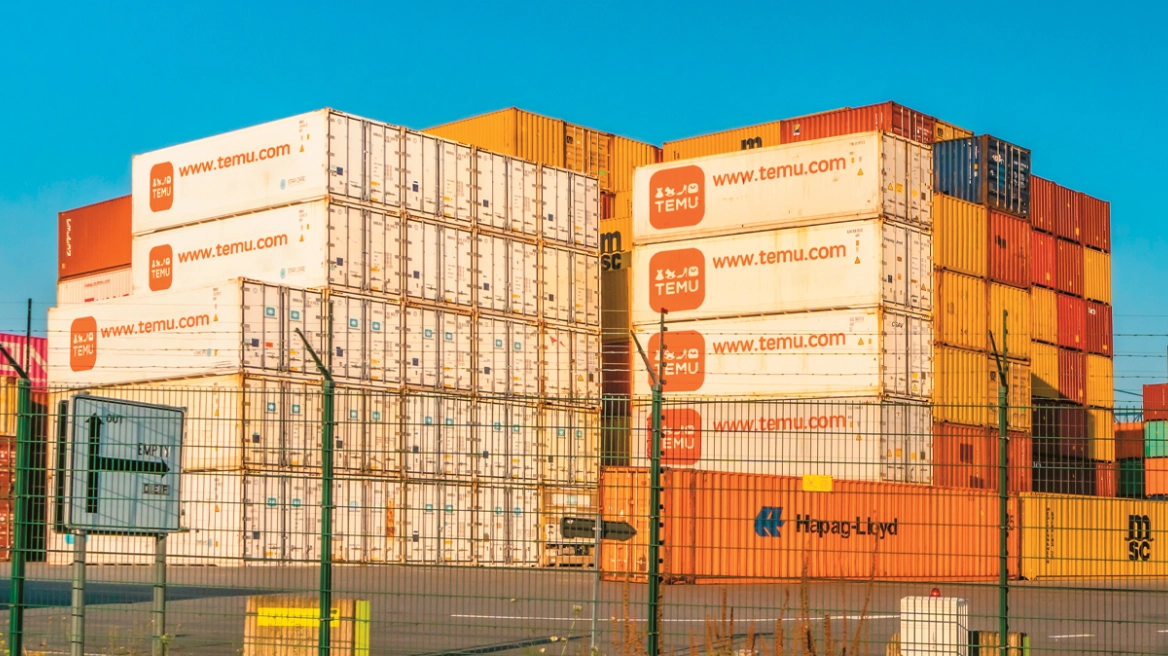
Thus, from spring 2026, orders from online platforms outside the EU (Temu, Shein, AliExpress, Banggood, Trendyol, etc.) will become less attractive — if not unprofitable — for European consumers, since customs duties and fees will be imposed even on low-value parcels imported from China or other third countries.
In fact, especially for very low-value parcels, as “THEMA” revealed already last spring, the combination of tariffs and handling fees may turn out to be even more burdensome than expected, with final costs rising by more than 50% even if the products come with free shipping. In any case, the final details and conditions of the charges planned to be imposed will be clarified in less than a month, at the next meeting of Finance Ministers on December 12.
The political background
The initial European Commission plan envisioned that the “big decisions” on e-commerce platforms from China and other third countries would be taken in one to two years. However, a major shift came due to initiatives by Greece and France, which led and pushed for a faster implementation.
Sources in Brussels told “THEMA” that just one day before last Thursday’s Ecofin, the Commissioner for Trade and Economic Security, Maroš Šefčovič, raised the stakes by sending a letter to EU finance ministers, proposing that tariffs be imposed immediately on purchases and parcels worth under 150 euros — earlier than the original target of 2028.
As a result, the Greek Minister of National Economy and Finance, Kyriakos Pierrakakis, arriving at Ecofin, expressed clear satisfaction, stating that “Greece fully supports the Commission’s proposal to abolish the 150-euro minimum amount,” aligning fully with France’s position, which had already taken similar action. He called for accelerating the measure and applying it EU-wide starting in early 2026, instead of up to 2028. Not coincidentally, in the U.S. this past September, a decree by President Trump abolished the 800-dollar exemption threshold for all imports.
What changes in 2026
With the new conditions already emerging for millions of Greek and European consumers, the landscape of duty-free shopping from China changes dramatically.
Specifically:
1. Tariffs from the first euro.
With the new European Commission proposal approved by Ecofin, the exemption for purchases up to 150 euros will be abolished in 2026. This means that every parcel from a third country may be subject to a tariff, depending on the product category according to TARIC (the EU customs tariff schedule).
Currently, parcels valued below 150 euros are not subject to tariffs and pass through customs without any charges, even if they come from non-EU countries.
The only obligation recently imposed on purchases from platforms selling outside the EU is that the buyer must pay the VAT applicable in their own country — but not at customs. It is paid directly at checkout through the IOSS system, so the VAT is prepaid and not lost by the country. However, in practice, many platforms misapply this, sometimes charging a lower VAT rate (e.g., 6% instead of 24%).
2. Additional 2-euro handling fee
Beyond tariffs, a unified processing fee per package is being planned to cover customs or carrier handling. As “THEMA” revealed months ago, the Commission’s plan estimated this fee at around 2 euros per parcel, though the final amount is not yet decided.
Examples
Based on the EU tariff schedule and actual customs clearance fees, abolishing the 150-euro de minimis exemption is expected to increase the final cost of a typical low-value product (10–20 euros) by 15%–35%.
For products with higher tariffs (clothing, accessories) or where higher handling fees apply, increases may reach 40%–50%.
Example 1 — Kitchen items worth ~10 euros:
Today: only VAT is charged at checkout; no tariff; final cost about 12 euros.
After abolition: tariff (e.g., 6.5% on some plastic kitchen items) + handling fee 2–5 euros → final cost 15–16 euros (20%–25% increase).
Example 2 — Clothing with high tariffs:
Clothing tariff: 12%
Increase may reach 35%–45%.
Shoes: tariffs up to 17%, increasing final cost even more.
Consumers will increasingly see clearer checkout prices as platforms adopt “all-in” payment systems. Otherwise, consumers may face multiple charges if platforms continue splitting orders into multiple parcels.
Stricter measures coming in 2028
These measures are only temporary. In 2028, things get tougher with a new electronic platform acting as a one-stop shop for importers — and as a filter for products. It will identify each importer/seller, calculate and collect taxes, and verify whether products comply with EU environmental and safety standards (ISO, CE, etc.).
Low-quality or non-compliant products — currently flooding the market at extremely low prices — will be blocked entirely before even entering the EU. Alternatively, they may be allowed only with additional “green taxes” to offset pollution or non-sustainable materials.
A “survival victory” for retailers
This development will give a lifeline to Greek retailers who have long struggled to compete with the influx of Chinese products via the internet. The president of the Hellenic Confederation of Commerce and Entrepreneurship (ESEE), Stavros Kafounis, stated that this is “a clear vindication of ESEE’s systematic efforts,” noting that the current regime has created serious distortions to healthy competition.
According to market representatives, the current volume of small shipments from platforms like Temu, Shein, and Trendyol has created distortions that the existing framework cannot manage: systematic undervaluation of declared prices, tariff avoidance due to the de minimis rule, shipments of questionable-spec products, aggressive pricing tactics, and misleading “free shipping” strategies.
In Greece, according to ESEE’s data, the two Chinese platforms absorbed 529–627 million euros in turnover in 2024 (17.6%–20.9% of domestic e-commerce), with an estimated fiscal loss of 188–204 million euros.
These developments directly affect consumer behavior — especially in times of high living costs, when cheap online purchases were a lifeline. Meanwhile, Chinese platforms have launched an advertising barrage on Europeans’ mobile phones to avoid losing ground, as their sales will soon become uncompetitive.
Ask me anything
Explore related questions