





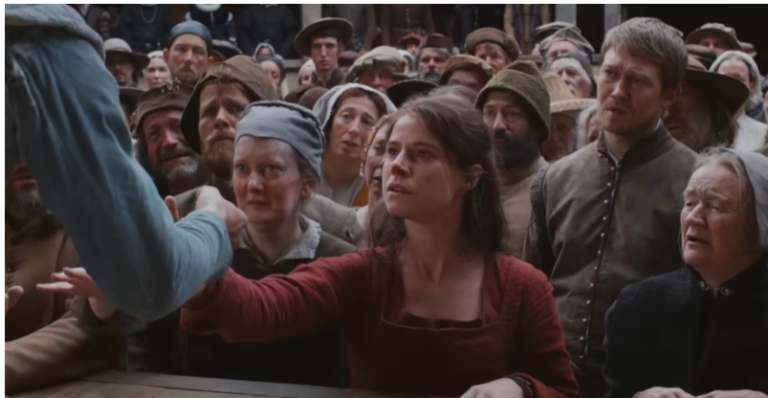
The story behind the new and already widely discussed film Hamnet seeks to illuminate one of the darkest and least known aspects of William Shakespeare’s life: his family life and the “emotionally devastating” grief he experienced after the death of his son.
The film, based on the novel of the same name by Maggie O’Farrell, builds a moving fictional narrative around sparse and fragmented historical facts.
In the film, Shakespeare’s wife, Agnes—an alternative version of Anne Hathaway’s name that O’Farrell draws from her father’s will—is portrayed as a woman deeply connected to nature, knowledgeable about herbs and medicinal remedies, and possessing an almost prophetic intuition, the BBC notes.
Although this depiction is not supported by historical sources, both the author and director Chloé Zhao use fiction to speak about the force of maternal loss and the ways in which that loss may have shaped the work of the greatest playwright of all time.
The little we know — and the vast gaps
Historical information about Shakespeare’s family is extremely limited.
We know that in 1582, an 18-year-old Shakespeare married the 26-year-old Anne Hathaway, who was already pregnant with their daughter Susanna. A few years later, the twins Judith and Hamnet were born. At the time, the names Hamnet and Hamlet were interchangeable.
In 1596, Hamnet died at the age of 11—most likely from the plague that ravaged England. Shakespeare was traveling with his troupe at the time and is considered almost certainly to have missed the funeral. A few years later, he wrote Hamlet. The connection between the tragedy and his personal loss has long been the subject of scholarly debate, though no definitive evidence exists.
Who Anne/Agnes truly was remains a mystery. O’Farrell chooses to give her a voice, drawing on clues about the lives of women in the 16th century—women who often ran small businesses, had knowledge of medicinal plants, and managed households in ways that required skill and real autonomy.
Restoring an overlooked figure
For centuries, Shakespeare’s wife has often been portrayed by biographers as an “illiterate peasant” or even as a woman who “trapped” him into marriage. O’Farrell argues that this image is unsupported by historical evidence and that the limited available data has been distorted by prejudice. “We only have one version of the story, and it rests on very little information,” she notes.
Experts interviewed by the BBC acknowledge that the film acts as a counterweight to this long-standing dismissal. Zhao’s Agnes, portrayed by Jessie Buckley, appears as a woman with a strong personality—cultivated, perceptive, and full of presence. Her characterization offers a plausible understanding of why Shakespeare may have loved her.
The connection to Hamlet
The relationship between Hamnet’s death and the writing of Hamlet remains speculative.
However, the film adopts an emotionally driven interpretation: Agnes travels to London to see the play and realizes that the actor portraying Hamlet bears a striking resemblance to her late son—a detail that becomes, within the film, a form of redemption and farewell.
According to scholar David Scott Kastan, it is “tempting, perhaps irresistible” to link the two events, even without direct proof. The loss of a child in an era of extremely high child mortality was always “crushing” for families—especially for a writer who so often depicted human suffering.
A film that may reshape Anne Hathaway’s legacy
Despite the historical uncertainties, Hamnet seems poised to significantly influence public perception of Shakespeare’s wife.
Many scholars believe the film will popularize the name Agnes as the more fitting version of her identity—even though future discoveries could overturn this interpretation as well.
As O’Farrell notes: “Perhaps something new will be found, and we will have to change what we believe once again. Who knows?”
Ask me anything
Explore related questions




