





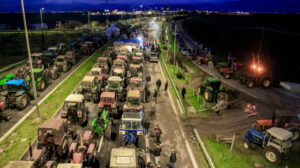
The Greek government is holding a series of meetings to formulate a comprehensive package for negotiations with farmers’ unions, who are intensifying their protests across Greece. The most affected regions include Crete and Thessaly, where the demonstrations have seen extreme incidents, including injured police officers, long flight delays due to airport occupations in Chania and Heraklion, and plans to block the port of Volos.
According to government sources, the administration will not negotiate local issues but will insist on finding national solutions for the agricultural sector’s challenges. Prime Minister Kyriakos Mitsotakis has emphasized the need for a coordinated and specific representation of farmers with clear demands.
On their side, the farmers are preparing a nationwide committee to take charge of negotiations at a national meeting in Nikaia, scheduled for Saturday. They also plan to escalate pressure on the government through activist measures, including the blockade of ports, airports, and major highways in the coming days.
Next week is considered critical for reaching a compromise that could end the blockades, as the holiday season approaches, with thousands expected to travel across Greece.
Government Commitments and Current Challenges
The government has committed to disbursing delayed agricultural subsidies, which were held up due to ongoing checks on thousands of farmers’ tax IDs for past issues and technical changes at OPEKEPE, the Greek agricultural payments agency. These technical adjustments have temporarily excluded many farmers from subsidies, fueling ongoing tension at the blockades.
Negotiations reportedly include discussions on the cost of agricultural production, a key issue for farmers. Energy costs for crops have been set at €0.092 per kWh, slightly above production costs. Farmers are demanding a reduction to €0.07 per kWh, though they have indicated willingness to compromise at €0.08 per kWh. However, this is still considered unfeasible, as the average production cost is around €0.09 per kWh.
Discussions also cover agricultural diesel subsidies, as unions seek higher reimbursement amounts, though increases are considered unlikely.
Another major concern for farmers is low producer prices for certain crops, such as durum wheat, which is currently at €7 per stremma. Farmers are requesting minimum guaranteed prices, but the government views this as an unrealistic demand.
Ask me anything
Explore related questions




