





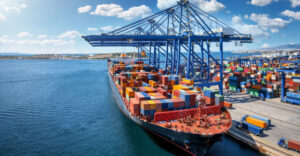
Five tons of cocaine, worth hundreds of millions of euros, were hidden in the cargo holds of a vessel owned by the arrested Alexandros Angelopoulos, who earned the nickname “the Greek Escobar.” The shipowner is accused of setting up a massive drug trafficking and money laundering network with proceeds exceeding €100 million, though he denies the charges.
For drug cartels, trafficking narcotics via chartered or privately owned ships, aircraft, and other vessels is now considered almost… mainstream—hardly imaginative enough. In order to evade law enforcement radar, cartel members invent increasingly extreme and inventive ways to move massive quantities of cocaine, primarily to transport it from the Americas across the Atlantic to Europe.
Drones, submarines and submersibles—semi-submerged vessels that travel with their roofs barely above the waterline to avoid detection—giant rockets strapped to passenger ships, massive magnetic “suitcases” attached to the hulls of commercial vessels whose crews are unaware of what they are carrying, detachable cargo retrieved by divers, livestock ships where sniffer dogs cannot detect drugs amid tons of manure, timber shipments with logs packed full of cocaine, and even chemical methods that render the drug “invisible.” Authorities often refer to these as “creative concealment methods.” Sometimes, reality surpasses fiction.
Cocaine has been found inside tuna cans, tree trunks, and chemically embedded into fabrics that are later “washed” in laboratories. If the consequences weren’t so tragic, one might almost laugh at the ingenuity.
Along the Maritime Highways
More than 80% of the cocaine reaching Europe travels by sea—not out of romance, but practicality. The Atlantic is vast, ships are countless, and containers are innumerable. Major European ports such as Rotterdam, Antwerp, and Hamburg handle tens of millions of containers each year. Inspecting them all is simply impossible.
Latin American cartels—mainly Colombian and Mexican—know this well. They use commercial cargo ships, freighters, and even livestock carriers. Drugs are hidden inside legitimate cargo: bananas, coffee, cocoa, frozen meat. The technique has a name: “rip-on, rip-off.” A container is loaded with legal goods, secretly opened at a Latin American port, cocaine is added, and the container is resealed. In Europe, collaborators inside ports remove the drugs before authorities detect them.
The quantities are staggering. A single container can hide anywhere from 200 to 1,000 kilograms of cocaine. With European wholesale prices reaching tens of thousands of euros per kilo, a single shipment can be worth hundreds of millions.
Air Transport: Small Loads, High Speed
Air transport is not the primary option for large quantities, but it still plays a role. Private jets, small aircraft, and commercial flights using “mules.” One person may carry only a few kilos on their body or in luggage, but repeated hundreds of times, the numbers add up.
Private aircraft depart from remote Latin American airstrips and land at equally discreet locations in Europe or North Africa. It’s an expensive method, but for certain cartels—especially Mexican ones—the speed justifies the cost.
Narco-Ships and Floating Contraptions
When large vessels become risky, cartels downsize. Semi-submersible vessels, known as narco-subs, are among the most striking examples. Built crudely in Colombian jungles, low in the water with minimal radar signatures, they can carry 3 to 5 tons of cocaine per trip.
They are not true submarines in the naval sense, but floating contraptions—often dangerous for their own crews. If detected, they are usually deliberately sunk to destroy evidence. The sailors are arrested, the cartels lose the cargo—but not the game.
They are difficult to detect, often traveling far from standard shipping routes, sometimes handing off cargo in Mexico’s Exclusive Economic Zone or, more rarely, attempting the full journey to Europe at great risk. Some can carry up to 7 tons, have significant autonomy, and are cheap enough for cartels to build by the hundreds and discard once used.
Livestock Ships: Cocaine with… Mooing
Ships transporting live animals have recently become a favorite canvas for cartels. Open decks, intense odors, and limited inspections—since animal welfare takes priority—make them ideal. Inspectors are often reluctant to spend time amid tons of manure and unbearable smells.
That’s where cocaine fits: in ventilation ducts, double floors, water tanks. Animals travel from Latin America to the Mediterranean and Northern Europe, with intermediate stops that obscure traceability. A single vessel can conceal hundreds of kilos without attracting attention. The irony is brutal: the most “innocent” cargo becomes the dirtiest cover.
Jungle Shipyards: Narco-Subs Are Real
Semi-submersibles aren’t a Netflix myth. They are products of makeshift engineering, built in illegal jungle shipyards. Low profile, minimal heat signature, crews of 3–5. They move 3–5 tons per trip, avoiding main sea routes. When detected, they sink. Losses are calculated—for cartels, not crews.
“Parasite Vessels”: Cargo That Clings
Small boats or capsule-like containers are attached externally to large commercial ships below the waterline. The ship’s crew is unaware. The cargo is attached in an American port and detached by divers at a European anchorage. The method exploits the lack of mandatory underwater inspections and port time pressure. Low cost, low risk, high reward.
Yachts and Jet-Set Boats: Luxury as Camouflage
Luxury vessels don’t raise suspicion. Tourist routes, marinas, flags of convenience. Under seats, inside double walls, fuel tanks—hundreds of kilos can be hidden. Often departing from West Africa and ending in the Mediterranean. The crew looks like vacationers but operates with military discipline. Luxury isn’t show—it’s a shield.
Containers and “Rip-On, Rip-Off”: The Classic That Endures
Legal cargo, illegal addition. Cocaine is placed in containers without the shipper’s or receiver’s knowledge. In Europe, cartel insiders retrieve it. The system survives because of sheer volume: millions of containers, few inspections. One box can hold up to 1,000 kilos. Industrial-scale smuggling.
Air Routes Again: Jets and Mules
Air transport favors speed over volume. Private jets connect isolated airstrips to small European hubs. Meanwhile, human mules steadily move kilos on bodies and in luggage. Drop by drop, the flow continues.
Chemical Concealment: Cocaine You Can’t See
Cocaine is dissolved, absorbed, chemically bonded to fabrics, paper, or plastics. In Europe, laboratories extract it back into pure form. Scanners and dogs detect products—not drugs. It’s technical, demanding expertise, but highly effective.
Fishing Vessels
Primarily tuna and shrimp fishing boats are used to transport cocaine and marijuana and provide logistical support to smuggling vessels.
The Cartels and the Players
At the top are Colombian production networks and Mexican distribution cartels. Sinaloa and Jalisco New Generation are among the dominant players. They may not grow the cocaine themselves, but they control routes, transport, and distribution.
Europe’s landscape is more fragmented. Dutch, Belgian, Italian, and Balkan criminal networks cooperate with Latin American cartels. There is no single “European cartel”—just a marketplace of partnerships.
Estimates vary, but international organizations agree on one thing: Europe is consuming more cocaine than ever. Hundreds of tons enter each year. Record seizures paradoxically coincide with increased availability—like trying to empty the sea with a bucket.
Ask me anything
Explore related questions




