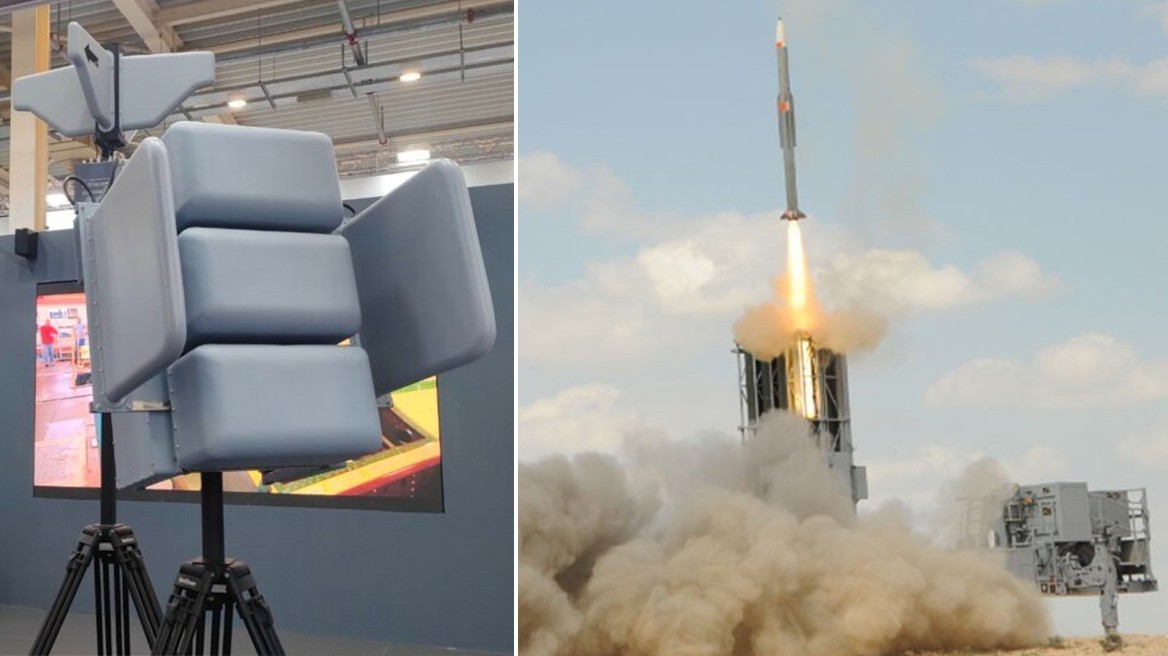
A new era that could bring a “cohesive” air defense is taking shape for Greece, following the successful completion—according to reliable information from newmoney.gr—of the integration of the Greek anti-drone system Kentavros into the advanced air and missile defense system BARAK-MX, after months of cooperation between Israel Aerospace Industries (IAI) and the Hellenic Aerospace Industry (HAI).
It is recalled that IAI and HAI signed a Memorandum of Cooperation several months ago. The partnership was further expanded last spring during the DEFEA defense exhibition, when a Memorandum of Understanding (MoU) was also signed with the Israeli company ELTA Systems, a subsidiary of IAI, for the co-production of Blue Whale, an autonomous underwater system that can enhance Greece’s capabilities in anti-submarine warfare.
It is noted that Kentavros has already been decided to be integrated into all four new Belharra frigates, while it is already being installed on MEKO frigates.
The backbone of the Greek Shield and the “Shield of Achilles”
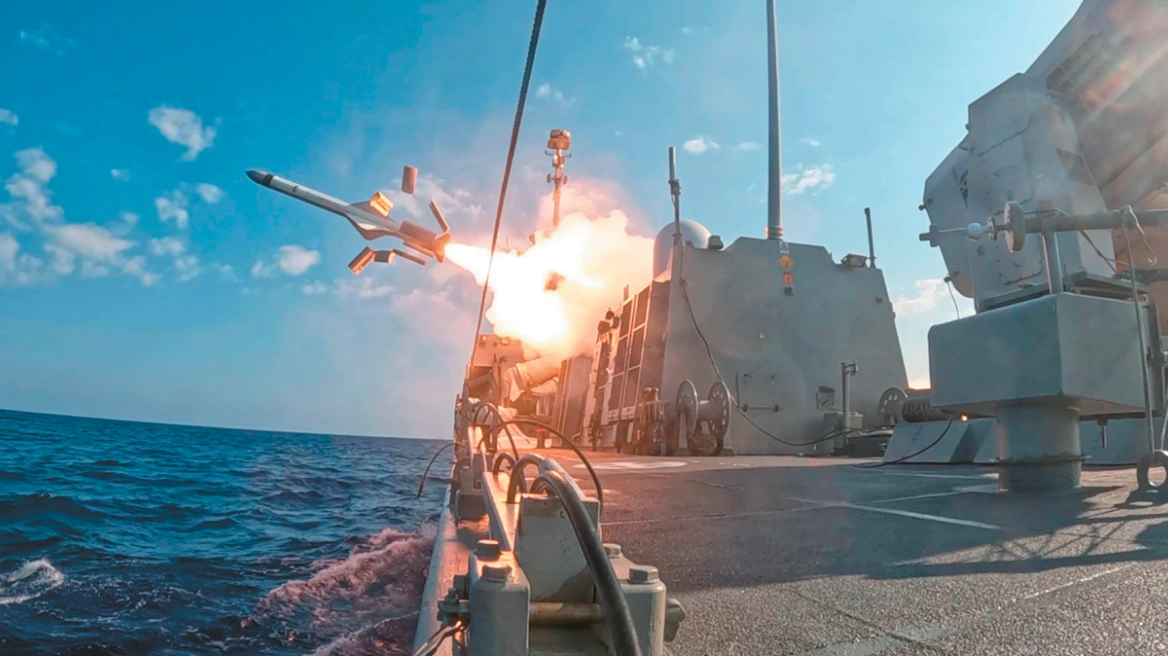
At the same time, IAI’s BARAK-MX air and missile defense system—expected to form the backbone of the Greek Shield under the name “Shield of Achilles”—is at the center of negotiations between the Greek side and Israeli companies, and is estimated to be the next major armaments program of the Armed Forces to move forward in the immediate future.
The integration of the Greek anti-drone system into the Israeli system takes on particular significance at a time when the aerial threat environment is changing at unprecedented speed.
As seen in recent conflicts, high-speed ballistic missiles, hypersonic weapons, as well as swarms of small UAVs and low-observable loitering munitions create an extremely complex operational landscape. For national air defenses, the challenge is no longer only interception, but the rational management of resources, costs, and operational priorities through multilayered and fully integrated solutions.
Hard-kill and soft-kill in a single operational system
In this context, combining BARAK-MX with Kentavros leads to the creation of a comprehensive, multilayered, and cost-effective air-defense “umbrella.” Greece will be able to address the full spectrum of aerial threats—from low-cost small drones to advanced tactical ballistic missiles—through a single operational system.
According to knowledgeable sources, integrating Kentavros into BARAK-MX is not a simple technical interface. It is the result of months of intensive cooperation among engineers, analysts, and operational personnel from both sides, who worked together so that the systems operate under a common command-and-control architecture. This partnership reflects a shared philosophy: developing sovereign, future-ready capabilities with a strong Greek industrial footprint.
BARAK-MX and multilayered defense architecture
BARAK-MX is among the most widely recognized and operationally proven air-defense systems internationally, deployable both on land and at sea, and was recently acquired by Cyprus as well.
Its architecture is based on multilayered defense, with a family of interceptors of different ranges: short-range up to 15 km, medium-range up to 35 km, long-range up to 70 km, and extended range up to 150 km, with advanced capabilities against complex ballistic threats. At the same time, it integrates gun solutions for VSHORAD missions and full sensor integration, providing a shared real-time air picture.
However, the modern asymmetric threat has highlighted a critical operational dilemma: using expensive missile interceptors against cheap and numerous UAVs is not always viable, either operationally or economically. This is where the role of the Greek Kentavros system becomes pivotal.
How Kentavros will work with BARAK
Kentavros is an advanced soft-kill effector that employs electronic warfare techniques to disrupt and disable UAV communication and navigation links. The system has already proven its effectiveness in real operational conditions, as it has been installed on the Hellenic Navy’s MEKO frigates, confirming that it can neutralize threats without kinetic engagement.
According to information, a recent technical demonstration held at HAI facilities successfully showcased the interoperability of the two systems.
The high-resolution radar of BARAK-MX detects the threat at long distances; the command-and-control system classifies it and decides on the method of engagement; and Kentavros is activated as a fully integrated effector, receiving commands directly from BARAK’s command center. Thus, hard-kill and soft-kill options are combined under centralized control, depending on the type of threat and operational priorities.
This architecture significantly strengthens Greece’s national effort to build the “Shield of Achilles,” offering strategic depth and flexibility. The use of soft-kill means against low-cost threats preserves missile interceptors for high-value targets, creating clear operational and fiscal benefits.
Beyond the purely military aspect, the IAI–HAI cooperation is also particularly significant at the industrial level, as it aligns with national policy for substantial participation of the domestic defense industry in major programs and opens export prospects.
This partnership could serve as a reference point for how allied defense industries can jointly develop competitive, exportable, and operationally superior solutions, with a clear strategic and industrial footprint for Greece—something also confirmed at the recent meeting of the Greek and Israeli Ministers of Defense, where further expansion of cooperation was agreed.
Ask me anything
Explore related questions