





The United States, Ukraine, and Russia rarely agree on anything. Yet as their delegations meet in Abu Dhabi — the first trilateral talks since Russia’s invasion of Ukraine in February 2022 — they appear to converge on one conclusion: only one issue remains unresolved, and it is decisive. Territory — specifically, eastern Ukraine’s Donbas region.
Statements ahead of the meeting leave little room for optimism. “Everything revolves around the eastern part of our country, around the land,” Ukrainian President Volodymyr Zelensky said, referring to Moscow’s long-standing demand that Kyiv relinquish the parts of Donbas it still controls.
While U.S. President Donald Trump has suggested that a deal may be within reach, Zelensky reiterated that Ukraine is not prepared to cede territory. At the same time, from the Russian side, Kremlin adviser Yuri Ushakov made clear — following his meeting with U.S. special envoy Steve Witkoff — that Moscow also has no intention of backing down. He warned that there can be no long-term settlement “without resolving the territorial issue,” repeating Russia’s position that it will continue pursuing its objectives “on the battlefield” until an agreement is reached.
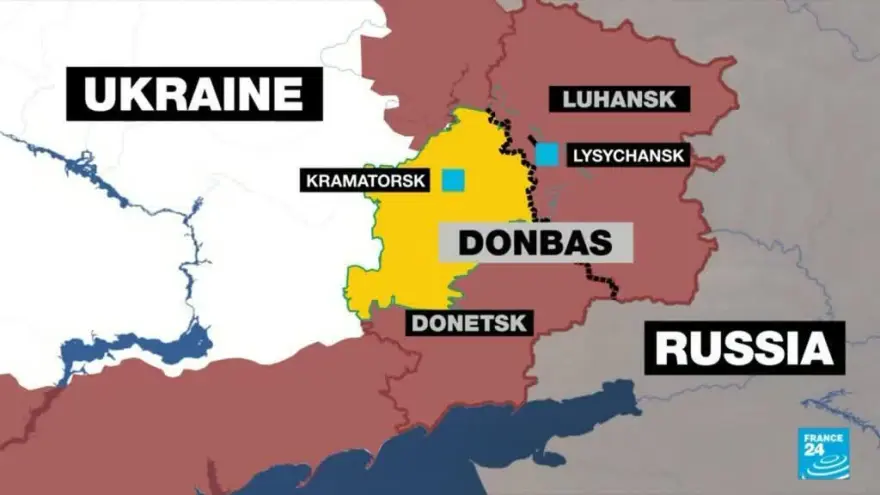
What is Donbas?
CNN has sought to explain what Donbas is and why Russia wants it — likening Putin’s interest in the region to Donald Trump’s fixation on Greenland.
Donbas refers to two coal-rich eastern Ukrainian regions, Donetsk and Luhansk, which once formed the industrial heartland of Ukraine. The area has long been a hub of steel production, transport infrastructure, and industrial activity, with access to the Sea of Azov through rivers and artificial canals.
In addition, Donbas includes fertile agricultural land and significant mineral resources, further enhancing its economic and strategic importance.
Why Putin wants Donbas
Russian President Vladimir Putin has repeatedly argued that Ukraine has no legitimate right to exist as an independent state, challenging its sovereignty since gaining independence in 1991 after the collapse of the Soviet Union. He has consistently claimed that Russians and Ukrainians belong to a single “historical Russia” and has accused Kyiv — without evidence — of committing “genocide” against Russian-speaking populations.
Historically, Donbas has been Ukraine’s most “Russian” region, with a large Russian-speaking population. It was there, in 2014, that Moscow’s efforts to destabilize and control Ukraine first took root.
How the conflict began
Twelve years ago, Russia illegally annexed Ukraine’s southern peninsula of Crimea following a covert military operation involving highly trained Russian troops without insignia. At the same time, Moscow began supporting pro-Russian separatists in Donbas, helping them seize parts of the Donetsk and Luhansk regions, including their regional capitals, exploiting the weakness of the Ukrainian military at the time.
For years, Russia denied having troops on the ground, but the United States, NATO, and Ukrainian authorities maintained that Moscow provided weapons, intelligence, advisory support, and Russian officers to separatist forces. For nearly eight years, the war in Donbas remained largely under the radar, despite approximately 14,000 deaths, according to Ukrainian figures.
In February 2022, Putin formally recognized the self-proclaimed “People’s Republics” of Donetsk and Luhansk and launched a full-scale invasion of Ukraine three days later.
The military situation today
After nearly four years of war — and despite Russia’s numerical and logistical advantages — Moscow has failed to fully seize Donbas. Russian forces control almost all of the Luhansk region and roughly 70% of Donetsk.
The remaining territory, which Russia demands Ukraine hand over, is largely under Kyiv’s control, while a third of it remains an active combat zone. According to the Institute for the Study of War, at the current pace of advance, Russia would need at least another 18 months to capture the remaining Ukrainian-held areas.
What losing Donbas would mean
Zelensky insists that permanent territorial concessions are non-negotiable. Even if there were popular support — which opinion polls do not indicate — such an agreement would violate international law, which prohibits the acquisition of territory by force.
With European backing, Ukraine has left open the possibility of acknowledging the current frontline realities as part of a ceasefire agreement to stop the bloodshed — effectively freezing the conflict along existing lines.
However, the permanent loss of Donbas would severely weaken Ukraine’s defenses. The region hosts a so-called “defensive belt” of industrial cities, rail networks, and road corridors that support the front line. Losing it would leave eastern Ukraine exposed to future Russian offensives.
Proposals and life under occupation
Details of the latest proposal have not been made public. Zelensky has said that a U.S. idea included the creation of a “free economic zone” in the Kyiv-controlled parts of Donbas in exchange for security guarantees. It remains unclear whether Russia would accept such a scenario.
Meanwhile, international human rights organizations, Ukrainian authorities, and media outlets continue to document serious abuses in Russian-occupied areas: arbitrary arrests, enforced disappearances, torture, sexual violence, and the complete suppression of political freedoms. A UN report last November stated that Russian occupation authorities continue to violate fundamental provisions of international humanitarian law.
Residents who have managed to flee speak of forced acceptance of Russian passports, ideological indoctrination of children, and harsh punishment for any form of resistance.
Ask me anything
Explore related questions




