





Closing underused access points, drone overflights to detect immobilized vehicles, diverting trucks to the old national road, and reserving the left lane for cars carrying more than two passengers during peak hours are among the proposals being examined by the government to relieve congestion on what is often described as the “river of suffering”: Kifisos Avenue, the busiest road axis in Athens.
Following a high-level meeting last Wednesday at the Prime Minister’s office on traffic congestion in Attica, Kifisos was placed firmly at the center of the discussion. Not by chance: traffic experts agree that congestion in Athens is expected to worsen, and that the epicenter of daily driver hardship has been, is, and will continue to be Kifisos.
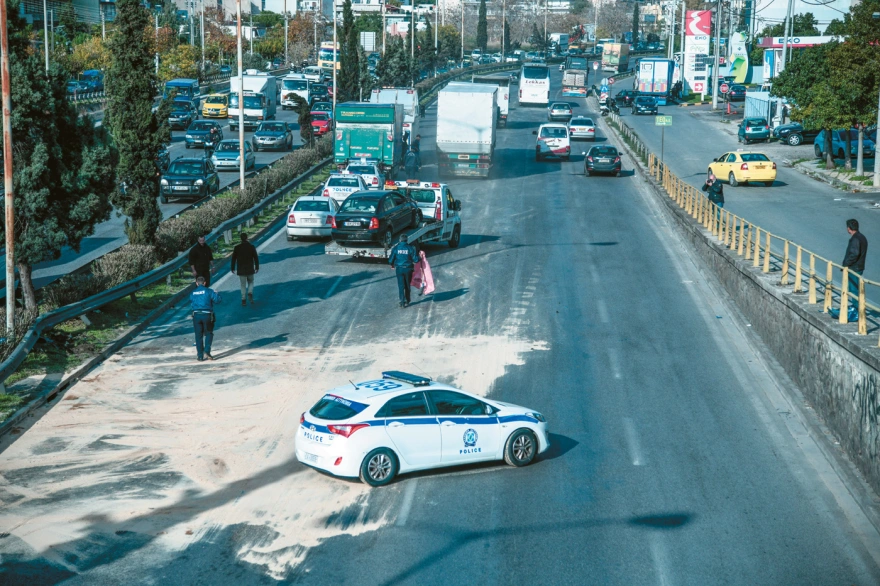
Older residents may remember flooding as the avenue’s biggest problem, when the river would overflow during heavy rain. Today, however, the only “floods” are those of hundreds of thousands of private cars, trucks, buses, and other vehicles. As Attica’s primary transport artery, Kifisos carries by far the heaviest traffic load—well beyond its design capacity—leading to chronic gridlock.
The impact goes far beyond inconvenience. Stationary traffic contributes to air pollution, health problems, stress, and millions of lost work hours that reduce productivity and quality of life. According to Thanos Tsianos, president of the Hellenic Institute of Transportation Engineers, delays on Kifisos cause economic damage approaching €90 million per year—an enormous figure for a single road axis.
More than 260,000 vehicle passages are recorded daily, with trucks exerting a disproportionate influence on traffic flow, even during peak hours. From 2024 to today, drivers in Attica are estimated to have lost more than 14–15 million hours simply waiting in traffic or moving at speeds below 5 km/h.
A significant share of congestion is linked to logistics centers and industrial activity, accounting for over 20,000 truck passages per day. Although trucks make up roughly 20% of traffic per lane—compared with about 3% on other major roads—their size and operating characteristics dramatically worsen congestion.
Congestion & Breakdowns
According to the Region of Attica, the worst times to cross Kifisos are Wednesday to Friday, between 15:00 and 18:00. When incidents occur—62.5% due to breakdowns and 37.5% due to accidents—traffic often comes to a complete standstill.
On average, 36 vehicles break down every day on Kifisos. Each breakdown can block a lane for a significant period, creating secondary traffic jams that ripple backward for kilometers.
Proposed Solutions
Transport experts suggest adopting a management model similar to Attiki Odos (without tolls), involving centralized traffic control, faster incident response, intelligent transport systems, and increased accountability—possibly even through private-sector operation.
Additional measures include:
- AI-based traffic monitoring using cameras
- Drone patrols during peak hours (07:00–09:30 and 17:00–19:00)
- Stricter rules for roadworks during peak periods
- Improved traffic signal timing and lane reconfiguration
- Stronger enforcement against dangerous driving behaviors (notably mobile phone use)
- Incentives to encourage public transport and park-and-ride facilities
Trucks & Carpooling
Proposals for a dedicated truck lane or full truck bans during peak hours were rejected. Instead, trucks may be encouraged to bypass Kifisos via the mountainous route connecting Elefsina to Thebes through the old national road—a move seen as a win-win for both private drivers and truck operators.
For private cars, the favored solution is carpooling: reserving the left lane during peak hours for vehicles carrying more than two occupants, a practice already common in many international cities.
The Problem in Numbers
- €90 million annual economic loss from delays
- 260,000 vehicle passages per day
- 15 million driver-hours lost since 2024
- 2,000 vehicles per hour per lane, about 400 of them truck
Ask me anything
Explore related questions




