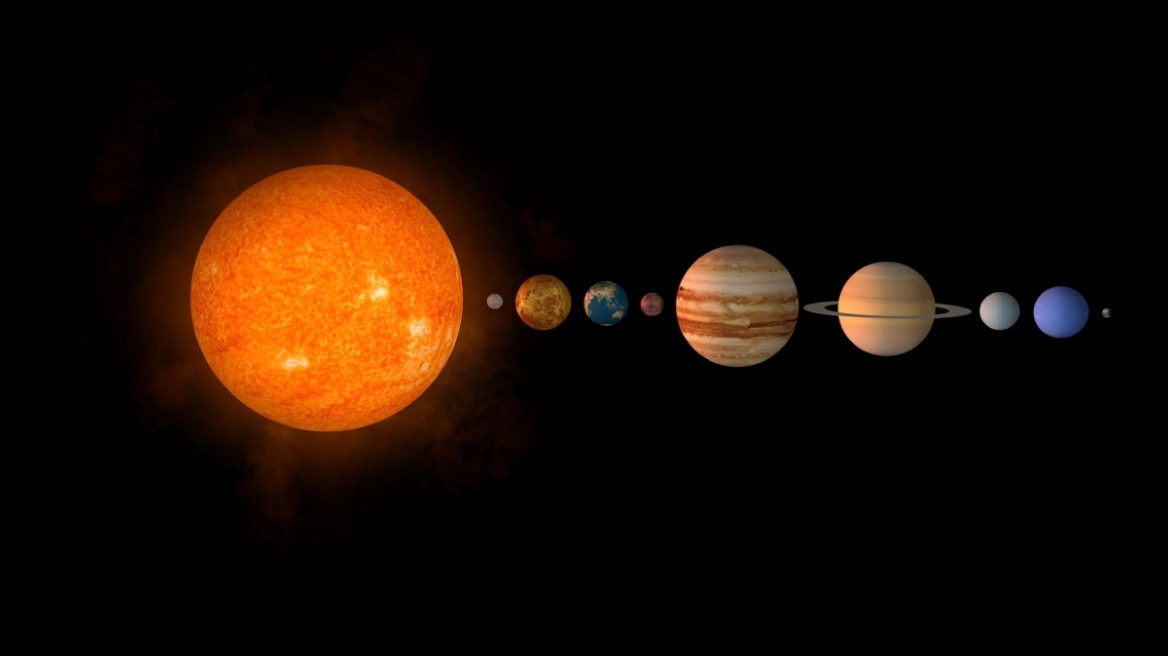
An impressive celestial spectacle is expected at the end of the month, as six planets will appear clustered in the night sky. The phenomenon, known as a “planet parade” or planetary alignment, occurs when at least four or five planets become visible simultaneously, according to NASA.
On February 28, skywatchers will be able to spot Mercury, Venus, Jupiter, Saturn, Uranus, and Neptune appearing relatively close together in the sky in a rare planetary display, The Guardian reports.
Why planetary “parades” happen
The phenomenon occurs because planets orbit the Sun roughly on the same plane, called the ecliptic plane. Although each planet moves at a different speed and distance from the Sun, there are periods when, from Earth’s perspective, they appear aligned.
In reality, the distances between them remain enormous — from millions to billions of kilometers. The alignment is purely an optical effect and does not mean the planets are actually close to one another in space.
Has it happened before?
Yes. On February 27, 2025, seven planets — Mercury, Venus, Mars, Jupiter, Saturn, Uranus, and Neptune — appeared in a rare alignment, a phenomenon that will not occur again until 2040.
At the time, astronomer Greg Brown of the Royal Observatory Greenwich told PA Media:
“Groups of three, four, or even five planets visible at the same time are not unusual and occur regularly each year… However, the more planets involved, the more conditions must coincide for them all to be visible at once. That makes full seven-planet parades quite rare.”
Which planets will be visible to the naked eye
According to NASA, such viewing opportunities can last from several weeks to more than a month, as planetary movements are slow and gradual. Some observers may be able to see the phenomenon even earlier, but February 28 is considered the most characteristic date, when the planets will appear most tightly clustered in the evening sky.
Four planets — Mercury, Venus, Mars, and Jupiter — will be visible to the naked eye. Uranus and Neptune, due to their great distance and low brightness, will require binoculars or a telescope. Mercury may be harder to spot because it will be low near the horizon.
When is the best time to observe
The ideal time to view the alignment will be about 30 minutes after sunset. The Star Walk app suggests observers look low toward the western horizon, choosing a location with an unobstructed view and a clear sky.
NASA notes that for a planet to be visible without optical aids, it should be at least a few degrees above the horizon, with 10 degrees or more considered ideal. “This is critical because Earth’s atmosphere near the ground reduces the brightness of celestial objects when they are rising or setting,” NASA says, adding: “Even bright planets become difficult or impossible to spot when very low, as their light is scattered and absorbed on its way to our eyes.”
Where the “parade” will be visible from
The planetary alignment will be visible worldwide. However, since February 28 is an indicative peak date, in different regions the phenomenon may be better observed a few days before or after.
According to Star Walk, the best observation date is February 25 for São Paulo; February 28 for Athens, New York, Mexico City, and Tokyo; March 1 for Beijing, Berlin, London, and Mumbai; and March 2 for Reykjavik.
Ask me anything
Explore related questions