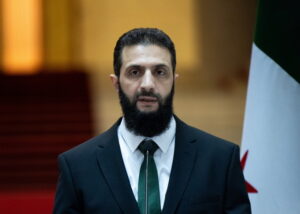
Turkey’s intelligence service allegedly asked its British counterpart, MI6, to take on a broader role in protecting Syrian leader Ahmed al-Sara after recent assassination plots against him, according to five sources cited by the news agency Reuters.
Following the report, Turkey denied that the MIT intelligence agency had submitted such a request to MI6.
If the request was indeed made, it highlights the efforts of Syria’s foreign allies to stabilize a country that is still shaken by sporadic violence 15 months after the overthrow of Bashar al-Assad, while the U.S.–Israeli war against Iran is also destabilizing the wider region. These allies believe Sara could prevent a new civil war following the previous conflict, which lasted 14 years, displaced millions of refugees abroad, and allowed the Islamic State to seize control of large parts of Syrian territory.
Last month, jihadists intensified their attacks on soldiers and police across Syria and declared Sara—himself a former rebel—their “number one enemy.”
It is not clear exactly what MIT asked of MI6, or what role the British intelligence service may have taken, if any.
The Turkish presidency said in a statement that MIT cooperates with the international intelligence community and Syrian security services in the fight against terrorism, but that the Reuters report does not reflect the truth.
“Contrary to what is stated in the report, it is not true that MIT submitted any request to MI6 regarding the protection of the Syrian president,” the statement said.
Concern in Syria over Islamic State activity
Turkey, Britain, and the United States have expressed support for Sara in his effort to reunify and rebuild the country of 26 million people. London and Washington have lifted most of the sanctions previously imposed on Damascus and on the Islamist group Hayat Tahrir al-Sham (HTS), which Sara once led.
The sources who spoke to Reuters asked to remain anonymous because the matter is “sensitive.” MIT, Turkey’s Foreign Ministry, the UK Foreign Office, and Syria’s defense and interior ministries declined to comment when contacted by the news agency before the report was published.
All the sources, including Syrian and foreign officials, referred to “growing concern” over reports of Islamic State attempts to assassinate Sara. One Turkish source said MIT— which played a key role in helping the new Syrian government consolidate power—approached MI6 for additional support following such an incident last month.
A senior Syrian security source said the request came after an assassination plot was uncovered and that MIT, MI6, and Syrian authorities are sharing intelligence.
Last year, Sara and two of his ministers were targeted in five assassination attempts, according to the UN Counter-Terrorism Office. In November, Reuters reported that Syrian authorities had prevented two attacks.
The jihadist organization carried out six attacks against Syrian authorities last month, declaring that it had begun a “new phase” in its campaign.
On Thursday, Damascus publicly acknowledged for the first time that it coordinates actions with MIT, saying they had worked together to prevent an Islamic State attack in the Syrian capital. According to Turkish sources, MIT identified a three-person cell planning attacks using remotely detonated bombs and helped Syrian security services prevent an imminent attack.
Ask me anything
Explore related questions