Two dead from Israeli airstrike in southern Lebanon, death toll now exceeds 1,100
The Lebanese National News Agency reported that an Israeli airstrike in the Hawta al-Ghadir area at dawn caused the deaths of two people.
Authorities stated that more than 1,100 people have lost their lives in Lebanon during the Israeli attacks.
The Israeli military announced on Thursday that it had deployed the 162nd Division to southern Lebanon, joining the thousands of soldiers already sent there since the start of the war.
Signs of wear among Israel’s Jewish population over the ongoing war with Iran
According to a survey by the Israel Democracy Institute (IDI), 78% of Israel’s Jewish population supports the ongoing war against Iran, but the intensity of this support has declined over the past month.
The full survey will be published next week.
While the majority of the Jewish population supports the war, 11.5% oppose it—a rise compared to 4% recorded in the two previous surveys conducted during the war. Additionally, only 50% strongly support the war, compared to 74% at the beginning of the month.
The majority of Arab Israelis remain opposed to the war, as noted in previous surveys. Only 19% of Arab respondents support the war, down from 27% earlier in the month, according to the IDI.
Berlin does not seek an immediate deal with Tehran for German ships’ passage through Hormuz
Germany is not pursuing any immediate agreement with Iran regarding the passage of its ships through the Strait of Hormuz.
Israel strikes ballistic missile facilities in Tehran overnight
The Israeli Air Force (IAF) bombed dozens of military targets in Iran during the night, including ballistic missile launch sites and Iranian soldiers reportedly preparing to fire at Israel.
According to the military, the attacks in the Tehran area hit dozens of weapons manufacturing facilities and other targets, including a military base storing air defense systems, a production unit for “key components for ballistic missiles,” a battery production unit for various weapons, and a weapons production unit of the Islamic Revolutionary Guard Corps (IRGC).
In a broad wave of attacks completed overnight in Tehran: the IDF struck dozens of military industries, launch sites, and soldiers from the missile network.
The Air Force, guided by Israeli Military Intelligence (AMAN), carried out a wide-ranging strike overnight against dozens of Iranian regime military infrastructures in Tehran.
As part of the strikes, the IDF deepened the impact on the regime’s production capabilities.
Additionally, during the night, the IAF targeted several ballistic missile launch facilities — including one belonging to the IRGC — air defense systems, and observation posts of the Guards and the Iranian army, according to the military.
The IDF also reports that they identified Iranian soldiers from Iran’s ballistic missile system in a building in Tehran. “Minutes after detection, the Air Force struck and neutralized the soldiers who were planning to open fire on the State of Israel,” the army stated.
27/03/2026 13:19 – Sirens in central Israel due to ballistic missile launches from Iran
27/03/2026 13:18 – Katz: Iran continues attacks on Israeli civilians; we will intensify and expand our operations against it
Israeli Defense Minister Israel Katz said that attacks on Iran will “intensify.”
“The Prime Minister and I warned the Iranian terrorist regime to stop missile attacks against civilians in Israel. Despite the warnings, the attacks continue, and therefore IDF strikes on Iran will intensify and expand to additional targets and sectors that assist the regime in manufacturing and using weapons against Israeli civilians,” he said during an assessment with military officials.
“They will pay a heavy and escalating price for this war crime,” Katz added, according to statements provided by his office.
Tehran denounces the US before the Human Rights Council for a “premeditated” attack on a school
The deadly bombing of an Iranian school on February 28, the first day of the war in the Middle East, was not a targeting mistake but a “premeditated” attack by the United States, Iranian Foreign Minister Abbas Araghchi said today in a video message broadcast in Geneva.
The attack on the school “was neither a mere ‘incident’ nor a ‘miscalculation.’ The contradictory statements of the United States, aimed at justifying their crime, cannot in any way absolve them of responsibility,” Araghchi said, calling it a “premeditated” attack by the US military in his message during an emergency session of the Human Rights Council in Geneva.
“More than 175 children and teachers were cold-bloodedly massacred,” he added, calling the attack a “war crime and a crime against humanity.”
During its annual session in Geneva, the Council is holding today an emergency meeting on the protection of children in the Middle East, following the deadly bombing of the school in Minab, southern Iran.
The Iranian government accuses the US military of striking the school complex. US President Donald Trump initially denied any involvement of his country, before partially backtracking and saying he “would accept” the outcome of the Pentagon-led investigation.
According to The New York Times, citing US officials and sources close to the investigation, the missile that hit the school was indeed fired by the US military due to a targeting error.
“At a time when the US-Israeli attackers themselves claim to possess the most advanced technologies and the most precise military and intelligence systems, no one can believe that the attack on this school was anything other than a deliberate and intentional action,” the Iranian minister insisted.
“This atrocity is unjustifiable, cannot be covered up, and must not meet silence and indifference,” he added.
Today’s discussion at the Human Rights Council, requested by Iran, Cuba, and China, is the second of this week dedicated to the war in the Middle East.
Two days ago, on Wednesday, a discussion requested by Bahrain on behalf of six Gulf Cooperation Council countries and Jordan focused exclusively on Iranian strikes against countries in the Gulf region and their consequences for the civilian population.
Following that discussion, 47 members of the Council unanimously approved a resolution condemning Iran’s “abhorrent attacks” on neighboring Gulf countries and calling for swift “reparations” for all victims of these strikes.
27/03/2026 12:37 – Europeans to pressure Rubio over Russian support to Iran at G7 summit
According to Reuters, the United Kingdom is “deeply concerned” about Russia-Iran ties.
European powers have accused Russia of helping Iran target US forces in the Middle East war and said they will raise the issue at today’s meeting in France.
Ministers are also expected to discuss the Strait of Hormuz, the Gulf’s critical oil and gas shipping route, which Iran has effectively blocked, driving energy prices up and disrupting financial markets.
Two Western security sources and a regional official close to Tehran told Reuters that Moscow is providing satellite imagery to Tehran and is also helping Iran upgrade its drones to mimic versions used by Russia against Ukraine.
“We are deeply concerned about the long-standing ties between Russia and Iran regarding shared capabilities—for example, drones provided to Russia by Iran that have been involved in the conflict in Ukraine,” said British Foreign Secretary Yvette Cooper.
“We have also seen support from Russia to Iran in the Middle East conflict,” Cooper told reporters in Paris. “As G7 countries, we have a common interest in meeting to discuss these issues.”
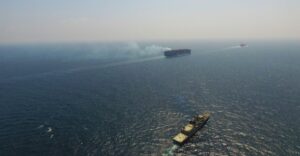
27/03/2026 12:20 – The three containers blocked by the Revolutionary Guards from passing through the Strait of Hormuz are Chinese
Tehran has warned it may target hotels across the Middle East that host American troops, raising concerns about the expansion of the conflict to civilian-linked infrastructure.
Israel, meanwhile, has bombed what it describes as Iran’s most important naval missile production facility. According to the Israeli military, the site in Yazd was used for the design, development, assembly, and storage of advanced missiles intended for launch from ships, submarines, and helicopters.
An Iranian drone attack caused material damage to Kuwait’s main commercial port, highlighting the growing risks to regional trade infrastructure.
At the same time, reports suggest that Donald Trump is considering sending an additional 10,000 ground troops to the Middle East, as tensions continue to escalate.
Diplomatic and political tensions
Iran has not requested a delay in attacks on its energy infrastructure, according to mediators, despite ongoing diplomatic contacts.
Iran’s Foreign Minister, Abbas Araghchi, stated that it is a legitimate right for Iran to block “hostile” ships from passing through the Strait of Hormuz, a critical global shipping route.
Meanwhile, the United States has extended its ultimatum to Tehran by ten days, signaling that diplomatic efforts are still ongoing despite the military escalation.
Escalation on the ground
Iranian Revolutionary Guard officials have urged civilians across the Middle East to stay away from areas near U.S. forces, warning of potential strikes.
Missile alerts were triggered again in southern Israel after several hours of relative calm, with Israeli defenses reportedly intercepting incoming threats.
In Kuwait, multiple attacks targeted port infrastructure, including the Mubarak Al Kabeer port, causing damage but no reported casualties.
Regional and international reactions
The United Kingdom’s Foreign Secretary, Yvette Cooper, called for a swift resolution to the conflict, accusing Iran of “holding the global economy hostage” by disrupting maritime traffic through the Strait of Hormuz.
Saudi Arabia has reportedly urged the United States to intensify its military campaign against Iran, while still weighing whether to become directly involved in the conflict.
Broader context
The conflict, which began on February 28, has significantly destabilized the region, with strikes on military and civilian infrastructure and growing fears of wider escalation.
The situation is further complicated by geopolitical rivalries and the strategic importance of energy routes, particularly those passing through the Strait of Hormuz.
As tensions rise, the international community is closely monitoring developments, amid concerns that the conflict could have far-reaching consequences for global security and trade.
Ask me anything
Explore related questions