





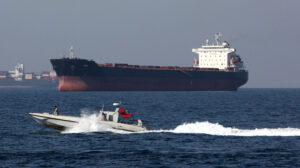
Tension between the US and Iran over control of the Strait of Hormuz is escalating, causing growing concern in the international community about the implications for the global economy and energy security.
The US armed forces announced that they will implement a blockade of Iranian ports as of 10:00 Washington time (17:00 GMT), via Central Command (CENTCOM), after the failure to reach an agreement to end the war in the Middle East.
CENTCOM reports that ships in the blockaded area will be subject to interception and occupation. The US military will impose a blockade in the Gulf of Oman and the Arabian Sea east of the Strait of Hormuz and will apply to the movement of ships of any flag, US Central Command (CENTCOM) said in a note to sailors seen by Reuters news agency.
“Any vessel entering or leaving the blockaded area without permission will be subject to interception, diversion, and seizure,” the memo said. “The blockade will not prevent neutral transit through the Strait of Hormuz to or from non-Iranian destinations.”
At the same time, US President Donald Trump appeared unconcerned about resuming talks with Iran, stating that “I don’t care if they come back or not” after the failure of the talks in Islamabad.
For its part, Iran reacted strongly, with an armed forces spokesman calling the US restrictions on international waters “illegal” and “tantamount to piracy.”
Meanwhile, Tehran has warned that it will implement a “permanent mechanism” to control the Strait of Hormuz, stressing that if Iranian ports are compromised, then no port in the Gulf or the Gulf of Oman will be considered safe.
What are the implications for oil flows
Blocking Iranian exports would remove a significant amount of oil from the global market. Iran exported about 1.84 million barrels per day in March, while April exports hovered around 1.71 million barrels per day.
However, the surge in production before the war began has led to high inventories, with more than 180 million barrels of Iranian oil already loaded on ships.
Navigation in the Sea Strait of Hormuz remains almost frozen, despite the recent ceasefire. Many tankers are avoiding passage, while some ships that attempted to cross have either turned back or remained at anchor.
However, a limited number of tankers are still moving, mostly for cargo from countries such as the United Arab Emirates and Kuwait.
Vance, he described, called him from the plane after he left Islamabad and “made it clear that the central issue is the removal of all enriched material and ensuring that there is no further enrichment.”
Fon der Leyen: “Of paramount importance” is the restoration of free navigation in the Strait of Hormuz
“The continued closure of the Strait of Hormuz is very damaging, and the restoration of free navigation is of paramount importance to us,” said today the President of the European Commission, Ursula von der Leyen, at a press conference shortly after the College of Commissioners meeting on the crisis in the Middle East and its impact on Europe.
Meanwhile, Ursula von der Leyen expressed the European Commission’s concern about the ongoing attacks in Lebanon, which “threaten to derail the whole process” for peace in the region. “There can be no stability in the Middle East or the Gulf while Lebanon is in flames,” she said, calling on all parties to respect Lebanon’s sovereignty and implement a complete cessation of hostilities. She noted that the EU is providing immediate assistance to the Lebanese people, but pointed out that “no assistance can replace the security of a lasting peace.”
Referring to the “huge impact” that the Middle East crisis is having on the economies of EU countries, the Commission President underlined that since the beginning of the conflict 44 days ago, the bill for fossil fuel imports has increased by more than €22 billion. Therefore, von der Leyen referred to a series of measures to reduce energy prices – the so-called “toolbox” – that the European Commission will present next week, April 22, just before the informal European Council to be held in Cyprus on April 23 and 24.
TARGETED, TIMELY, AND IMMEDIATE ACTIONS FOR RECOVERY
According to the Commission President, EU Member States must respond in a coordinated way to rising energy prices. She said these measures should be “targeted” – giving particular support to the most vulnerable households and sectors of the economy – “temporary” and “implemented promptly and without delay, when they are really needed”. In the same context, the Commission is expected to present best practices for the design of income support programmes, while a consultation on more flexible state aid rules is being launched to give states more room to intervene in the most exposed sectors.
Von der Leyen stressed that the Commission is placing particular emphasis on better cooperation between member states, building on the experience of the 2022 energy crisis, to avoid competition between them in the energy market.
Enhanced European coordination is also envisaged for the filling of gas reserves, as well as joint planning for the release of strategic oil reserves, to achieve the maximum possible effect. At the same time, as von der Leyen stressed, it will be ensured that national emergency measures “do not compete with each other” and do not disrupt the functioning of the single market.
According to von der Leyen, the Commission is also considering measures to reduce energy demand “with full respect for consumers’ freedom of choice”, with an emphasis on energy efficiency, such as upgrading buildings and renewing industrial equipment.
At the same time, more structural interventions to reduce energy costs are being promoted, with a review of the Emissions Trading Scheme (ETS), interventions in taxes and network charges and a broader overhaul of the energy mix.
Concluding, von der Leyen stressed that dependence on fossil fuels makes Europe vulnerable to crises and high prices, stressing that the transition to renewable and nuclear energy is the only long-term solution for energy independence and stability for the EU. He also said that investment in networks, storage and electrification of the economy should be accelerated, using European resources and mobilising private capital, in order to enhance energy security and reduce prices in a sustainable way.
Finally, in response to a question on the possibility of activating more drastic measures, von der Leyen clarified that at the moment “the conditions for activating alternative measures, such as the general escape clause, are not met”. She stressed that any interventions should not overly burden public deficits and that the response to the crisis should be “step by step” as the situation evolves. He added that the Commission would constantly reassess the situation, depending on developments in the Middle East.
Britain does not support the blockade of the Strait of Hormuz, says Kir Starmer
British Prime Minister Kier Starmer said today that Britain will not be dragged into war with Iran and does not support a blockade of the Strait of Hormuz.
“We do not support a blockade,” he said. “We have been clear about the fact that we will not allow ourselves to be dragged into this war,” although London has engaged in “defensive actions” since the conflict began in late February, he added during an interview with the BBC, hours before the US military blockade of Iranian ports was announced yesterday, Sunday, by US President Donald Trump.
In remarks made on BBC Radio 5 Live, Starmer also noted that it is vital to achieve the reopening of the Straits of Hormuz.
“It is, in my view, vital that the straits are opened and fully opened, and that is what we have focused all of our efforts on in recent times and will continue to do so,” Starmer added.
Macron calls for a diplomatic solution for the Middle East, plans a multinational mission to the Strait of Hormuz
The need to reach a strong and lasting diplomatic agreement to end tensions in the Middle East was underlined today by Emmanuel Macron, while announcing an initiative by France and the UK to ensure freedom of navigation in the Strait of Hormuz.
In a post on X, the French president stressed that every effort should be made to reach a stable and long-term settlement of the Middle East conflict through diplomatic means as soon as possible.
The French president stressed that such an agreement should form a strong security framework for the entire region, allowing all states to coexist in peace and stability. As he said, reaching a viable solution requires addressing all key issues, including Iran’s nuclear and ballistic missile programme, the actions causing destabilisation in the region, as well as the need for the rapid restoration of free and unhindered navigation in the Sea of Hormuz.
At the same time, Macron stressed the need for Lebanon to return to a path of peace, with full respect for its sovereignty and territorial integrity, stressing that France remains ready to actively contribute to any initiative aimed at de-escalating the crisis, as it has done “since the first day of the conflict.”
Specifically on the Strait of Hormuz, the French president announced that in the coming days France and the United Kingdom will organize a conference with countries willing to participate in a peaceful multinational mission aimed at restoring freedom of navigation in the region.
According to Macron, the mission will be strictly defensive in nature and will operate independently of the warring sides, to deploy as soon as conditions allow.
“No sense” in a US naval blockade of the Strait of Hormuz, Spanish defence minister sees no point
The US naval blockade of the Strait of Hormuz announced yesterday, Sunday, by US President Donald Trump “makes no sense”, Spain’s Defence Minister Margarita Robles said today.
“I also think it is something that makes no sense (…) It is another episode in this whole aberration that we have been led into,” she said in an interview with Spanish public television.
Moscow re-proposes to receive Iranian enriched uranium as part of a deal
The Kremlin today criticized an announcement by US President Donald Trump that the US would block the Strait of Hormuz, saying it would hurt international markets.
“Such actions will likely continue to hurt international markets. This can be assumed with a high degree of certainty,” Kremlin spokesman Dmitry Peskov told reporters.
The U.S. military said it will block naval traffic to and from Iranian ports from 1700 hours today, a move that will prevent some two million barrels a day of Iranian oil from entering international markets, further restricting global supply.
As Dmitry Peskov pointed out, many dimensions of that plan remain unclear. At the same time, the Kremlin has reiterated that Russia is ready to receive Iranian enriched uranium on its territory as part of a possible peace deal between Washington and Tehran.
“This proposal was put forward by the president (Vladimir Putin) during contacts with the US, as well as with countries in the region. The offer is still valid, but it has not been implemented,” the Russian presidential spokesman said during his regular press conference.
Ask me anything
Explore related questions




