





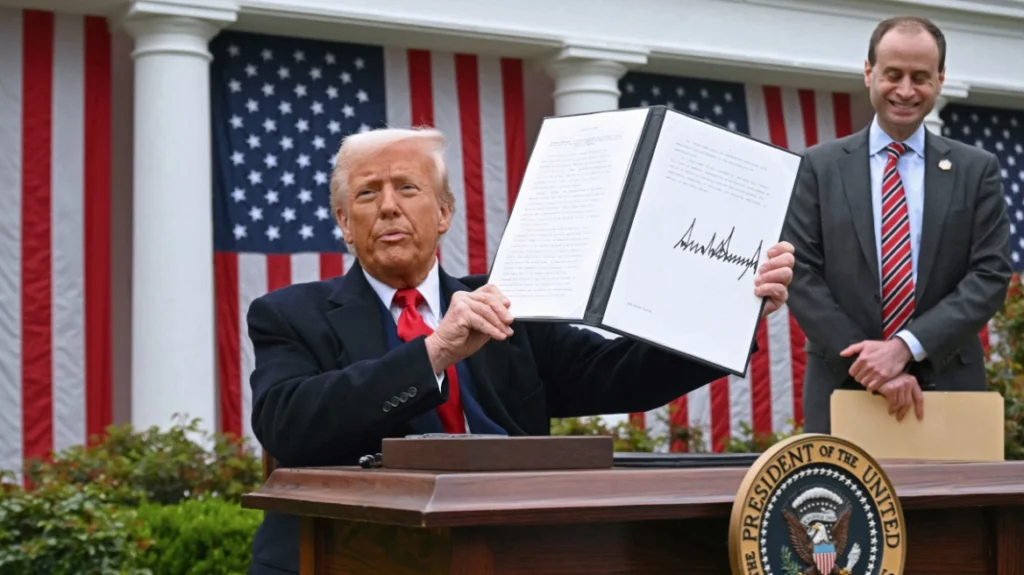
When Donald Trump presented his aggressive tariff policy last spring, he accompanied it with a promise: that the new measures would fill U.S. coffers and make the United States “rich again.” A few months later, following a significant defeat in the Supreme Court, that same administration is now preparing to go in the opposite direction—returning this so-called “trophy” money.
Starting today, the Trump administration is activating the first mechanism to return more than $166 billion collected through tariffs that were struck down by the courts in February. This is an enormous sum—not only in absolute terms, but also because it reveals the true scale of a policy that was presented as a tool of national strength but ultimately became a heavy burden for thousands of businesses.
The refunds will not only include the original amounts. The U.S. government must also pay interest, further increasing the cost of a legal and political defeat that strikes at the core of Trump’s economic narrative.
Relief for businesses, but not for consumers
For many American companies, the start of the refund process could prove lifesaving. Tariffs were essentially taxes on imports. For businesses dependent on foreign raw materials, intermediate goods, or finished products, this policy became a constant financial strain.
For months, companies faced the same dilemma: absorb the cost, cut expenses elsewhere, or pass it on through higher prices.
Those who paid these tariffs can now begin submitting documentation to reclaim their money. The scale of pressure is evident: over 3,000 businesses—including FedEx and Costco—have already taken legal action against the Trump administration seeking compensation, some even before the Supreme Court’s final ruling.
However, there’s a crucial limitation: only those who formally paid the tariffs are eligible for refunds. This means that end consumers—the millions of Americans who faced rising prices—cannot seek direct compensation from the state.
In other words, tariff refunds do not automatically translate into recovery of losses for society. Whether consumers benefit will depend on whether businesses choose to pass some of the refunded money on—something very few have committed to so far.
Uncertainty remains despite the first step
Despite the launch of the process, businesses remain cautious. Many small and medium-sized enterprises say they are unsure how functional the new system will be or how quickly funds will arrive.
This skepticism is reinforced by Trump’s own stance, as he has made it clear he does not politically favor these refunds. The administration has warned it could take months before the first payments are completed. Meanwhile, the White House has not clarified whether it may attempt further legal maneuvers to block part or all of the refunds.
For many small businesses, this is the core issue: the refunds come too late to reverse layoffs, cuts, and losses from the past year.
The legal defeat behind the reversal
At the heart of the case are the so-called “reciprocal tariffs” imposed by Trump using the International Emergency Economic Powers Act (IEEPA), a 1977 law never previously used by a U.S. president to impose tariffs.
Trump used it as a tool of trade pressure, giving it an interpretation that ultimately did not withstand Supreme Court scrutiny.
The February ruling was not just technical—it effectively invalidated the most flexible trade weapon Trump had relied on. It revealed that a central element of the administration’s trade strategy rested on an aggressive and legally questionable interpretation of presidential power.
The $166 billion—and growing interest
The scale is unprecedented in modern U.S. trade history. By March, more than 330,000 importers had paid tariffs under IEEPA across over 53 million import entries.
The U.S. government collected more than $166 billion—and the amount continues to grow due to interest: roughly $650 million per month, or about $22 million per day.
This explains why Trump fought the legal battle so aggressively. He had warned that losing could even trigger a “major recession”—a claim most economists dismissed as exaggerated.
After the Supreme Court ruling, the administration tried to delay matters, but in March, the Court of International Trade explicitly ordered the refunds.
A system built under pressure
U.S. customs authorities were suddenly forced to build a mass refund system from scratch. The technical and logistical challenges are significant: distinguishing legal from illegal charges, even for the same products, and building new digital infrastructure.
In some cases, the government lacks the capability to directly deposit funds into importers’ accounts—highlighting how hastily the tariff system was originally implemented.
The new system, called CAPE, launches today but initially covers only about 63% of relevant import entries. Even when claims are approved, refunds may take 60 to 90 days.
What will big companies do?
The next major question is whether large corporations will pass the refunds on to consumers.
FedEx has indicated it may try to pass benefits along, while Costco has suggested it might lower prices. However, both face pressure—including lawsuits from customers demanding direct reimbursement.
Many economists doubt that savings will be quickly or fully passed on, as companies may instead use the funds to cover past losses or prepare for future uncertainty.
Trump is already seeking new tools
Politically, the refunds do not mark the end of Trump’s tariff strategy. The administration has already launched new trade investigations under different provisions of the 1974 Trade Act, aiming to build a new tariff framework.
A temporary 10% tariff on most imports has already been imposed under another provision—and it is also being challenged in court.
In short, Trump is not abandoning tariffs—he is changing legal pathways. The Supreme Court defeat makes the strategy harder, slower, and more vulnerable to legal challenges.
The damage is done
For small businesses, this is the most bitter reality. Even if refunds arrive with interest, the damage of the past year—layoffs, frozen investments, squeezed margins—cannot be undone.
This is why the $166 billion issue is not just accounting—it is deeply political. It shows how an aggressive trade policy can be presented as a national triumph, function as a drain on the economy, and ultimately end in a costly and imperfect reversal.
Trump now faces the difficult phase where the state must return what he once portrayed as a “trophy”—a powerful political statement in itself. Not because it ends his tariff ambitions, but because it reveals that one of the loudest pillars of his trade policy produced far more cost, confusion, and uncertainty than prosperity.
Ask me anything
Explore related questions




