





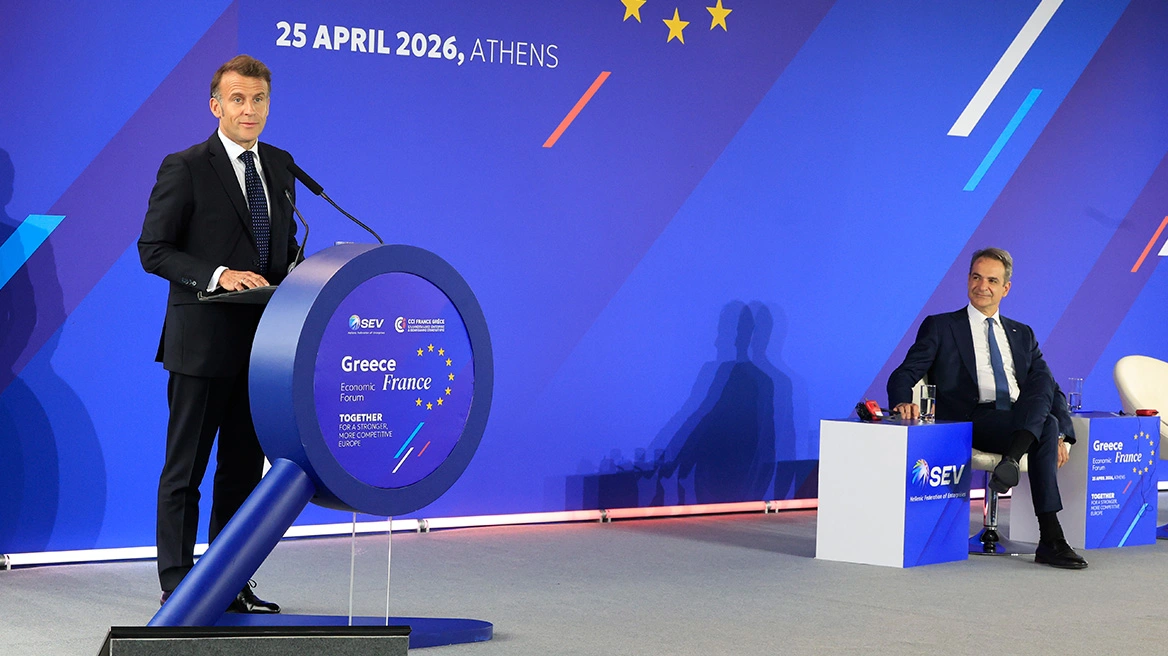
The particularly positive course of the Greek economy was highlighted by the President of France, Emmanuel Macron, during his address at the Greek-French business forum, describing Greece as a “model of economic progress” in recent years.
The French president acknowledged the significant rise in investments, noting however that there is still room for improvement. “We have seen progress, but we are not yet at the level we would like. We can do more,” he said, emphasizing the need to strengthen the presence of French businesses in Greece.
As he underlined, French investments in Greece do not yet match the level of shared potential, despite the fact that the two countries share strong strategic interests. “We must do more, because we have a common vision and a common realism,” he noted.
“Long live the friendship between Greece and France,” were the words used by the French president as he concluded his speech at the Greek-French business forum.
Beyond the clear message to French companies to invest in Greece, the French president also expressed strong support for the creation of the IMEC corridor, speaking of a complete alignment of the geostrategic interests of Greece and France.
“We have a vision to strengthen Europe’s independence, to build partnerships with other countries, to create an ‘alliance of independents,’” he said, describing IMEC—which will start from India and reach Marseille—as the backbone of this alliance that will bring significant new investment frameworks to Europe.
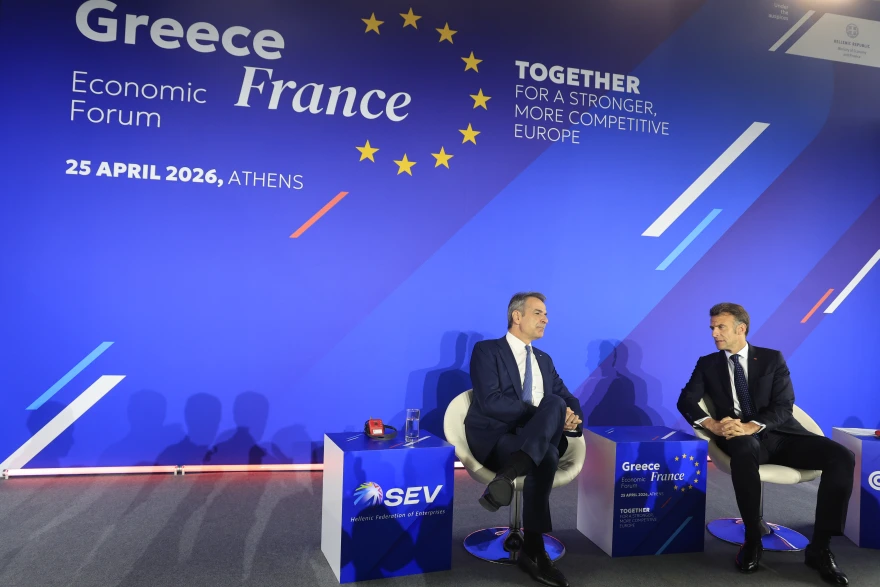
Strengthening competitiveness is “key” to maintaining the European social model, emphasized Prime Minister Kyriakos Mitsotakis at the Greek-French Economic Forum, while also highlighting the role of cooperation among EU member states during a period of successive crises and geopolitical shifts.
According to the prime minister, the European Union must act with speed and determination, making the most of opportunities that emerge from challenges. “There are many crises, but they also bring opportunities—not with inertia and complacency,” he stressed, outlining a more proactive European strategy.
He placed particular emphasis on innovation, noting that Greek-French cooperation can serve as a model. The Greece–France partnership, as he said, is not limited to formal agreements but is based on deep relations of appreciation and mutual trust.
In the field of defense, the prime minister clarified that the discussion on European defense policy is not theoretical but a “geopolitical necessity,” as threats are becoming increasingly unpredictable. He referred to joint initiatives with France, such as the construction of modern ships, as a tangible example of European cooperation in practice.
At the same time, he stressed the need for Europe to take greater responsibility for its collective defense, strengthening its autonomy through joint investments, unity, and solidarity.
On the economic front, Mitsotakis highlighted the importance of investments in energy, infrastructure, and security, noting that Europe lags behind the US and China in competitiveness, especially in artificial intelligence. To bridge the investment gap, he referred to proposals for reducing bureaucracy, strengthening human capital, and promoting a unified European energy market.
He also made special reference to Greece’s progress in renewable energy sources, while noting that the energy transition also requires stable baseload sources, welcoming the revival of the European discussion on nuclear energy.
In conclusion, he emphasized that Greece and France remain fully aligned in this common European effort, sending a message of cooperation and cohesion during a period of major challenges for the continent.
“Greece and France are aligned in this effort,” the prime minister said, adding: “Behind the texts and agreements with France, there is something much deeper. There are relationships of appreciation and affection. I assure you that Greece loves France.”
Ask me anything
Explore related questions




