





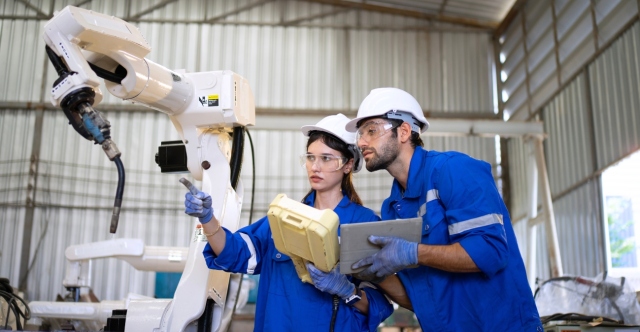
While an electrician with ten years of experience can earn between €2,500 and €2,800 per month, one in four university graduates in Greece remains unemployed. At the same time, hundreds of companies report that they are actively seeking technical professionals but cannot find them.
Each year, thousands of young people graduate from universities and enter the labor market without securing roles that match their qualifications. Around 30% end up in jobs for which they are overqualified, while more than 2 in 10 (24%) remain outside the workforce altogether.
The gap between the studies young people choose and the skills the market demands is not new. However, as highlighted at the Delphi Economic Forum, it remains deeper than many are willing to acknowledge.
“Technical professions are socially undervalued”
About 90% of secondary school graduates in Greece aim to enter university, with 82% succeeding—one of the highest rates in Europe, according to professor Giorgos Doukidis of the Athens University of Economics and Business.
“Technical professions continue to be socially undervalued. In Greece, success is still closely associated with academic degrees, even when the market clearly shows that certain fields are already saturated,” noted Byron Nikolaidis, President and CEO of PeopleCert, who organized the discussion at the Delphi forum.
According to Doukidis, the issue is not the number of graduates, but the disconnect between the education system and the labor market. Structured internships are implemented in only a small number of university departments. Where they do exist, however, 72% of students are hired by the same companies.
A similar pattern can be seen across Europe. Germany faces a shortage of 400,000 positions in technical professions, while in France and the UK employers struggle to fill industrial and technical roles. In Greece, however, the response to market needs is slower.
“We are a country that has deindustrialized”
Despite higher wages in technical professions, families still tend to steer their children toward careers in law or education.
The consequences extend beyond the labor market. “We are a country that has deindustrialized. We do not produce as much as we should,” stressed Spyros Theodoropoulos, President of the Hellenic Federation of Enterprises (SEV).
Shortages in fields such as industrial electricians, applied engineers, and welders are making it difficult for businesses to expand. Companies now factor in the availability of such skills when deciding where to invest.
“We need to overcome stereotypes”
Traditional “white-collar” professions, long associated with stability, are now under pressure from both market saturation and artificial intelligence.
“The sense of security we associated with banking professions ten years ago no longer applies in the same way today,” said Elena Vrettou, CEO of Credia Bank, emphasizing that adaptability and continuous development are now key.
Countries such as Germany, Switzerland, and Austria have already adapted. In their education systems, vocational training is not seen as a secondary option but as an equally valuable path aligned with economic needs. In Greece, this conversation is only just beginning.
“There are children with innate talents we cannot ignore. We need to move beyond stereotypes, because there is more than one path to success,” said Theodoropoulos.
“Families still prefer their child to become a lawyer or a teacher, even if prospects are limited, rather than pursue a technical profession with clearly higher demand,” added Nikolaidis.
Ask me anything
Explore related questions




