





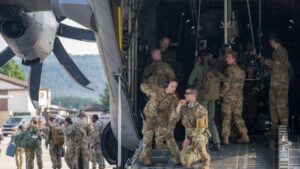
Donald Trump has escalated his dispute with German Chancellor Friedrich Merz, with the U.S. Department of Defense announcing the withdrawal of around 5,000 American troops from Germany over the course of a year — roughly 15% of the U.S. forces stationed in the country.
“Disengagement is expected to be completed within the next six to twelve months,” said Pentagon spokesperson Sean Parnell. More than 36,000 U.S. troops are currently based in Germany, according to official figures from late 2025.
The announcement follows Trump’s earlier remarks this week suggesting he was considering reducing the American military presence in Germany, a NATO ally, after comments by Merz that reportedly angered him. The German chancellor had said that the United States “apparently has no strategy” in Iran and that Tehran was “humiliating” the world’s most powerful nation.
“Does he think it’s okay for Iran to get a nuclear weapon? He doesn’t know what he’s talking about,” Trump responded on Tuesday.
The following day, Trump wrote on social media that Washington had begun “studying and considering” a possible reduction of its military presence in Germany, adding that a decision would be made “very soon.”
“An invaluable gift for Putin”
Democratic lawmakers sharply criticised the move, warning it could weaken Western security at a sensitive geopolitical moment.
“We must stand united with our allies, not undermine each other’s security interests out of petty grievances,” said Senator Jeanne Shaheen. Senator Jack Reed urged Trump to reverse the decision, calling it a “serious mistake.”
“Reducing our military presence in Europe while Russian forces continue to relentlessly attack Ukraine and harass NATO allies is an invaluable gift to Vladimir Putin,” Reed added.
Impact on NATO and Europe
The withdrawal is expected to reshape aspects of the U.S. strategic footprint in Europe, although key facilities such as the Landstuhl military hospital — the largest U.S. military medical centre outside the United States — are not expected to be affected.
The move is part of Trump’s broader policy of pressuring NATO allies to increase their defence spending and reduce reliance on the United States. He has repeatedly criticised European members for underinvesting in their armed forces and has even threatened to reconsider U.S. commitment to the alliance.
Military analysts cited by Bild suggested the withdrawal is unlikely to have an immediate major impact on European security, noting that many NATO allies are increasing defence budgets and expanding their own military capabilities.
Broader tensions with Europe
Trump has also signalled possible tariffs of up to 25% on European car imports, further straining relations with Germany, a major exporter of automobiles to the U.S.
In recent weeks, the U.S. president has intensified criticism of European allies, accusing them of underinvesting in defence and relying too heavily on American protection. He has also suggested similar troop reductions could be considered in Italy and Spain.
“Maybe I will, why wouldn’t I?” he said when asked about the possibility. “Italy hasn’t helped much, and Spain is terrible, absolutely terrible.”
As of late 2025, there were 12,662 U.S. troops stationed in Italy and 3,814 in Spain, according to official figures.
The European Union responded on Thursday by stressing that the presence of U.S. troops in Europe “also serves U.S. interests in the context of its global operations.”
Ask me anything
Explore related questions




