





The 26 days of ceasefire – 27, if we take into account that there is a 7-hour time difference with the U.S., specifically Washington – appear to be coming to an end. This is because a series of actions on both sides shows a clear deadlock and a gap that currently cannot be bridged through diplomacy.
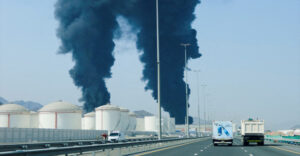
This time, Iran seems to have made the first move, at least militarily. By striking the United Arab Emirates, and specifically a key oil facility, it is making the decision – along with taking a major risk – to once again push the Middle East crisis onto the battlefield.
Why did Iran strike Fujairah?
The oil facilities of Fujairah, in eastern UAE, are of critical importance to the global energy market. The port is located outside the Persian Gulf, on the Gulf of Oman side, and serves as a major hub for oil storage, refueling, and exports.
Its strategic advantage lies in its connection to UAE pipelines that bypass the Strait of Hormuz, the most vulnerable maritime artery in the region.
For this reason, any attack or fire near Fujairah immediately gains international significance. It does not concern only the UAE. It affects maritime security, oil prices, and the ability of Gulf countries to continue exports even in the event of a full-scale crisis in the Strait of Hormuz.
The U.S. is not Tehran’s only problem
Just hours after Iran’s strike on the UAE’s oil facilities, dozens of sources are reporting immediate military mobilization by Arab countries against Iran. In the previous phase of the conflict, Washington had taken multiple steps to reassure Saudi Arabia and other Gulf allies that the crisis would be manageable and that the American president himself guaranteed that Tehran would be defeated and would pay the price.
Today, another pole seems to be emerging—one that possesses advanced military technology and significant combat capacity—and is likely to enter the equation of upcoming military operations, as all indications suggest.
Why is Iran choosing war again?
Since the day the U.S. announced and imposed its own blockade in response to Iran’s blockade of Hormuz, Tehran has found itself at a critical crossroads. The fact that Iran cannot export its own oil and capital through this “chokepoint” is suffocating it and pushing it deeper into internal crisis—one it seems to have no option but to externalize.
Donald Trump, unwavering in negotiations—where he demands nuclear issues be on the table and does not impose immediate time pressure on Tehran—can now claim he too is being pushed into a conflict, one he did not choose this time. The fact that the U.S. remains “silent” does not mean the signal has not reached Washington or that the alarm has not been sounded.
The truth is that the U.S. also did not intend—amid reports in the American press about insufficient weapons stockpiles—to re-enter a conflict that it knows would require “boots on the ground” in Iran to achieve a complete victory (a very difficult prospect). However, there appears to be no alternative.
Next steps
For starters, conditions today are quite different from a month ago.
The participants in the conflict that began on February 28 appear likely to increase if the situation escalates, with Saudi Arabia and the UAE signaling that they will no longer keep their fighter jets grounded but will take action—even at the risk of exposure.
Secondly, Israel’s approach now differs significantly. Benjamin Netanyahu knows well—better than anyone—that it is preferable for Tel Aviv not to be in the spotlight at this moment and that it should wait for Washington to make its move or send a signal. Israel’s endurance was tested over 38 days, but for Netanyahu today, greater priority lies in the front with Hezbollah, as well as upcoming elections that must be held by October.
Israel certainly has the capability and method to strike Tehran again, but its stockpile of interceptor missiles—supplied exclusively by the American defense industry—remains unclear. Given these factors, a U.S. response may be more “surgical” rather than sweeping, as it was a month ago. However, it remains certain that Tehran will respond, likely with a broader range of actions than in the initial phase of the conflict.
If Gulf countries ultimately become involved, they will bear economic and military costs they did not assume in the first phase—hoping that the final “bill,” even if not smaller, will at least be definitive.
Ask me anything
Explore related questions




