





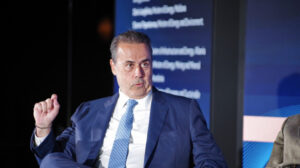
Stavros Papastavrou highlighted the importance of Renewable Energy Sources, the role of energy interconnections across the Eastern Mediterranean and Southeastern Europe, as well as the need for “energy realism.”
“The discussion is not about stepping back from or limiting our commitment to clean energy. It is about the need to be pragmatic and realistic. This is something the Prime Minister also referred to yesterday in his interview with Ben Hall,” the minister said, adding that Greece remains firmly committed to the transition toward clean energy.
“Despite ten years of an unprecedented economic crisis, Greece has managed to reduce CO2 emissions by nearly 50% over the last 20 years compared to 2005. Therefore, we are fully committed to this path. We are fully committed to the 2030 target and fully committed to the 2040 target,” he stated.
“Greece belongs among the global champions in renewable energy sources. When we talk about the share of solar and wind energy in electricity production, we rank 3rd in solar energy and 9th in wind energy,” he added.
“We are now trying to introduce some order, some clear ‘dos and don’ts.’ The Special Spatial Planning Framework for Renewable Energy Sources will be announced in the coming days. I believe it is important for every country to have a framework for how development takes place,” he noted.
Papastavrou also stressed that Europe remains committed to this direction, but is increasingly recognizing that natural gas is not necessarily in competition with the energy transition and may instead serve as a complementary element. He made the remarks during the “Energy Transition Summit: East Med & Southeast Europe,” organized by Financial Times in collaboration with Kathimerini.
Asked about the Vertical Corridor initiative, the minister underlined that it represents “far more than an economic dimension.”
“It has a transformative impact. For our region, this is a historic paradigm shift — a cultural shift. We grew up with a history that divided us. A history of wars and, at times, a history of division between East and West. And now, all the ministers of these countries are emphasizing how inextricably connected we are,” he said.
“This is a colossal paradigm shift for the region. We were not taught to cooperate. And energy has this unique dimension — it brings us closer together,” Papastavrou stated, emphasizing that “the more interconnected we become, the more we succeed in functioning as ‘we,’ the better it will be for all of us.”
Following his participation in the panel discussion, Papastavrou held consecutive bilateral meetings with his counterparts from Georgia, Mariam Kvrivishvili, and from Albania, Enea Karakaçi.
Ask me anything
Explore related questions




