





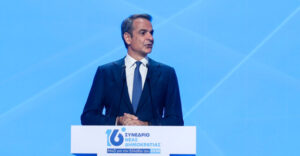
In a more combative and pre-election tone, Mitsotakis is preparing to bring the New Democracy congress to a close with a message built on two pillars: absolute unity and clear electoral dilemmas for the next national vote. Shutting down what he sees as pointless internal grumbling or introversion, he is expected to make clear that party cohesion is the first and non-negotiable condition for maintaining the country’s political stability.
The electoral dilemmas
The Prime Minister will distribute “roadmaps” to government and party officials for the major campaign ahead. According to reports, these will not merely include slogans, but also a detailed guide of political arguments that will serve as the core messaging handbook for all party officials, MPs, and local organizations throughout Greece. The aim is complete consistency in messaging, direct communication of the government’s work, and the dismantling of populist narratives.
The centerpiece of Mitsotakis’ intervention will be the framing of clear electoral dilemmas ahead of the elections. He is expected to highlight questions aimed at discouraging protest or “relaxed” voting, centering on a theme he referenced earlier in the congress with his example involving the three-digit emergency number:
A new strong mandate to continue major reforms — or a step backward that could risk everything the country has achieved through sacrifice?
“On our field against the opposition”
Mitsotakis is also expected to emphasize the comparison between New Democracy’s governing plan for “Greece 2030” and what the government describes as the opposition’s lack of an alternative proposal.
According to reports, he will insist that the request for a clear parliamentary majority is not about repeating past mistakes, but about continuing seven years of systematic work toward real convergence with Europe, with strengthening the middle class at the center of that strategy. Support for the middle class is expected to become one of the ruling party’s main campaign banners.
In terms of political confrontation, Mitsotakis will reportedly follow a carefully calibrated strategy. References to opposition parties are expected to remain limited and measured, as they were during the opening of the congress. While he may briefly mention current political developments, aides suggest he will again stress that he consciously chooses to leave his political opponents “trapped” in the arena of toxicity, sensationalism, and sterile negativity.
The question of former party leaders
Several speeches at the congress included references to the need to bridge the gap with former Prime Ministers Antonis Samaras and Kostas Karamanlis.
According to reports, close associates of Mitsotakis point to one of his recurring slogans when asked about the issue: “History is written by those who are present and participating.”
At the same time, Health Minister and ND Vice President Adonis Georgiadis was emphatic in calling for unity:
“Everyone should return to our great political family. Let us fight these battles together so that Greece can be great.”
Development Minister Takis Theodorikakos echoed the same sentiment, warning that “political divorces never worked out well in this party.”
Reactions to Dendias’ intervention
Attention is also focused on how Mitsotakis will respond to the notable internal political positioning expressed during the congress, especially by Defense Minister Nikos Dendias.
According to reliable sources, Mitsotakis does not intend to open a direct debate with the Corfu-born politician. However, Dendias’ speech generated extensive discussion among party officials, with some arguing that interpretations about the “next day” in New Democracy are premature.
Others, meanwhile, stressed that a party congress is precisely the appropriate venue for proposals and criticism to be openly expressed, pushing back against accusations of internal division.
Pierrakakis’ line
Finance Minister Kyriakos Pierrakakis also made a strong impression, outlining what many described as one of the congress’s distinct “platforms.”
He was sharply critical of internal rivalries and personal political strategies, sending a clear message to party officials:
“Society does not expect us to focus on ourselves. It is not interested in internal whispers, narcissism, and petty egos,” he said, emphasizing that citizens expect solutions to everyday problems and improvements to their lives.
He also called on party members to show political courage, stressing that “great political movements do not win when they look in the mirror, but when they look toward the horizon of the country.”
“History does not remember those who hesitated in fear, but those who dared. Let us dare again, let us dare together, with Kyriakos Mitsotakis at the helm of the country, to inspire and prove that we can succeed,” he concluded.
Dendias’ position
On the other side, Dendias stirred considerable debate with a speech built around concerns over polling data and what his associates described as a broader “political proposal.” According to observers, it was interpreted as the emergence of a distinct internal party pole.
“Citizens expect a lot from us. They expect us to change the country. Otherwise, we risk them changing us,” he stated sharply.
His remark about the importance of the government listening carefully to MPs’ concerns also drew attention. Many interpreted it as linked to the mini internal dispute sparked recently by a text signed by five ND MPs in the newspaper Ta Nea.
Meanwhile, significant interest surrounds the upcoming vote for the party’s political committee, which is expected to provide an early indication of the balance of power among the party’s internal factions. Behind the scenes, intense political maneuvering reportedly took place over recent days among all major players within the party.
Ask me anything
Explore related questions




