





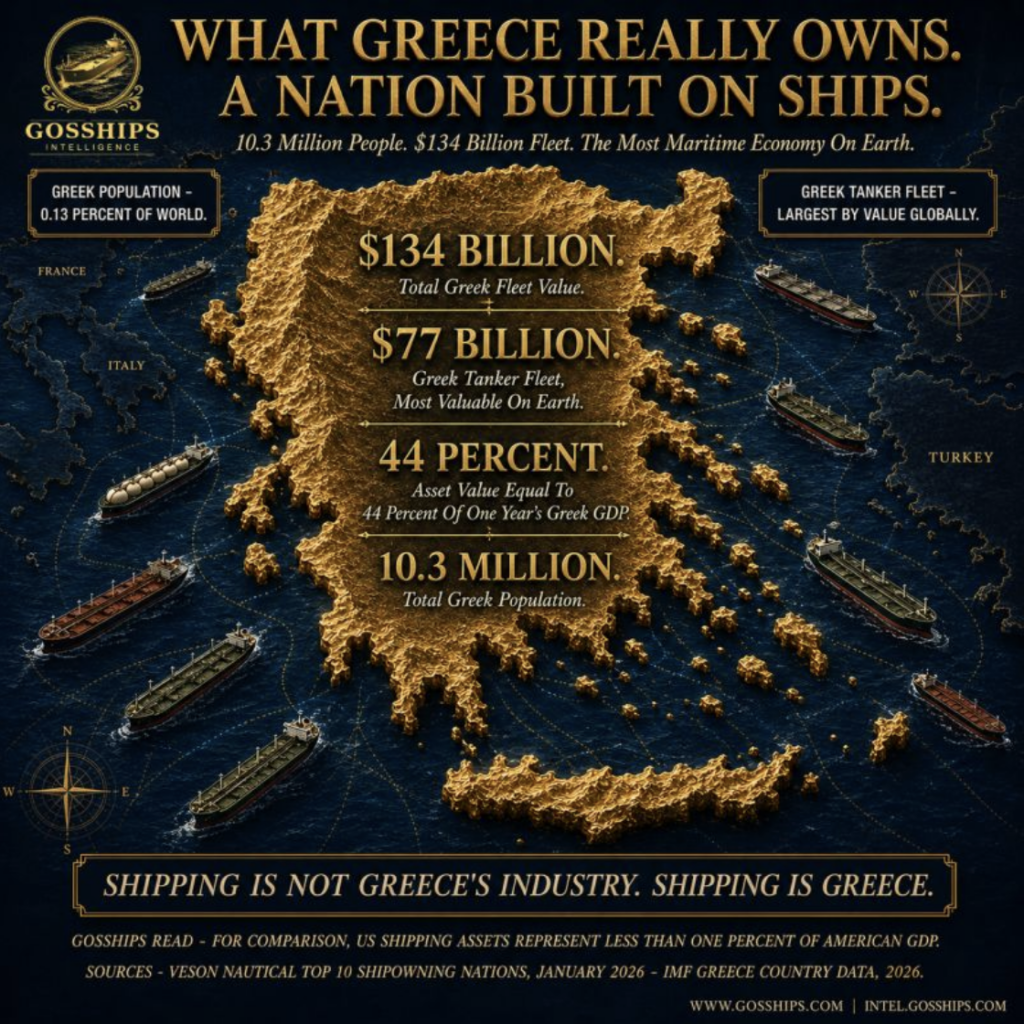
With a population of just 10.3 million people, Greece represents a unique global phenomenon: it possesses a shipping fleet with a total value of $134 billion, making it the most “maritime” economy in the world.
Data from Gosships Intelligence reflects the scale of Greek dominance in shipping. The Greek-owned tanker fleet is valued at $77 billion, the largest in value worldwide, while the LNG fleet reaches $31 billion, placing the country second internationally.
Overall, the value of Greek shipping assets corresponds to 44% of annual GDP, while Greece accounts for only 0.13% of the world’s population. By comparison, in the United States, with a population of 335 million, shipping assets account for less than 1% of GDP.
In practice, shipping is not merely a key sector of the economy, but the pillar of the country’s international influence. The role of the major Greek shipping companies is decisive.
Fleet expansions, such as those by Nikos Tsakos, lead to adjustments by refineries and energy markets. Shipowners such as Maria Angelicoussis, George Prokopiou and Vangelis Marinakis, through VLCC orders, directly influence international oil flows. This influence is also reflected in comparisons with other major powers. Greece surpasses China by $21 billion in tanker fleet value, despite the Asian country having a population of 1.4 billion.
On a per capita basis, each Greek corresponds to roughly $13,000 in maritime tonnage. This concentration explains why the decisions of Greek shipowners reach all the way to the fuel pump. Investments in new vessels affect freight rates, which in turn determine the cost of transporting energy. At the same time, the strong presence in LNG shapes global natural gas flows.
A key element of Greek success is the strategy of the shipowners, who act as counter-cyclical investors — positioning themselves during periods of uncertainty and maintaining strong positions as markets shift.
The result is an unprecedented concentration of shipping power among a limited number of players, unmatched in any other developed economy — a model that continues to shape the balance of international maritime transport.
Ask me anything
Explore related questions




