





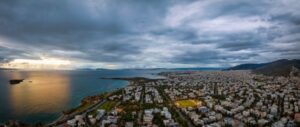
A full day after the strong odor that covered many areas of southern Attica for several hours, authorities are still searching for the source of the phenomenon, with no clear answers so far.
The first and main concern among residents was a possible natural gas leak. However, the company managing the natural gas network ruled out that scenario, clarifying that no issue was detected in the facilities or the network.
Kolydas’ analysis of the odor dispersion
Meteorologist Theodoros Kolydas added a new dimension to the case by analyzing how the smell may have dispersed using meteorological data.
In his post, he noted that “the episode of the intense odor detected in areas of Athens cannot be explained solely through general estimates or simple references to wind direction.”
As he explained, the HYSPLIT model was used — specifically the backward dispersion plume visualization from Nea Smyrni — in order to examine the path of air masses in the lower atmosphere before they reached the area where the odor was reported.
According to Kolydas, the results of this preliminary investigation do not prove a specific source, but they do highlight a possible area that requires further examination.
Focus on the coastal zone and the inner Saronic Gulf
The analysis shows repeated indications pointing toward the southern and southwestern sector of Attica — namely the coastal zone and the inner Saronic Gulf.
The meteorologist stressed that this data could serve as an initial scientific basis for the competent authorities, who are now expected to carry out more extensive measurements and inspections in the areas where the phenomenon was observed.
Excerpt from Kolydas’ post
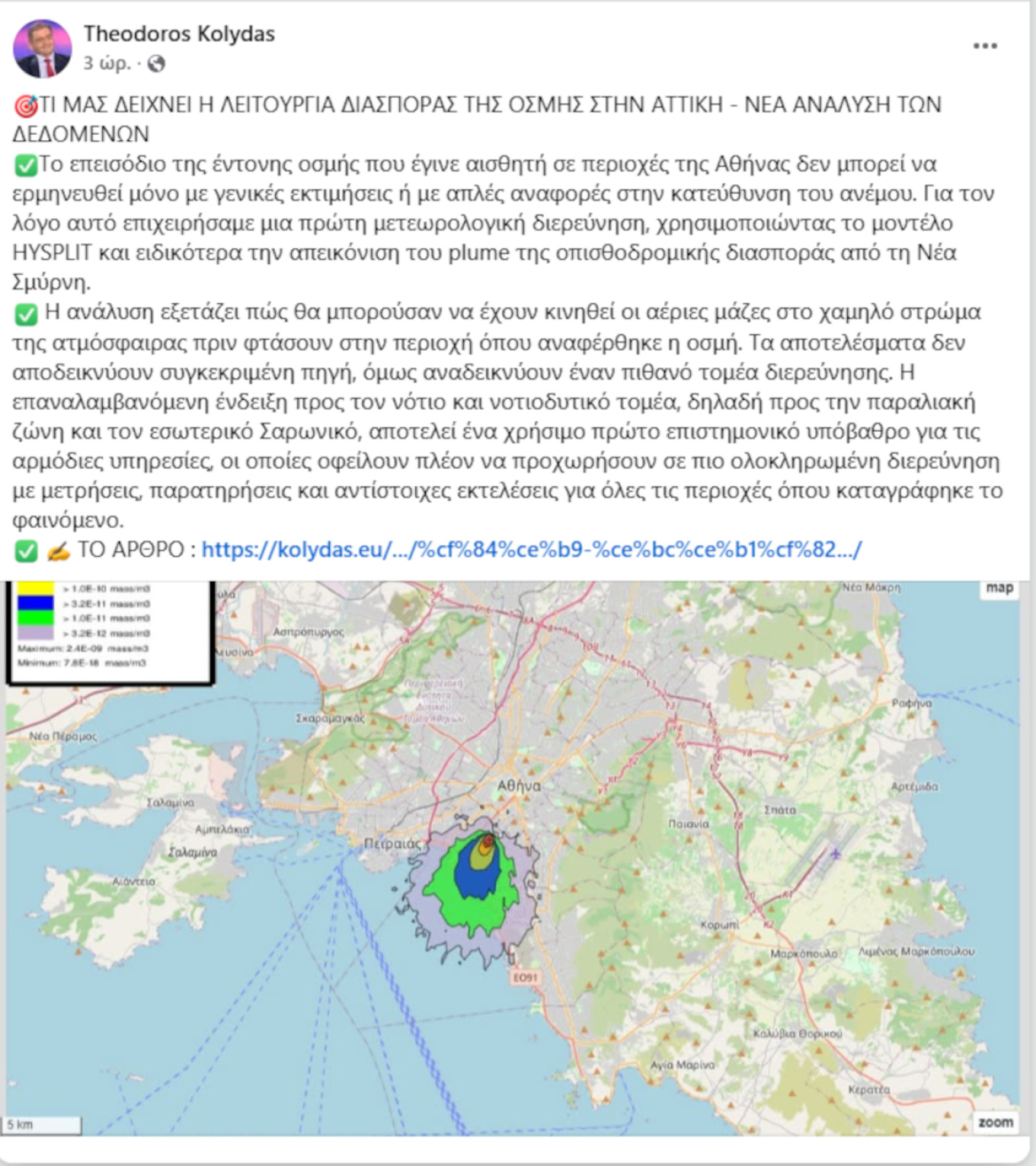
“What does the odor dispersion analysis in Attica show — new data analysis.
The episode of the intense odor that was perceived in parts of Athens cannot be interpreted only through general assessments or simple references to wind direction. For this reason, we carried out a preliminary meteorological investigation using the HYSPLIT model and specifically the visualization of the backward dispersion plume from Nea Smyrni.
The analysis examines how air masses in the lower atmosphere may have moved before reaching the area where the odor was reported. The results do not prove a specific source, but they highlight a possible area for investigation. The repeated indication toward the southern and southwestern sector — namely the coastal zone and the inner Saronic Gulf — provides a useful first scientific basis for the authorities, who must now proceed with a more comprehensive investigation involving measurements, observations, and similar analyses for all areas where the phenomenon was recorded.”
Synolakis: The characteristic “rotten egg” smell and deeper waters containing hydrogen sulfide and ammonia
Kostas Synolakis told Protothema that one possible explanation for the odor that disturbed large parts of Attica, especially the southern suburbs, may be linked to the particular characteristics of the Saronic Gulf combined with weather conditions.
He emphasized that hasty conclusions should be avoided and pointed to the proximity of Psytalia Wastewater Treatment Plant — one of the largest wastewater treatment facilities in the Mediterranean — as well as the long-term burden on the Saronic Gulf from nutrients and organic loads, which under certain conditions could result in the release of hydrogen sulfide and other gases.

The academic stressed that “what is immediately required is systematic measurements of the chemical composition of the waters, monitoring, and public transparency: measurements of oxygen, nutrients, hydrogen sulfide, and marine currents, as well as clear updates from the responsible authorities. Residents of the Saronic Gulf deserve scientific documentation and assurances that the environmental quality of the area is being monitored seriously.”
More specifically, Synolakis explained that in recent days an intense foul smell has been observed in the sea area between Salamina, Psytalia, and the exit toward the Saronic Gulf. While similar phenomena are not unknown in enclosed or semi-enclosed bays during warm periods, the intensity and scale of this event justify immediate scientific investigation and clear public information.
He noted that during spring and summer, parts of the Saronic Gulf experience strong thermal stratification: warmer surface waters sit above colder and often oxygen-poor deeper waters. Under certain wind and circulation conditions, deeper waters containing hydrogen sulfide, ammonia, and decomposition byproducts can rise to the surface through local upwelling or vertical mixing. Such episodes are often accompanied by the characteristic “rotten egg” smell.
At the same time, the proximity of the phenomenon to Psytalia naturally raises questions. Even highly advanced wastewater treatment systems can occasionally experience temporary malfunctions, overloads, sludge management issues, or failures in odor-control systems. Because the inner Saronic Gulf has areas with relatively weak water renewal and local recirculation, even short-lived disturbances can lead to noticeable odors over a wide area.
A third possibility involves broader eutrophication phenomena and reduced oxygen levels in deeper layers and seabed sediments. The long-term burden of nutrients and organic loads in the Saronic Gulf has left certain areas vulnerable to oxygen-depleted conditions during the warmer months, resulting in the release of hydrogen sulfide and other gases.
Finally, he added that the contribution of shipping or industrial activities from the wider Perama–Elefsina–Piraeus area should not be ruled out.
Ask me anything
Explore related questions




