





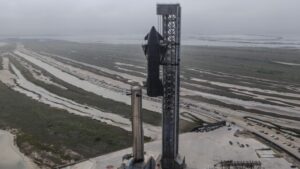
SpaceX is preparing for one of the most important milestones in the Starship program to date: the first test flight of its upgraded Starship V3 system from Starbase, Texas. The mission represents a critical step forward for the company’s long-term ambitions in deep space exploration, lunar transport, and Mars missions.
The launch is also being closely watched beyond the aerospace industry, with implications for NASA’s lunar roadmap under the Artemis Program and broader commercial expectations tied to SpaceX’s future financial trajectory.
The new SpaceX Starship V3 represents a significant upgrade over previous iterations. The system now stands at approximately 124 meters tall, making it the largest and most powerful version of Starship developed so far.
At its core, the vehicle is powered by the latest Raptor V3 engines. The configuration includes 33 engines on the Super Heavy booster and 6 on the Starship upper stage. SpaceX claims these engines deliver higher thrust performance while improving reliability across multiple flight cycles.
Key engineering upgrades focus on full reusability and in-orbit refueling capability—both essential for long-duration missions to the Moon and Mars. These capabilities are central to SpaceX’s long-term vision of building a fully reusable interplanetary transport system.
The upcoming mission will also serve as a key test for satellite deployment systems. The upgraded Starship will carry 20 test satellites alongside two operational Starlink satellites.
These payloads include experimental camera systems designed to monitor how the heat shield performs during atmospheric re-entry, providing valuable data for future missions and spacecraft redesigns.
Success for Starship V3 is closely linked to NASA’s upcoming lunar missions. SpaceX has been selected to provide the Human Landing System for astronauts returning to the Moon as part of future Artemis missions, including Artemis IV Mission, currently targeted for 2028.
However, several key milestones still lie ahead. Starship has not yet completed a fully successful orbital mission, and critical technologies such as orbital refueling, long-duration space operations, and human-rated life support systems still require validation.
NASA is also expected to conduct additional orbital demonstration missions in the coming years, including Earth-orbit tests involving docking procedures with the Orion spacecraft.
The stakes for the Starship V3 test extend beyond SpaceX. A successful flight would strengthen SpaceX’s dominance in the commercial launch sector at a time when competitors are advancing their own lunar systems.
One of the most notable rivals is Blue Origin, which is actively developing its Blue Moon lunar lander and increasing testing activity in preparation for future missions.
Any major failure in the Starship program could introduce delays, particularly as NASA continues to rely on multiple commercial partners for lunar infrastructure development.
Beyond technical and scientific implications, Starship’s performance is also tied to SpaceX’s long-term commercial valuation. The company is widely reported to be preparing for a potential public offering in the future, with speculative valuations reaching as high as $1.75 trillion.
A successful Starship program is considered central to that valuation, as it underpins multiple revenue streams including satellite launches, interplanetary cargo missions, and human spaceflight services.
A significant failure, on the other hand, could affect investor confidence and delay strategic milestones tied to commercialization.
SpaceX CEO Elon Musk has downplayed concerns about potential setbacks, emphasizing the company’s iterative development approach.
He has suggested that even unsuccessful test flights are part of the engineering process, noting that failures would not fundamentally derail the program unless they cause major damage to ground infrastructure.
The Starship V3 test flight represents a defining moment for SpaceX. With implications spanning NASA’s Artemis program, commercial satellite deployment, and long-term interplanetary ambitions, the outcome of this mission could shape the future of space exploration for years to come.
Whether it succeeds or encounters setbacks, the launch underscores the high-risk, high-reward nature of developing next-generation spaceflight technology.
Ask me anything
Explore related questions




