





Greece is entering the summer season with a 9.3% increase in demand for Airbnb-type short-term rentals, according to current booking data, as shown in AirDNA figures. The average price for the summer period stands at €174.
Demand for short-term rentals in Greece for the summer season is increasing by 9.3% compared to last year, reaching 3.9 million overnight stays.
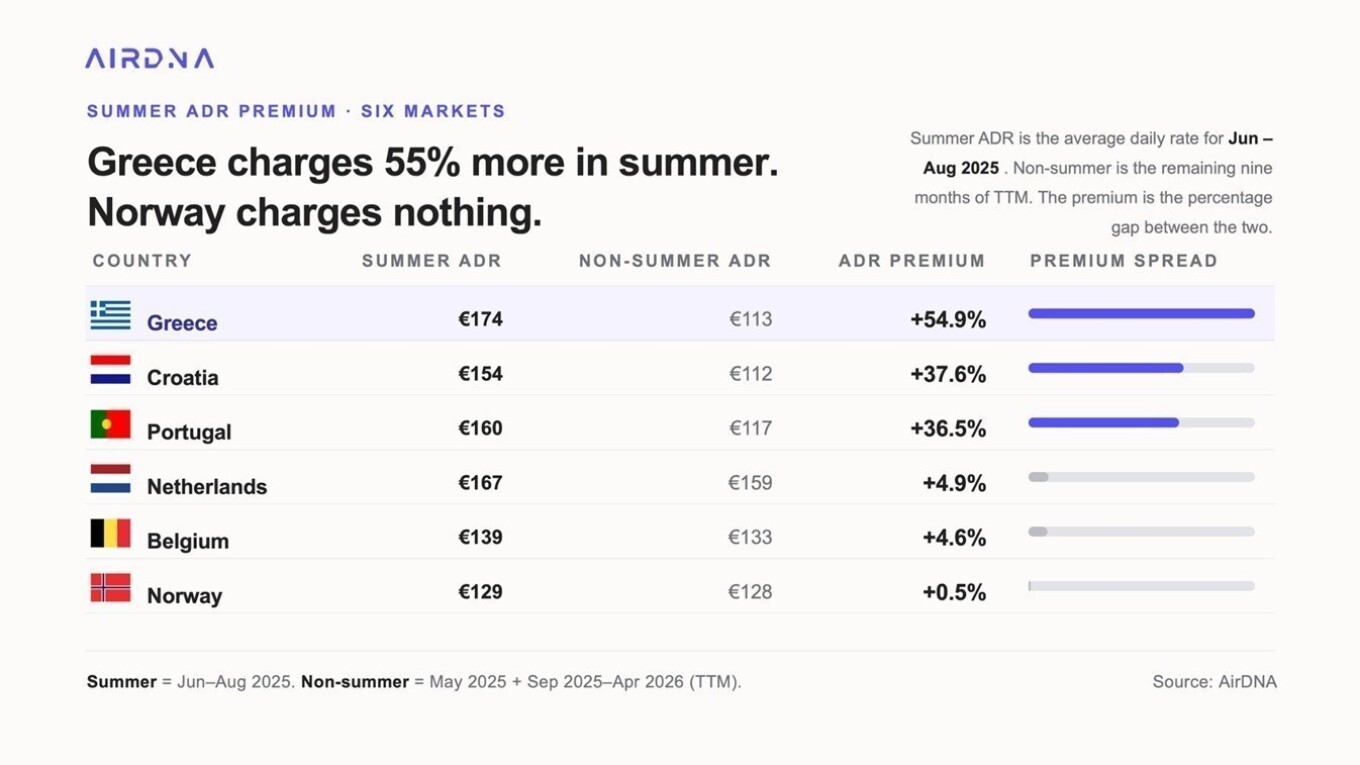
Greece records the highest seasonal price premium in Europe this year at 55%, with an average summer price of €174.
Total demand for the summer season across Europe’s 20 largest short-term rental markets is increasing by 7.8%.
Northern Europe is showing stronger performance this year, with Denmark recording the largest increase in Europe (+50.9%).
In April, demand in the Greek market decreased by 7% year-on-year, while the average daily price increased by 7.8%.
Greece is entering this year’s summer season with strong momentum in short-term rental demand, despite a more subdued picture recorded in April.
The data comes from the latest European analysis by AirDNA. According to the pre-bookings for the summer period, demand in Greece for Airbnb-type accommodations is already running 9.3% higher compared to last year, reaching 3.9 million overnight stays.
July (+13.5%) and August (+11.4%) show the strongest growth, while September also shows strong momentum (+12.4%), confirming the extension of the tourist season.
Notably, demand growth in Greece exceeds the European average of 8.2%, while the country also shows the highest seasonal price premium in Europe at 55%. This reflects significant room for price increases during peak season: the average summer price (June–August) is €174, compared to €113 in the remaining nine months outside the peak season.
Croatia ranks second with a summer premium of 37.6% and an average summer price of €154, followed by Portugal with +36.5%, with an average nightly price of €160 during the summer.
Impact of the Middle East situation
Regarding the impact of geopolitical developments in the Middle East on travel for the upcoming European summer season, the combination of higher transportation costs and stable employment levels is expected not so much to reduce travel demand, but rather to change how and where Europeans travel, with an increase in domestic trips and nearby destinations.
In major European markets, domestic travel already represents a key pillar of demand: in 2025, domestic travel accounted for 67% of short-term rental demand in France, 66% in the UK, and 55% in Germany.
Under these conditions, rising fuel prices are expected to mainly discourage long-distance and international travel. However, markets with strong domestic travel bases are better positioned to offset potential declines in foreign demand, as more travelers may choose closer destinations rather than cancel trips altogether.
Summer in Europe
Demand for the 2026 summer season (June–August) across the 20 largest European short-term rental markets remains strong despite geopolitical uncertainty, increasing by 7.8% compared to last year, equivalent to 6.4 million additional overnight stays. Overall, 17 out of 20 major markets currently show a better outlook than in summer 2025.
The key trend this summer is stronger performance in Northern Europe compared to traditional Mediterranean destinations.
- France remains the largest market with 22.7 million overnight stays and +8.7% growth
- Italy (+11.6%) and the UK (+13.6%) continue strong growth
- Spain shows more modest growth (+1.9%), possibly indicating saturation or price resistance in coastal destinations
- Germany is slightly negative (-0.5%)
In Mediterranean markets:
- Greece (+9.3%) with 3.9 million overnight stays
- Portugal (+5.7%) continues steady growth
- Croatia (-6.4%) shows the weakest performance among the 20 largest markets
Northern Europe is the standout region:
- Denmark (+50.9%)
- Poland (+19%)
- Sweden (+17.8%)
- Norway (+15%)
Smaller markets such as Belgium, Ireland, Hungary, Finland, and the Czech Republic also show positive growth.
Overall, European summer travel demand continues to spread geographically, with more travelers choosing alternatives to traditional southern destinations, as high prices, overtourism, and extreme summer temperatures increasingly influence visitor behavior.
April performance
For April, Greek demand fell by 7% year-on-year, while occupancy dropped to 54.8%, following the broader European trend where supply is growing faster than demand.
However, in Greece, available listings decreased by 3.6%, limiting pressure on occupancy rates.
At the same time, property managers continued to raise prices:
- ADR increased by 7.8% to €107.1
- RevPAR increased by 2.1% to €58.7
Across Europe, short-term rental markets continued to grow in supply (+3.6%), reaching 3.71 million listings, while demand fell by 5.7%, reducing occupancy to 55.3%.
Despite weaker demand, prices continued to rise:
- ADR increased by 6.3% to €127.3
- RevPAR increased by 2.5% to €70.4
Ask me anything
Explore related questions




