





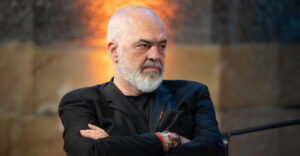
When Edi Rama welcomed Ivanka Trump and Jared Kushner to Tirana in 2024, he made sure to heavily promote both the dinner they shared and the couple’s plans for a massive tourism investment based on two pillars: one on the uninhabited island of Sazan, which still bears traces of its past as a military base under Hoxha, and the other in the Vjosa–Narta area, one of Europe’s most important coastal habitats.
However, the start of construction work on the tourist resort has triggered one of the biggest crises for Rama’s government, which renewed its mandate for a fourth term last year.
Protests
Following the incidents last Saturday in Zvërnec, demonstrations in Tirana have become a daily occurrence, with tens of thousands of citizens participating. The issue is gaining attention not only because of its connection to the son-in-law of U.S. President Donald Trump, but mainly because Albanian environmental organizations are denouncing what they describe as an unprecedented scandal regarding the transfer of the land, while a large portion of it is being claimed in court by local residents.
Most of those residents belong to the Greek national minority and lost their properties when the communist regime abolished private ownership. After the fall of the regime in 1991, as MEP Fredi Beleri told THEMA, ownership titles began to be issued, but they were not final, and various cases remain pending before property restitution committees.
Faced with growing opposition, with protesters in the streets and the opposition seeking to increase pressure, the Albanian prime minister has attempted to identify an “external enemy,” a practice dating back to the communist era. He initially directed his accusations toward Greece, while more recently there has been talk of Russian involvement and hybrid warfare conducted through the internet.
After last Saturday’s incidents, which attracted worldwide attention—especially images showing an ethnic Greek protester being dragged across the ground and injured by members of a security company—the SPAK (Albania’s Special Anti-Corruption and Organized Crime Prosecution Office) began investigating the allegations and has already launched a criminal investigation into how the land was transferred, where the funds used to acquire it originated, and has simultaneously halted the construction works.
Albanian environmental organizations, led by PPNEA (Protection and Preservation of Natural Environment in Albania), have alleged that no proper procedures were followed: no construction permits, no work permits, and no environmental impact studies.
“Such illegalities did not occur even during Albania’s darkest days,” they state, adding that although the government amended the law on protected areas to allow construction of the five-star resort, it is now violating even that amended law.
It is noted that at the end of 2024, the Albanian government rapidly granted “strategic investor” status to Atlantic Incubation Partners LLC, a company directly linked to Affinity Partners, Jared Kushner’s investment fund.
The Ethnic Greek Minority
Following the injury of the Greek citizen in Zvërnec, Greece’s Foreign Ministry immediately contacted Albanian authorities. The injured man was transferred to the Hospital of Ioannina and later discharged.
Ethnic Greek minority are claiming ownership of more than 100 hectares in the disputed area.
In an effort to cope with the intense domestic backlash, Rama tried to shift the issue toward Greece. He first claimed he was unaware of the presence of a Greek ethnic population in the area and then compared the situation with reactions to investments in Greece. At the same time, articles began appearing that spoke of “the neighbor’s jealousy” regarding Albania’s tourism development.
However, the opposition has proven far broader than Rama anticipated and includes many different groups: people who fear losing their properties, environmental organizations denouncing what they see as an ecological crime in a highly significant habitat, nationalist groups whose central slogan is that Albania should not be sold off, Albanian investors who see opportunities being lost, and an opposition eager to pressure Rama in his 13th year as prime minister.
Rama insists that all procedures concerning the transfer of the 100,000-stremma property were legal. In a statement, he spoke of “enemies of European Albania”:
“Two projects already implemented by the co-investors of the project that has shocked the enemies of European Albania, the competitors of tourist Albania, the blind Albanians who are used as blind instruments against Albania, as well as honest and environmentally sensitive Albanians who have unfortunately been manipulated by the hybrid war being waged ferociously on social media by the country’s enemies.”
Rama presents Albania’s tourism development as one of his government’s successes and boasts about the increasing number of visitors.
However, even those figures are disputed, as they include people merely passing through Albania on their way to destinations such as Greece, as well as Albanian citizens visiting their hometowns. These groups are estimated at around two million annually, many of whom travel more than once per year.
The model of tourism development being pursued also resembles that of Greece in past decades: lacking infrastructure and planning. For example, Dhërmi, which has experienced enormous growth in recent years, is now described by many as “a crowded urban neighborhood with a beach,” emphasizing its uncontrolled concrete expansion.
The incidents in Zvërnec, which brought widespread publicity to the investment project, prompted a parliamentary question to the European Commission by New Democracy MEP Fredi Beleri.
After noting that the developments occurred on land that had been unlawfully confiscated, not returned to its lawful owners, and was effectively being occupied, he added that the incidents raise serious questions about respect for fundamental freedoms, property rights, and the protection of recognized national minorities in a country seeking accession to the European Union.
The Reactions
A leading role in the escalating protests in Tirana is being played by PPNEA.
Its executive director, Aleksander Trajçe, who holds a master’s degree in Biodiversity from Oxford and a PhD in Environmental Anthropology from the University of Roehampton in London, explained to THEMA the enormous environmental importance of the Adriatic coastal area targeted for the investment:
“It is a protected landscape classified in Albania as a Category V protected area and is known for its extraordinary diversity of bird species.
The Narta Lagoon, as it is called, is Albania’s second most important coastal lagoon. More than 220 bird species have been recorded there, while over 20,000 migratory birds arrive every winter. It forms part of the wider Vjosa River Delta, the last wild river delta in Europe. As an internationally recognized Important Bird Area and part of the Emerald Network, it plays a crucial role in biodiversity conservation. Upon Albania’s accession to the European Union, it is expected to become part of the Natura 2000 network, further strengthening its protected status.”
Mr. Trajçe notes:
“Based on the research we have conducted, motivated by our concern for preserving the area, we know that the land appears to consist of a mixture of public and possibly private property. We have seen reports referring to disputed ownership rights, although we have not fully investigated those claims. What we know with certainty is that a significant portion of the area is publicly owned.
This includes at least two natural monuments: the Molassic Hills of Zvërnec and the Limopouo Lagoon, which together cover 35 hectares of protected natural monuments. In addition, there are three public beaches: Dailan Beach, Porto Novo Beach, and Hidrovori Beach.
Beyond these public areas, some residents claim land-use rights, while legal disputes over private properties appear to be ongoing.”
The organization’s protests, along with those of other environmental groups, began after bulldozers entered the site, which was subsequently fenced off and closed to public access.
The fenced area even includes the medieval Monastery of the Life-Giving Spring, which celebrates its feast day on August 15 and serves as a gathering point for the local Greek community in the area known as Nisi. The monastery is reached by walking across a wooden bridge.
“PPNEA organized an on-site protest on May 16, followed by a second demonstration on May 26 outside the Ministry of Environment in Tirana,” said Mr. Trajçe.
“Then, on May 30, a local protest took place near the southern section of the fence, close to the village of Zvërnec.
During that protest, a citizen was violently dragged inside the site by private security guards and suffered serious injuries, an incident captured on video. The images shocked the public and spread rapidly on social media, triggering a wave of outrage.
That same Sunday, tens of thousands of people gathered in Tirana, and from that point onward, daily mass protests spread throughout the city, attracting thousands of citizens every evening and giving new momentum to the movement.”
“Trump’s Island”
Opposition in Albania had already begun when Ivanka Trump and Jared Kushner announced their investment plan for the small island of Sazan, which once belonged to Greece.
It has been described as “a small rock in the Adriatic,” a kingdom of snakes, crickets, and birds, with natural vegetation including wild lavender and 300-year-old stone pines, as well as remnants of Albania’s communist past—bunkers dating from the period when the island, now referred to by Albanians as “Trump’s Island,” served as a military base.
At the time, the investment was estimated at €1.4 billion, but Rama recently referred to a project with a total value of €4 billion.
According to the Agence France-Presse report, when AFP contacted Affinity Partners seeking information about the investment, it was referred to the communications firm P2 Public Affairs.
The company responded in writing, expressing its “enthusiasm for the idea of creating a world-class destination and carrying out one of the most significant private investments in the region,” adding that the concept belongs to “Asher Abehsera, president of Sazan Real Estate Development LLC,” the company presented as the project manager, “together with a broad group of investors.”
However, AFP noted that it was unable “to identify any legal record confirming the existence of this company.”
Ask me anything
Explore related questions




