





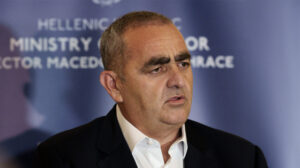
The European Parliament has adopted the European Commission’s report on Albania, which recognises that the Greek national minority of Northern Epirus maintains a strong historical presence, particularly in the south, and calls on the neighbouring country to ensure the protection of property rights. MEP Fredi Beleris stressed that, for the first time, the report recognises both the historical presence and the property rights of the Greek minority.
The European Parliament plenary approved the European Commission’s 2025 report on Albania by a broad majority. The report incorporated amendments submitted by New Democracy and European People’s Party (EPP) MEP Fredi Beleris in cooperation with EPP MEPs Vangelis Meimarakis and Andrey Kovachev.
The amendments highlighted Albania’s key shortcomings in the areas of the rule of law, human rights and minority rights, while including, for the first time in the history of the report, an explicit reference to the Greek national minority. The recognition of both the historical presence of the Greek national minority in Albania and its property rights now constitutes an official position of the European Parliament.
In addition, the report calls on Albania to achieve decisive progress in the initial registration of properties and in providing fair, mutually agreed compensation, by improving the transparency of the state cadastre and the quality of cadastral data in the property register. It also calls on the country to ensure respect for the right to a fair trial and the right to effective legal remedy in cases involving expropriation and the confiscation of property.
At the same time, it recalls that the judiciary continues to face political pressure and threats that risk undermining judicial independence in Albania.
Parliamentary immunity forms part of Albania’s constitutional framework, designed to safeguard the proper functioning of democratic institutions. The report stresses that any related decisions should be taken strictly in accordance with constitutional provisions and established legal procedures, without political interference and without unnecessary delay.
The report calls for enhanced transparency, conflict-of-interest checks, integrity risk assessments and targeted preventive measures in high-risk sectors, particularly public procurement and concession contracts, licensing and inspections, as well as construction and spatial planning.
Furthermore, it expresses concern over serious irregularities identified by the European Anti-Fraud Office (OLAF) during the implementation of the EU Instrument for Pre-Accession Assistance for Rural Development program (IPARD II) in Albania. It underlines the importance of ensuring full transparency, accountability and effective oversight mechanisms in the use of EU financial assistance in order to protect the EU’s financial interests and maintain public trust.
During his address to the plenary session, Mr Beleris stated:
“The report we are discussing recognises both Albania’s desire to become a full member of the European Union and the European Parliament’s willingness to support it. Today, Albanian citizens are protesting over the lack of democracy, the lack of prosperity, violations of property rights, the manipulation of the judiciary, the government’s close ties with organised crime and, ultimately, the abandonment of the country by its young people. Naturally, these pathologies place a disproportionate burden on minorities, particularly the Greek minority, which is the largest.”
He added:
“The concealment of reality, the whitewashing of the situation and, in many cases, Commissioner Kos’s alignment with the Albanian Prime Minister are interpreted by a large part of Albanian society not as support for the Albanian people in achieving their European dream, but as support for Rama. We must be clear. Yes to accession, but without compromises on the European acquis.”
The report was approved with 483 votes in favour, while 103 MEPs voted against and 70 abstained.
Ask me anything
Explore related questions




