





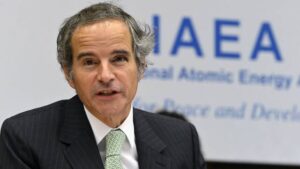
The Memorandum of Understanding (MOU) between the U.S. and Iran stipulates that UN inspectors will have access to Iranian nuclear facilities, as reiterated on Friday by the head of the International Atomic Energy Agency (IAEA), following indications from Tehran that key sites would remain off-limits until a final agreement is reached with Washington and sanctions are lifted.
“There is an agreement, and for it to be upheld, the IAEA must have access and conduct inspections,” said the agency’s director general, Rafael Grossi, at a press conference in Japan. “We hope to be there soon.”
A “very robust” verification system is needed in Iran following the conflict in the Middle East to ensure that the country does not develop nuclear weapons, stressed the UN’s top nuclear official.
“I believe the goal of this agreement is to ensure that there is no development of nuclear weapons in Iran. The Iranian government has clearly stated that this is not its intention,” Rafael Grossi told reporters in Japan. “But, of course, intentions are not enough. There must be a very robust verification system… as soon as possible,” he added.
Iran calls on Gulf states to support the initiative for a nuclear-free Middle East
Meanwhile, Iran called on the states of the Gulf Cooperation Council (GCC) to support the initiative to create a nuclear-weapon-free zone in the Middle East.
At the same time, Tehran rejected the positions of the United States and the Israeli government regarding Iran’s “peaceful nuclear program,” calling them false allegations.
The Iranian Ministry of Foreign Affairs called on the GCC countries to support the initiative for a nuclear-free Middle East “rather than aligning themselves with policies that portray Iran as a threat.”
At the same time, it emphasized that lasting peace and security can be achieved only through regional cooperation without external interference, condemning efforts to portray Iran’s defense capabilities—including missiles and drones—as threatening.
Iran Says U.S. Military Presence in the Gulf Is a Source of Regional Insecurity
At the same time, Iran argued that the U.S. military presence in the Gulf is a source of regional insecurity, while insisting that the Strait of Hormuz should be controlled by Iran and Oman.
A statement from the Iranian Ministry of Foreign Affairs noted that the joint statement by the U.S. and the Gulf Cooperation Council contained “interfering, irresponsible, and provocative positions,” while Tehran reiterates that the U.S. military presence in the Persian Gulf is a source of instability and division in the region.
Iran also insists that the Strait of Hormuz must be jointly managed with Oman, in accordance with the terms of the memorandum of understanding with the United States.
Ask me anything
Explore related questions




