





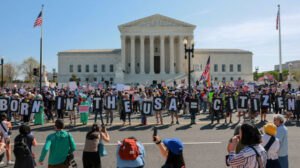
In a ruling seen as a major blow to U.S. President Donald Trump, the Supreme Court today struck down his attempt to challenge the “birthright citizenship” provision, that is, the granting of citizenship to all those born on U.S. soil.
By a 6-3 vote, the Court struck down the executive order signed by Trump last year, immediately upon his return to the White House for his second term. This executive order repealed the birthright citizenship provision for the children of undocumented immigrants born in the U.S., as part of the strict measures he was attempting to impose to curb immigration.
This is the second time this year that the Supreme Court has struck down a major Trump initiative. In February, it struck down his decision to impose sweeping tariffs worldwide.
The U.S. Supreme Court has blocked President Donald Trump’s executive order to end birthright citizenship for all individuals born on U.S. soil, ruling that children born in the country remain entitled to citizenship under the Constitution. pic.twitter.com/vNGRPGgZu8
— Al Jazeera English (@AJEnglish) June 30, 2026
The three liberal justices and three of the conservative justices, including the Chief Justice, upheld the lower court’s ruling, which had blocked Trump’s order directing U.S. agencies not to recognize the citizenship of a child born in the U.S. if neither of the child’s parents is a U.S. citizen or a lawful permanent resident (holder of a so-called “green card”).
The lawsuits filed against the executive order argued that it violated the 14th Amendment to the Constitution. Trump’s critics accused him of racial and religious discrimination in his approach to immigration.
The Supreme Court is thus weighing in on the question of what it means to be an American citizen, just four days before the Fourth of July celebrations and the 250th anniversary of the founding of the United States.
Before the ruling was issued, experts estimated that Trump’s executive order could affect the legal status of up to 250,000 babies born each year, while the families of millions more would have to prove the citizenship of their newborns.
Parents and children whose citizenship was threatened had filed a lawsuit against the executive order in the state of New Hampshire.
The 14th Amendment, passed in 1868, has for decades been regarded as the guardian of citizenship for all babies born in the U.S. Very few cases are exempt from this provision: the children of foreign diplomats or members of an enemy occupying force. The provision in question, the Citizenship Clause, states that “all persons born in the United States or naturalized therein and subject to its jurisdiction are citizens of the United States and of the State in which they reside.”
The Trump administration argued that the phrase “subject to the jurisdiction” of the U.S. meant that being born in the country is not sufficient to acquire citizenship, and that the children of immigrants who are in the country illegally or legally but temporarily – such as the children of university students or holders of temporary work visas.
When the Supreme Court heard the case and considered the arguments from both sides on April 1, Trump made history as the first sitting president to attend a hearing. However, he did not stay in the courtroom for long, as he left as soon as the opposing attorney began presenting his arguments.
According to the petitioners, the Supreme Court had already considered and ruled on the issue in 1898, in the case “United States v. Wong Kim Ark,” in which it was recognized that the 14th Amendment grants citizenship to all those born on U.S. soil, even the children of foreigners.
Conservative Justice John Roberts, who authored the majority opinion, stated that Trump’s executive order violates the language of the 14th Amendment, which guarantees citizenship to anyone born in the U.S. – with very few exceptions.
“Citizenship, then and now, has been the right to have rights, to participate freely in our political community,” he wrote, noting that the framers of that document promised that right to every free person in the country.
“Today, we uphold that promise,” he added.
Roberts recalled the 1898 court decision. “It is no surprise, therefore, that in the 128 years since then, we have repeatedly interpreted the Wong Kim Ark case as guaranteeing citizenship to all children born in the United States and subject to its jurisdiction. “We see no reason to depart from this view today,” he added.
Roberts noted that there was “very little evidence” to support the Trump administration’s “highly revisionist view” regarding the interpretation of the 14th Amendment to limit birthright citizenship.
It should be noted that conservative Justice Brett Kavanaugh agreed with the decision to strike down Trump’s executive order, but for different reasons: According to his reasoning, the executive order violates a separate federal law regarding the right to citizenship, not the 14th Amendment.
Ask me anything
Explore related questions




