





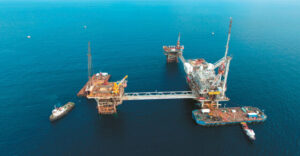
The path is opening for an investment expected to exceed €1 billion in Prinos, northern Greece, with Development Minister Takis Theodorikakos signing the installation permit for the new offshore platform of EnEarth’s carbon dioxide storage project.
EnEarth, a subsidiary of Energean, is developing what will become the first underground permanent carbon dioxide storage facility in Southeast Europe, using the depleted oil reservoirs of Prinos. The permit allows work on the new offshore platform to begin, reportedly in October, marking the effective launch of the investment.
It is the first permit of its kind issued for such a project in Southeast Europe and only the third in the European Union.
The project is designed to store carbon dioxide captured from cement plants, refineries and other energy-intensive industries, preventing it from being released into the atmosphere. For Greek industry, however, the project is not only an environmental tool. It is also expected to help curb the rising cost of CO2 emission allowances, helping businesses remain competitive as the European Union continues to tighten climate regulations.
The “Omega” platform
The permit signed by Theodorikakos concerns the installation of the new offshore “Omega” platform, which will form the core of the project. From there, carbon dioxide will be injected into the depleted oil reservoirs of Prinos, thousands of metres below the seabed, where it will be stored permanently and safely.
Once fully operational, the facility will be able to store up to 2.8 million tonnes of carbon dioxide per year. Its first phase is expected to have a capacity of 1 million tonnes annually, while the reservoir’s total storage capacity is estimated at around 66 million tonnes, making Prinos one of the most important facilities of its kind in Europe.
The investment is also a key part of a wider network of industrial projects already under way in Greece. These include AGET Heracles’ OLYMPUS project at its Milaki plant and TITAN’s IFESTOS project at its Kamari plant in Boeotia. Both involve the installation of specialised units to capture carbon dioxide from cement production, which will then be transported to Prinos for permanent storage.
So far, EnEarth has signed 16 non-binding memorandums of understanding with Greek and European industries for the storage of a total of 6.12 million tonnes of carbon dioxide. Companies involved include TITAN, AGET Heracles, HELLENiQ ENERGY and Motor Oil, while further agreements are expected.
The main driver is economic. As the European Union’s Emissions Trading System becomes stricter, industries face steadily rising costs for carbon dioxide emissions. Permanent CO2 storage offers companies a way to reduce that burden, preserve competitiveness and continue producing in Greece.
According to EnEarth estimates, the infrastructure could help safeguard more than 150,000 jobs directly or indirectly linked to energy-intensive industries, which account for around 32% of Greek exports. It is also expected to create the foundations for a new investment ecosystem around carbon dioxide capture, transport and storage.
A new licensing model
The speed with which the permit was issued was not accidental. The process was completed in around two weeks, an unusually short period for an investment of this scale and complexity.
This was made possible by the special regime applied to Projects of Common Interest, (PCI projects), with the General Secretariat for Private Investment at the Ministry of Development, headed by Stellina Siarapi, acting as a one-stop shop for all agencies involved.
In practice, the General Secretariat coordinates the relevant authorities so that their opinions are assessed in parallel rather than consecutively, significantly reducing licensing times. The model applies to projects included in the European Union’s lists of Projects of Common Interest and Projects of Mutual Interest, which are designed to accelerate strategic cross-border infrastructure investments.
Prinos’ inclusion on the EU’s PCI list not only ensures faster permitting. It also opens the way for European funding and for the integration of Greek infrastructure into the wider carbon dioxide transport and storage network now being developed across Europe.
EnEarth has already secured funding from the Innovation Fund, while the infrastructure is being designed to serve not only Greek industries but also companies in neighbouring countries. For this reason, the project is considered strategically important both for Greece and for the European Union.
If the timetable is met and work begins in October, Prinos will become the first Greek PCI project to move effectively from planning to implementation. Alongside it, a new market will begin to take shape around carbon dioxide capture and permanent storage, with Greece seeking a leading role in Southeast Europe.
Ask me anything
Explore related questions




