





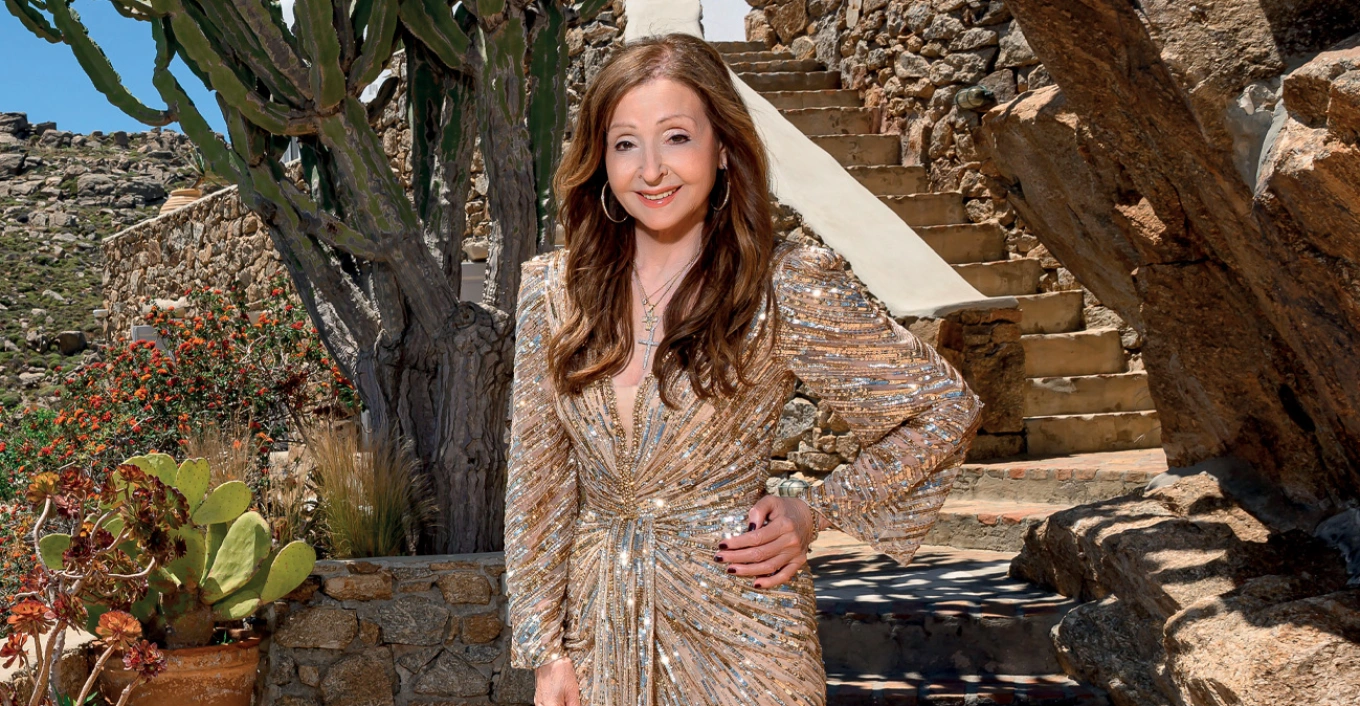
Having sold more than 100 million records internationally and carrying memories of performances at some of the world’s greatest theatres, Vicky Leandros counts 54 years of success on the music scene. Following her honorary appearance at this year’s Eurovision in Vienna and ahead of her upcoming concert at Sani Festival in Halkidiki, we meet her in her private paradise in Mykonos.
“I come here to rest. I love the island and the opportunity my home gives me to withdraw from everything. Very often, I host friends and relatives. My children adore Mykonos,” she says as she welcomes us. Her house seems hidden among the rocks, perfectly in harmony with the surrounding landscape. “The strange thing is that I bought it one winter while I was in Germany and could not travel to Greece. I saw it through a video call and fell in love with it. Here I recharge, I wake up early and swim for hours, I relax in the sun… Our country is a magical place!”
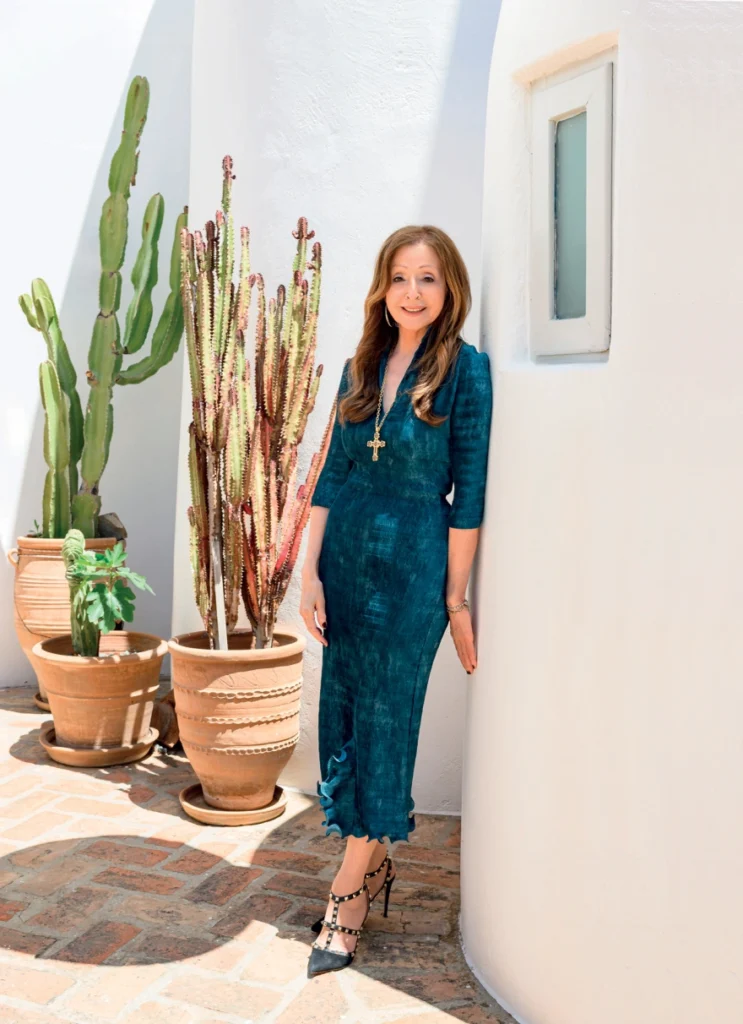
On the evening of 12 May, Vicky Leandros, following the anniversary video marking 70 years of Eurovision that opened the first semi-final of the contest, performed “L’amour est bleu”, the song with which she represented Luxembourg in 1967. “When I first went to Eurovision, I was barely 15 years old and had no sense of danger. I came fourth and was a little disappointed, but that song became my first major international success and sold more than 10 million records.” Five years later, in 1972, she won first place with “Après toi”, again representing Luxembourg.
Vicky Leandros did not achieve international recognition by chance. Having been immersed in the artistic world from a very young age, she managed, through the unique tone of her voice and the powerful emotions she conveys on stage, to be described not merely as successful, but as a phenomenon. I ask her about this impressive and long-lasting journey.
“It has been a wonderful journey, with difficulties but also unexpected surprises. I was lucky because, from the time I was a little girl, I had the support of my father, Leandros Papathanasiou, this great composer and record producer. The team was strong and united. But what ultimately led me to success was willpower. In a long journey there are difficulties and disappointments; no one can take success for granted. Those who stand out are the ones who have the inner strength to keep going,” she says, taking the opportunity to add something more: “Some people ask me, ‘But since you started so young with Eurovision, don’t you feel you lost the carefreeness of childhood?’ Well, not at all.
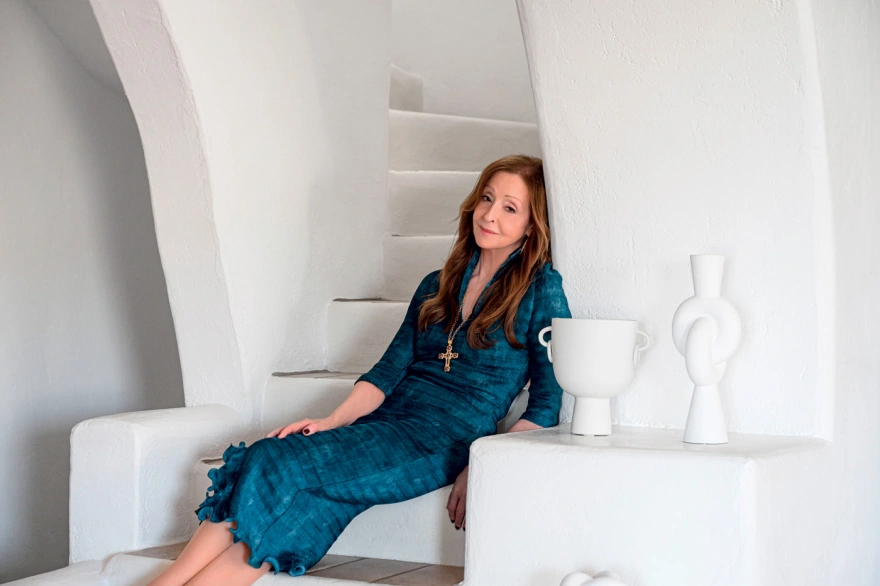
Because my father always made sure that I lived like other girls my age. He may have arranged some television appearances for me, but beyond that there was school, friendships. I have strong relationships that I have maintained since childhood.” With her recent appearance in mind, I ask her how much Eurovision has changed compared with her own experience. “Today’s music contest bears no resemblance to the one of the past. Now we are talking about a huge stage, spectacular lighting and supporting sets that create a super-show. In my time, things were completely different.”
From the age of five, she lived with her parents in Hamburg, where her base remains today. A mother of three children — Leandros, Milana and Sandra — she has instilled in her family a love for Greece. “I learned to speak Greek at home, and I did the same with my children. In my home there was always, and still is, a strong Greek element. We know the culture of our homeland, we cook Greek food. The family is close, according to our traditional values.
Even today, on holidays and celebrations, everyone gathers at my house and I cook for them,” she says with a happy smile. Beyond being a woman fulfilled by success, she is also a devoted mother and grandmother, enjoying every moment of those roles. “My grandchildren come to my house every day — on the days, of course, when I do not have concerts or other professional obligations. I cook for them and we spend hours together. Things flow completely naturally at home, as if I were not the Vicky the world knows through music, but any grandmother. It was funny because two hours before I appeared live at the semi-final in May, my phone rang. It was my grandson, calling to ask whether I could pick him up by car. I told him I was at Eurovision!” she says with her characteristic directness, and we burst out laughing.
“I have always believed that a great career and success are not the only important things in an artist’s life. For me, family and my children have always mattered more. I must also admit that I never felt professional insecurity. Even during difficult times, when my career may have slowed down, I knew that life would be waiting for me with another success further down the road. Today, I can say that I feel grateful for everything that has happened to me, that I am here and still singing.
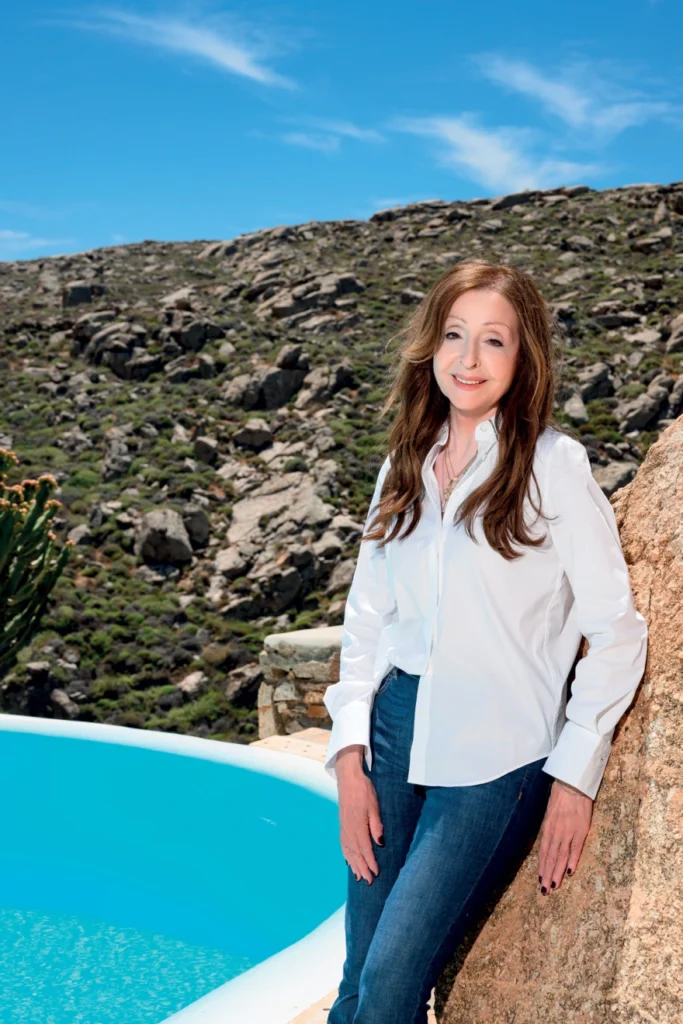
I had success, and I had longevity.” An artist of the old school, she does not believe solely in the power of social media. “The truth of an artist is revealed on stage; that is where real communication lies. Personally, I invest in the power of this mutual relationship: genuine, warm contact, without the need for artificial embellishments involving technology. For example, I am happy that this year, on 15 August, not only will I be in Greece, but I will also connect with the audience by singing at Sani Festival in Halkidiki.
As I often say, we cannot make our days longer, but through music we can make them better. Technology is evolving, Artificial Intelligence has flooded everything, but we must preserve our human essence.” For the past 25 years, she has also been a composer and lyricist, creating songs that she performs herself or that are performed by other artists. She keeps up with current affairs and, whenever time allows, welcomes friends to her home. “I like cooking and taking care of my friends, having a glass of wine, enjoying Greek cuisine and talking until late. We are living through difficult times, and human contact is certainly a powerful antidote.”
The landscape of Mykonos and the sea breeze have completely captivated us. “The years of the memoranda hurt me, when foreigners spoke badly about my country,” our conversation returns to Greece. “At that time, I wrote articles in the largest and most influential German-language newspapers in order to explain the truth about Greece and the Greeks and to defend my homeland. All that, however, has been overcome. Greece emerged stronger from that great ordeal. The brand ‘Greece’ has added value, and this is no longer disputed. It is no coincidence that more and more foreigners choose our country as a travel destination, as a permanent place of residence and as a country for investment.”
Vicky Leandros is a person who often feels gratitude in her life. And, as one would expect, she has felt it many times for those precious moments she has experienced on stage, creating indelible memories. “It was at a concert in London. At the end of a song, the British audience stood up and began applauding me with such passion that I was deeply moved. I looked at the person in charge of the event and did not know what to do. It was the first time tears came to my eyes to such an extent that someone had to offer me a handkerchief and I had to leave the stage for a few minutes. It was beautiful, truly beautiful. The audience is very warm towards me. The audience at the Herodion was also exceptionally warm. People were crying with emotion, I was crying too; the feelings were so heartfelt!” she says, referring to experiences that continue to this day in the concerts she still gives across Europe. Without doubt, for the Greek superstar of the international music industry, this entire journey has been worth it. But if we were to ask her to choose just one photograph from the album of her life? “It would definitely be a photograph with my three children and my five grandchildren,” she replies without a second thought, bringing the cup of still-fragrant coffee to her lips once more.
Ask me anything
Explore related questions




