





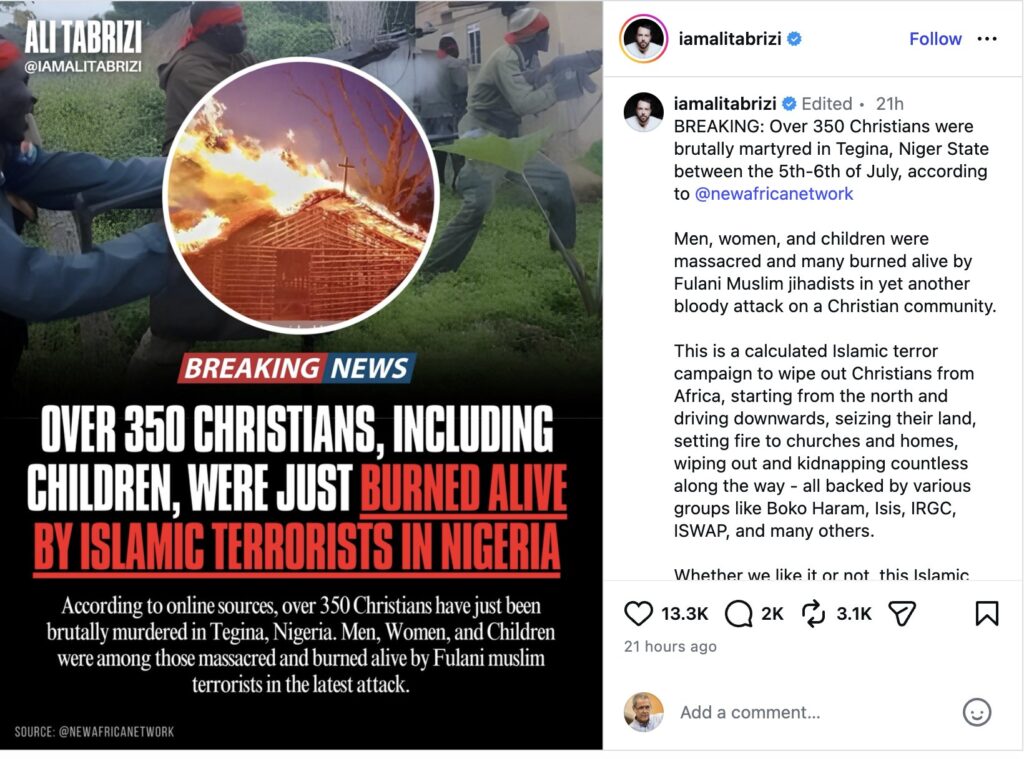
Reports from local sources and Christian advocacy networks describe a horrific attack in Tegina, Niger State, Nigeria, between July 5 and 6, in which more than 350 Christians – including men, women and children – were massacred by Fulani Muslim militants, with many burned alive in their homes and churches.
Eyewitness accounts and circulating images depict armed attackers targeting Christian communities, setting fire to buildings and resulting in gruesome deaths by burning. The violence is part of a long-running pattern in Nigeria’s Middle Belt and northern regions, where Fulani herder militias and Islamist groups such as Boko Haram and ISWAP have been accused of systematic raids, church burnings, village destructions, and land seizures against Christian farming populations.
Advocacy organizations monitoring religious freedom have long documented Nigeria as one of the world’s deadliest countries for Christians. Groups including Open Doors and the U.S. Commission on International Religious Freedom (USCIRF) report thousands of Christians killed in recent years, often in attacks involving extreme brutality.
Despite the scale of these reported atrocities, coverage in major Western mainstream media outlets has been minimal or absent. Prominent international NGOs and activist movements – many of which have mobilized extensively around the conflict in Gaza with statements, protests, boycotts, and sustained campaigns – have shown little to no comparable engagement or support for Nigerian Christian victims.
This disparity highlights a clear inconsistency in global attention to human rights crises. Conflicts framed through certain ideological lenses receive intense scrutiny and activism from left-leaning organizations and media, while religiously motivated violence against Christian minorities in Africa, frequently involving Islamist perpetrators, elicits widespread silence.
The pattern of underreporting suggests that selective outrage continues to shape which victims of violence receive international solidarity and which do not.
Nigeria’s ongoing crisis deserves the same level of factual examination and humanitarian concern afforded to other global conflicts, regardless of the religious or ethnic identity of the victims.
Ask me anything
Explore related questions




