





Organizations today have access to powerful large language models, increasingly autonomous AI agents, and cloud platforms that make enterprise AI more accessible than ever before. The technology has advanced at an extraordinary pace, lowering the barrier to adoption and accelerating innovation across every industry.
Yet despite these advancements, one challenge continues to undermine AI initiatives before they have the opportunity to create meaningful business value.
It isn’t the model.
It isn’t the infrastructure.
And it certainly isn’t a lack of AI tools.
The greatest challenge remains something organizations have struggled with for decades: data quality.
While AI has transformed what machines can do with information, it has not changed one fundamental truth. AI can only produce valuable outcomes when it is built on trustworthy, well-managed, and meaningful data.
The principle of “Garbage In, Garbage Out” has never been more relevant.
AI Doesn’t Eliminate Data Problems—It Magnifies Them
Many organizations assume that modern AI models are intelligent enough to compensate for imperfect data.
They’re not.
AI is exceptionally good at identifying patterns, retrieving knowledge, summarizing information, and generating insights. But it cannot distinguish between accurate information and inaccurate information if both are presented as equally trustworthy.
If customer records are duplicated, AI will use duplicate records.
If product specifications are outdated, AI will confidently recommend outdated information.
If policies exist in multiple versions across different systems, AI cannot reliably determine which version represents the truth.
In many ways, AI acts as a mirror.
It reflects the quality of the organization’s knowledge.
When enterprise data is fragmented or inconsistent, AI simply scales those problems faster than humans ever could.
The Real Cost of Poor Data
The consequences of poor-quality data extend far beyond inaccurate AI responses.
They affect how organizations operate every day.
Employees spend hours searching for information spread across disconnected systems. Different departments rely on different definitions of the same customer, product, or transaction. Reports generate conflicting numbers, forcing teams to validate data manually before making decisions.
These inefficiencies often become accepted as part of daily business.
Until AI enters the picture.
Suddenly, organizations expect AI to deliver instant insights, automate complex processes, and support strategic decisions. Instead, they discover that the information feeding those systems is incomplete, inconsistent, or unreliable.
The issue was never hidden.
AI simply exposed it.
Poor data quality is therefore not an AI problem.
It is a business problem that AI makes impossible to ignore.
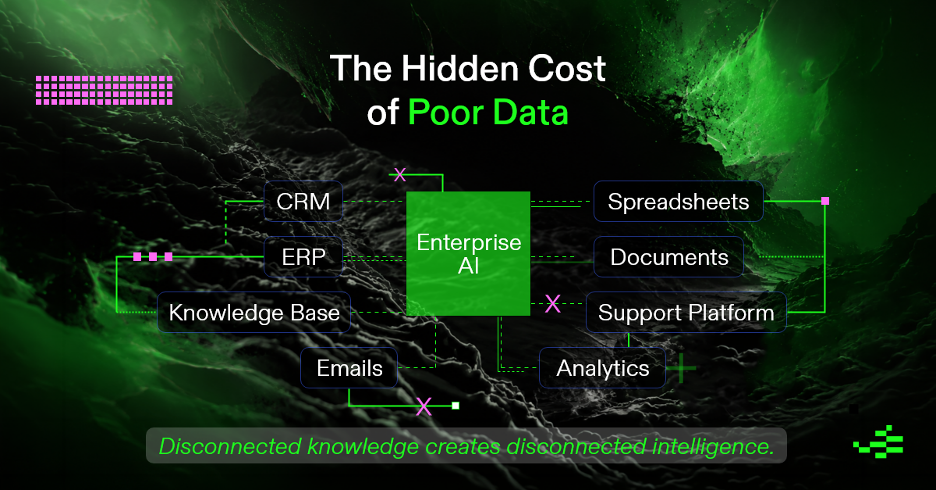
Breaking Down Data Silos
One of the biggest obstacles to enterprise AI is fragmented information.
Over the years, organizations have accumulated data across ERP systems, CRM platforms, cloud applications, spreadsheets, emails, shared drives, knowledge bases, ticketing systems, and countless departmental databases.
Every platform contains valuable information.
None contains the complete picture.
Humans have learned to navigate these silos through experience and institutional knowledge.
AI cannot.
Without connected, accessible, and governed enterprise data, AI systems operate with only a partial understanding of the business.
Preparing data for AI is therefore not about collecting more information.
It is about connecting the information organizations already have.
Data Quality Goes Beyond Clean Data
When organizations hear the phrase “data quality,” they often think about removing duplicate records or filling in missing values.
Those activities are important, but they represent only part of the challenge.
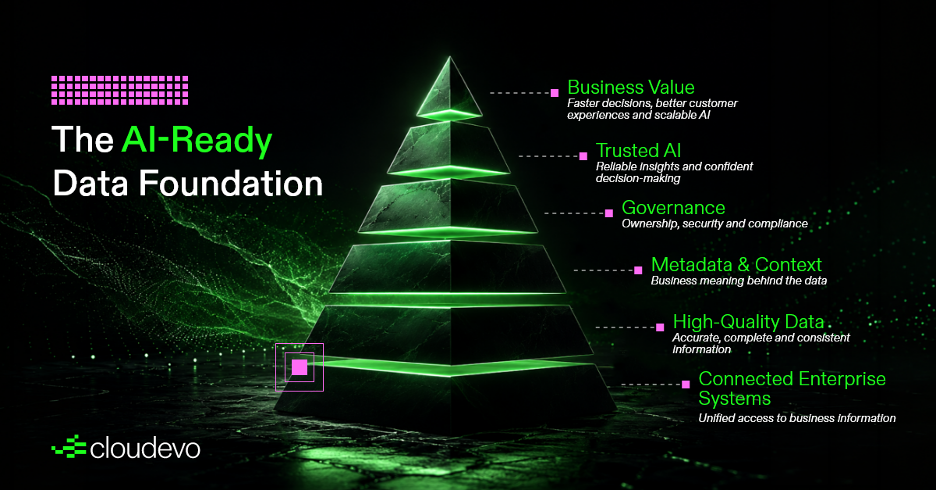
Enterprise AI requires data that is consistent across systems, enriched with meaningful metadata, governed through clear ownership, and continuously maintained over time.
Context is just as important as accuracy.
A customer’s name alone provides very little value.
Understanding previous interactions, purchase history, service agreements, communication preferences, and contractual obligations provides the context AI needs to deliver relevant, personalized, and trustworthy responses.
The richer the organizational context, the more valuable AI becomes.
This is why metadata management, master data management, and semantic consistency have become strategic capabilities rather than purely technical disciplines.
Governance Builds Trust
As AI becomes embedded in core business operations, organizations need confidence in the information their systems retrieve.
That confidence doesn’t come from the AI model.
It comes from governance.
Organizations must understand where data originates, who owns it, how frequently it is updated, who can access it, and whether it can be trusted.
Too often, governance is viewed as a compliance requirement.
In reality, it is one of the key enablers of enterprise AI.
Strong governance ensures that AI retrieves authoritative information, respects security policies, complies with regulatory requirements, and produces outputs that business leaders can rely on with confidence.
Trustworthy AI starts with trustworthy data.
Preparing Data for AI at Scale
Building AI-ready data is not a one-time initiative.
It is an ongoing organizational capability.
Successful organizations treat enterprise data as a strategic asset rather than an operational by-product. They establish common standards across departments, assign clear ownership, continuously improve data quality, and ensure information remains accurate as the business evolves.
More importantly, they recognize that AI transformation and data transformation are inseparable.
Organizations cannot become AI-native without becoming data-driven first.
The companies creating the greatest value with AI are rarely those experimenting with the newest models every month.
They are the ones investing consistently in the quality, accessibility, and governance of their enterprise knowledge.
Data Quality Is a Competitive Advantage
As enterprise AI matures, access to advanced models is becoming increasingly democratized.
Organizations can choose from a growing ecosystem of powerful AI platforms, foundation models, and enterprise tools.
Technology alone is no longer the differentiator.
The real competitive advantage lies in the data that organizations can provide to those technologies.
Two companies may use the same AI model.
The organization with trusted, structured, and well-governed enterprise knowledge will consistently produce better insights, better decisions, and better customer experiences.
In the years ahead, organizations will not compete solely on the intelligence of their AI.
They will compete on the intelligence of their data.
The Bottom Line
Artificial Intelligence is changing the way organizations operate, but it has not changed the importance of trustworthy information.
As AI capabilities continue to evolve, the quality of enterprise data will increasingly determine whether organizations create lasting business value or simply automate existing inefficiencies.
Investing in data quality is no longer just an IT initiative. It is a strategic business decision that affects operational efficiency, customer experience, regulatory compliance, and every future AI capability an organization hopes to build.
For organizations looking to unlock the full potential of AI, the journey starts long before deploying a language model or an AI agent. It starts by creating a trusted, connected, and well-governed data foundation.
At Cloudevo, we help organizations build that foundation—combining data engineering, enterprise integration, governance, AI-powered knowledge management, Microsoft technologies, and intelligent automation to turn fragmented information into a strategic business asset.
Because the most powerful AI model in the world cannot create value from information it cannot trust.
True enterprise intelligence begins long before the model is deployed.
It begins with the data.
“The future of enterprise AI won’t be defined by who has access to the best models—but by who builds the strongest data foundation beneath them.”
— Cloudevo
Ask me anything
Explore related questions




