





These days, anyone taking a walk or simply pausing to gaze at the Rhine in Bonn, or in any other riverside town, senses that something is missing. It is the cargo ships that normally pass by without stopping, almost in convoy, carrying goods and fuel along the roughly 1,200 kilometre route linking the Swiss Alps to Rotterdam in the Netherlands. More than 6,500 vessels move along the Rhine each day, making it the world’s second busiest river in terms of freight volume, after the Mississippi.
The Rhine is one of Europe’s most important commercial arteries. Some of Germany’s largest industries are located along its banks, relying on the river both to bring in raw materials and to carry their finished products to the major northern European ports.
This crucial European artery has now effectively seized up. Heatwaves and drought have left the river “dried out”, with both its depth and width shrinking to the point where large commercial barges can no longer pass through narrower, winding stretches such as Kaub, south of Koblenz. Water levels have essentially matched the record lows recorded in 2018. Following the Strait of Hormuz, Europe now faces a headache of its own making, in the “straits” of the Rhine.
Costs skyrocket
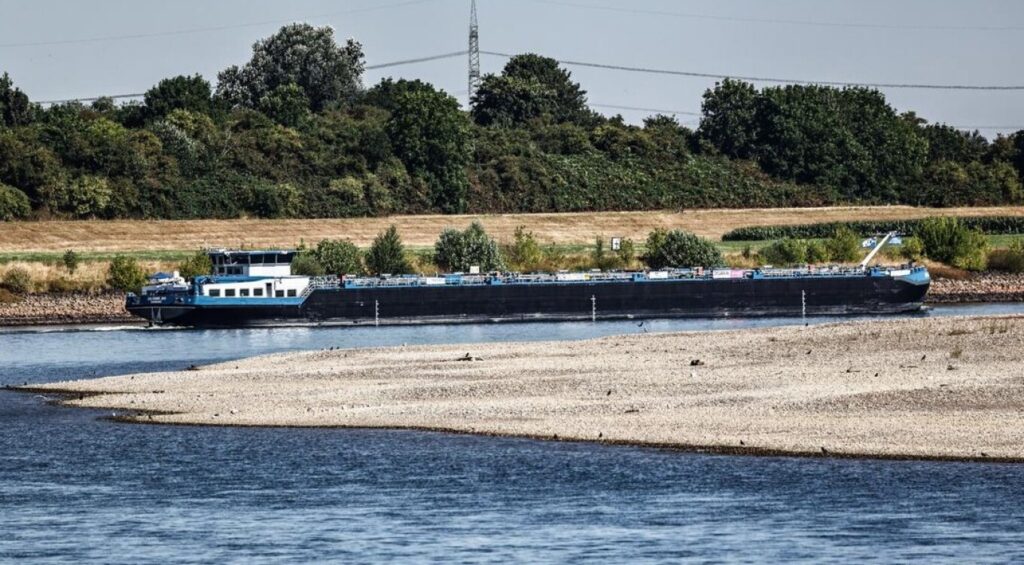
Only small barges can still move along the river, and even they are struggling to do so. Only smaller, shallower vessels remain able to navigate the waterway, but their capacity is significantly reduced. Transporting the equivalent cargo of a single barge by road would require dozens of lorries, pushing costs to prohibitive levels. River freight charges themselves have also risen sharply.
This is yet another consequence of climate change, one that shows how far its effects now reach across human activity, and how delaying action for the sake of short-term economic calculations could prove far more costly in the long run.
Even once the heatwave gradually easing across Germany passes, it is expected to take days, and rainfall, before conditions return to normal, since the smaller rivers that feed into the Rhine along its course have also run dry.
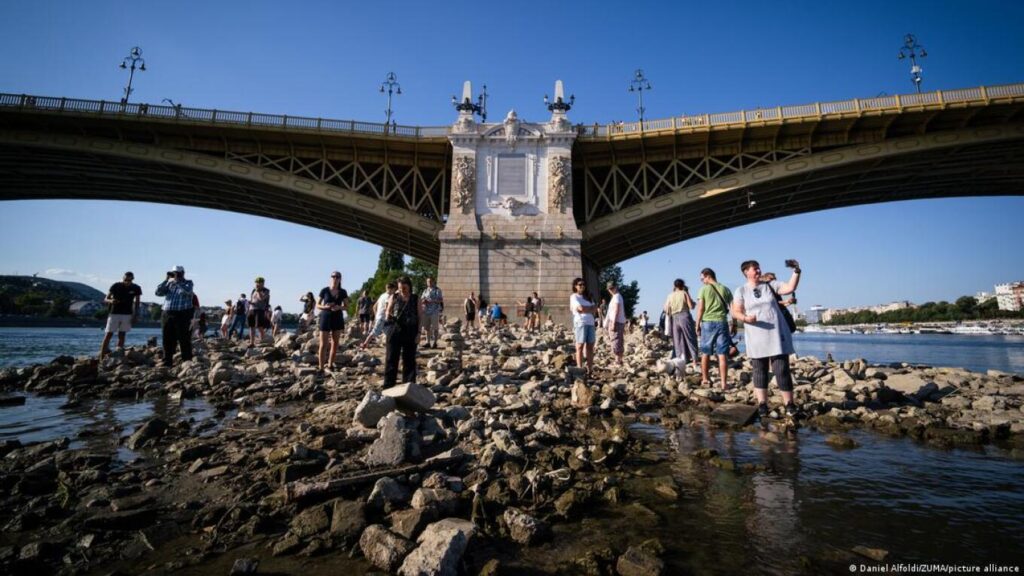
The Danube has also “dried up” in Budapest
Europe’s second great river, the Danube, is facing a similar crisis. Hungary and Romania have both been forced to shut down units at nuclear power stations, which require large volumes of water for cooling, and Romanian authorities have not ruled out possible disruptions to electricity supply as a result.
There are also consequences for tourism at resorts such as Lake Balaton in Hungary, which has likewise shrunk so severely that areas once used for swimming can now be crossed on foot. This has already led to booking cancellations at hotels in the area, with little sign of improvement expected soon. This summer, the climate crisis is baring its teeth across a growing number of fronts.
Ask me anything
Explore related questions




