





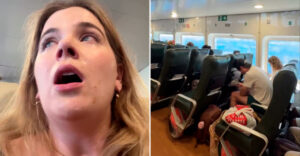
Island hopping across Greece is the stuff of dreams for millions of foreign visitors, conjuring images of picture-postcard Cycladic villages, spectacular beaches and lazy crossings of the Aegean. The reality of a ferry journey can look rather different, however, once the Meltemi winds pick up and the sea turns rough.
The Wall Street Journal (WSJ) has examined this less glamorous side of Greek summer holidays, gathering accounts from tourists who endured gruelling crossings between the islands. Heavy swells, seasickness and hours of discomfort feature heavily in their stories, with some travellers taking to social media to nickname the vessels “vomit comets”, a nod to the aircraft used to simulate weightlessness during astronaut training.
Despite the dramatic footage flooding social media, experts who spoke to the American newspaper stress that such gruelling crossings are the exception rather than the rule. They also point out that if a ferry has been given clearance to sail, conditions are considered safe, however violent the pitching might feel to passengers.
“Handing out sickness bags left and right”
Austin Croteau, 38, was waiting to board a ferry from Syros to Athens with her husband and their four children. The sea looked calm, she recalled, but within minutes of departure the situation changed. Large waves battered the boat as it rocked violently, and she watched water washing over the windows. Crew members rushed between passengers who were struggling with seasickness.
“They were going around fanning people, handing out barf bags left and right,” she told the WSJ, adding that there was little point even trying to reach the toilet.
Croteau, who now lives on Syros, remembers looking around and seeing pale passengers with their heads in their hands, trying to keep the nausea at bay. One of her children’s reactions stood out in particular. “I’ve never seen my kid’s face go completely green,” she said. “Now I understand where the cartoons got it from.”
“Holding on for dear life for six hours”
The experience was even tougher for Emily Savage, 25, who had planned a relaxed Greek getaway with her best friend. On the crossing from Naxos to Milos, the pair found themselves clinging desperately to their seats as the boat slammed into wave after wave.
The rough conditions did not last just a few minutes; they continued for around six hours. At every stop, passengers boarded and disembarked, while those staying on tried to cope with their nausea by closing their eyes and taking Dramamine. The ordeal, though, had an unexpected upside. “It was kind of a bonding experience,” Savage said.
Why the Naxos to Milos route can turn rough
Petros Zissimos, managing director of the Greek travel agency Hellenic Holidays, told the WSJ that travellers heading to Milos frequently run into difficult conditions because of the strong Meltemi winds that sweep the Aegean each summer. The Naxos to Milos crossing in particular can be rough whatever type of vessel is used, since it cuts through waters heavily exposed to these seasonal winds.
Summer in the Cyclades, the island group that takes in destinations such as Mykonos, Naxos and Milos, tends to bring strong winds just as millions of tourists arrive. Conditions in the Ionian islands, by contrast, are generally calmer, according to the report.
The WSJ also highlighted Greece’s surging popularity as a destination. Golden beaches, whitewashed villages, sunsets and ancient history have drawn growing numbers of visitors. According to figures from Greece’s central bank, the Bank of Greece, cited by the newspaper, the country welcomed 21 per cent more travellers between January and May 2026 than in the same period of 2025.
Over the past decade, the number of American visitors to Greece has nearly quadrupled, while cruise ships now crowd the ports of Athens, Mykonos and Santorini.
“If a ferry sails, conditions are considered safe”
The report also addresses ferry safety. Spyridon Roussos, a political scientist and shipping expert based on Paros, notes that strict protocols banning departures in dangerous weather were introduced after the sinking of the ferry Iraklion in the Aegean in 1966, one of Greece’s worst maritime disasters.
As he explains, the fact that a ferry sets sail means conditions have been judged sufficiently safe for the crossing, however alarming the pitching feels to passengers. “The captains are highly skilled,” he said, adding that handling such conditions is routine for those working in Greek ferry transport.
“The chaotic videos don’t reflect everyday reality”
Sophie Jansen, 33, from Amsterdam, visits Greece more than five times a year and reckons she has made almost 100 inter-island ferry crossings. Of all of them, she says, only one turned genuinely unpleasant.
“People love posting these chaotic videos online,” she said. “It gives the impression this happens every day, but that’s definitely not the case.” A self-described fan of the Greek ferry network, which connects most inhabited islands and is often more practical than flying, Jansen prefers larger, slower ferries, which are steadier at sea and have enough space to carry cars. She also advises anyone prone to seasickness to choose islands served by bigger vessels and to research routes carefully before planning their itinerary.
Even between popular islands such as Paros and Milos, she notes, there may be only one small direct ferry a day depending on the season, and the sea is not always calm. “The key is to do your research and not just follow the itinerary you had in mind,” she said.
Zissimos also advises travellers not to be swayed by faster but smaller boats, since these are more likely to be affected by heavy swells. He recommends anti-seasickness measures such as motion sickness patches or chewing gum.
“Even if you’re scared, do it”
Despite the discomfort, the sickness bags, the nausea and the waves, the travellers who spoke to the WSJ were not entirely negative about the experience. Croteau, in fact, was so taken with the country that after three years travelling the world with her family, she settled on Syros last September.
Her advice to anyone nervous about a rough Aegean crossing is simple. “Even if you’re scared, do it,” she said. “There’s nothing like the Greek islands.”
Ask me anything
Explore related questions




